
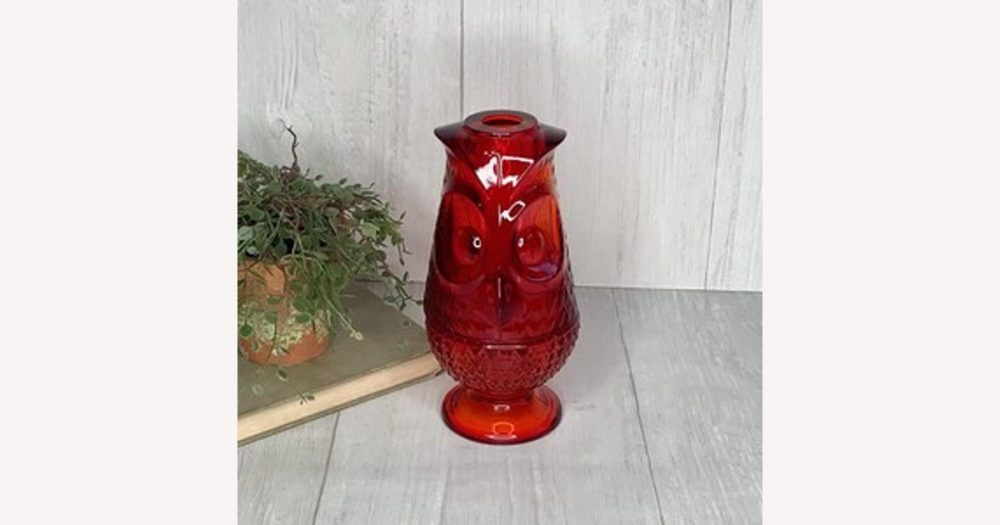
If you’re browsing DHgate for Viking-style glass owl or fairy lamps, it helps to know what the classic vintage pieces actually look like. They’re compact, two-piece glass fairy lights: an owl-shaped top over a small base, sized for a tealight or tiny bulb and made in various colors. That makes it easier to tell whether a listing follows the format or is simply generic owl decor before you assess authenticity or price.
What Viking glass owl and fairy lamps typically look like
Classic Viking glass owl and fairy lamps are usually two-piece glass fairy lamps: a lower base that holds a tealight or small light source, and an owl-shaped upper cover that sits over the base to glow when the light is lit.
Most examples are compact, often described at roughly 7 inches tall, with the owl figure rising from a smaller pedestal-style base. The glass body is hollow so light can shine through, and you’ll typically see molded owl details—eyes, beak, feathers—and textured or patterned glass that helps diffuse the glow.
Collectors discuss these lamps in a range of colors, including various greens, ruby-like reds, cobalt-style blues, and other tints. Exact color names and rarity debates matter more to collectors than to DHgate buyers. For shopping purposes, focus on the overall format: an owl-shaped glass top, a matching glass base, a hollow interior for a small candle or bulb, and the look of a vintage-style fairy lamp. That template helps distinguish simple owl-themed decor from a listing clearly modeled on the classic two-piece style.
Vintage Viking glass vs. modern owl and fairy lamps
Authentic Viking glass owl and fairy lamps were made by the Viking Glass company as mid‑20th‑century decorative glassware and are now traded mainly as vintage collectibles. By contrast, most owl or fairy lamps on broad marketplaces like DHgate are modern decorative pieces that borrow the general look—glass owl figure, glowing body, two-part construction—without being documented vintage Viking glass.
On DHgate, the word “Viking” in a title or description is not proof of brand or origin. It’s often a style or keyword reference, especially when the listing doesn’t mention the original manufacturer, a specific model name, the era of production, or show clear photos of any marks or labels. Stronger provenance for a true vintage piece would include consistent branding in the text, concrete model or pattern references, and close, well-lit photos of any molded marks or stickers that you could research independently—details that are uncommon in typical DHgate decor listings.
Vague or sloppy listings deserve extra caution. Copy‑paste descriptions that say very little, missing dimensions, a single low‑quality photo, and contradictory material claims—such as calling the same item “crystal,” “glass,” and “plastic”—are all red flags. When that combination appears alongside loose use of “Viking,” I would treat the item as new decor and avoid paying a collectible‑level price. I’d assume DHgate owl lamps are decorative purchases unless a listing offers unusually strong, verifiable detail; even then, I would cross‑check it through independent vintage or collector sources before spending serious collector money.
Why DHgate is a place to apply checks, not the single “best” source
No single online marketplace can honestly be called the best or most reliable source for authentic Viking glass owl lamps, and that includes DHgate. Genuine vintage Viking pieces tend to appear sporadically across different collector, resale, and auction channels, and availability changes over time, so there is no stable place where you can always find the best examples.
DHgate makes more sense as a venue for Viking-style decor than as a dedicated marketplace for authenticated Viking glass. Most owl and fairy lamps you’ll see there are likely new or unbranded decorative pieces that borrow the look—owl motif, glowing body, two-part lamp construction—at a range of price and quality levels, rather than documented mid‑century Viking Glass products.
In practical terms, DHgate is one place to browse the style while checking photos, materials, dimensions, and seller history before deciding whether a listing fits your goals. If strict authenticity and provenance are the priority, it should be only one channel in a broader search. I would approach it cautiously and walk away from any listing that falls short on clarity and evidence rather than chase a bargain that might disappoint.
Checklist: how to evaluate owl and fairy lamp listings on DHgate
- Review the seller’s track record: check overall rating, how many orders they’ve completed, and whether they’ve been active recently. A long history with steady positive feedback usually feels more reassuring than a handful of isolated sales.
- Read written reviews with an eye for specifics about lamps: comments on actual product quality, how closely colors match the photos, and whether the packaging protected the glass during shipping are more useful than generic praise.
- Scrutinize listing photos: look for multiple clear angles showing both the base and the owl or fairy cover, plus close‑ups of the glass texture, seams, and joins. Blurry or single photos make it hard to judge what you’re really buying.
- Confirm materials: the text and images should consistently indicate glass if that’s what is promised. If the lamp is labeled as glass but looks dull or plasticky, or if the description mixes terms like “crystal,” “glass,” and “plastic,” treat that as a warning sign.
- Check dimensions carefully and compare them with the typical Viking-style template you already have in mind. Knowing whether a lamp is closer to a small night‑light or a larger decorative piece helps you avoid surprises in scale once it arrives.
- Evaluate the description language: realistic, concrete details about size, color, material, and use are more trustworthy than vague claims about rarity or museum‑level quality that appear without any supporting evidence.
- Match your tolerance to your goal: if you mainly care about look and price, an unbranded owl or fairy lamp can be acceptable when the photos, materials, reviews, and dimensions all look solid. If you care about collectible authenticity, you should demand stronger evidence—clear provenance details and verifiable information—before considering a purchase.
- Adopt a strict cutoff: if a listing fails several of these checks—weak or minimal photos, missing measurements, inconsistent material claims—I would skip it rather than hoping for a lucky bargain. With fragile glass decor, it’s usually better to pass on a doubtful offer than to risk paying for something that may arrive disappointing or misrepresented.
What to expect from DHgate’s order and payment flow
- If the listing offers options, select the preferred variation of the owl or fairy lamp, such as its color, design, and quantity.
- Add the lamp to your cart and carefully review the order summary, including unit price, shipping cost, any estimated taxes or fees, and the total amount.
- Confirm your shipping address and check the estimated delivery time, noting how it changes if you switch between different shipping methods.
- Consider whether the total remains reasonable after adding shipping for a fragile glass item; don’t focus only on the headline price.
- Proceed to DHgate’s checkout and select one of the platform-supported payment methods, keeping the transaction inside DHgate’s secure payment flow.
- Avoid any seller who suggests paying outside DHgate (for example by direct bank transfer or a separate app), because that bypasses the platform’s protections.
- Save or screenshot the order confirmation page and any emails so you have a clear record of what you ordered, how much you paid, and the agreed shipping details.
Shipping fragile glass lamps safely
- Treat glass owl and fairy lamps as fragile; the way a seller packs and ships them largely determines whether they arrive intact.
- Review the shipping methods and estimated delivery times shown on DHgate, balancing speed, cost, and how reliable each option seems for your location.
- Favor sellers who describe protective packaging—such as foam inserts, bubble wrap, and sturdy cardboard boxes—or whose reviews specifically praise how well items were packed.
- Keep in mind that long international routes or multiple shipping handoffs increase the chance of rough handling, so solid packaging matters even more for glass decor.
- I would personally choose a seller with a slightly higher price but clearly documented packaging and shipping practices over the absolute cheapest option for a breakable lamp.
- When trying a new seller, consider ordering a single lamp as a test shipment before committing to several expensive pieces, so you can gauge their shipping reliability first.
Using DHgate’s dispute and refund protections
On DHgate, buyer protection is generally built around a limited period after delivery when you can either confirm that everything is fine or raise a problem if the lamp arrives damaged, incomplete, or clearly not as described. Instead of assuming every issue will be covered, treat this as a safeguard that works best when you act promptly and can show exactly what went wrong.
If you need to open a dispute, you typically do it from the order page for that lamp. The stronger your evidence, the easier it is for the platform to understand your case, so take clear photos of the outer packaging, any inner padding, and the lamp itself—highlighting chips, cracks, or obvious differences from the listing’s photos and description. Use the dispute form or message thread to explain the problem briefly and stick to concrete facts.
Return and refund details are not identical for every seller. Individual stores on DHgate often define whether they accept returns at all, who pays for return shipping, and how long the return window lasts. For a fragile glass owl or fairy lamp, it’s important to read the “return” or “refund” section on the listing before you place the order; I would always choose a seller with clear, reasonable terms over one whose policy is vague, confusing, or heavily tilted against the buyer.
To protect yourself if something goes wrong, keep basic records. Save screenshots of the original listing, your order confirmation, and any key messages with the seller, so you can show what was promised and how you tried to resolve the issue. DHgate’s dispute and refund tools are there to help, but outcomes and timelines can vary by case, so think of them as typical mechanisms rather than a guarantee that every problem will be resolved in the same way.
If you want authenticated vintage Viking glass
Should I rely on DHgate alone if I’m serious about buying an authenticated vintage Viking glass owl lamp?
No. DHgate is generally better suited to Viking-style decorative owl and fairy lamps than to fully authenticated vintage Viking glass, so it shouldn’t be your only source if you’re building a serious collection. On a broad marketplace like DHgate, strong provenance and detailed documentation—clear branding, model names, production era, and verifiable marks—are the exception rather than the rule, which makes full authenticity hard to confirm. I would treat DHgate as a supplementary venue at most: it can be useful if you mainly care about look and price and can accept some uncertainty, but it’s less ideal when provenance and documentation are non‑negotiable. In my view, it’s better to pass on listings that can’t back up big claims than to pay collectible‑level prices on uncertain information, and your shopping strategy should match your priorities—style, authenticity, or a mix of both.