
Marketplace comparisons
Compare Sourcing Routes Without a False Winner
Use this hub to compare marketplaces, supplier directories, local wholesale routes, and direct supplier relationships with the same dimensions and buyer scenarios. A route that works for a low-budget test may be unsuitable for regulated products, fast local delivery, high customization, or a large repeat order.
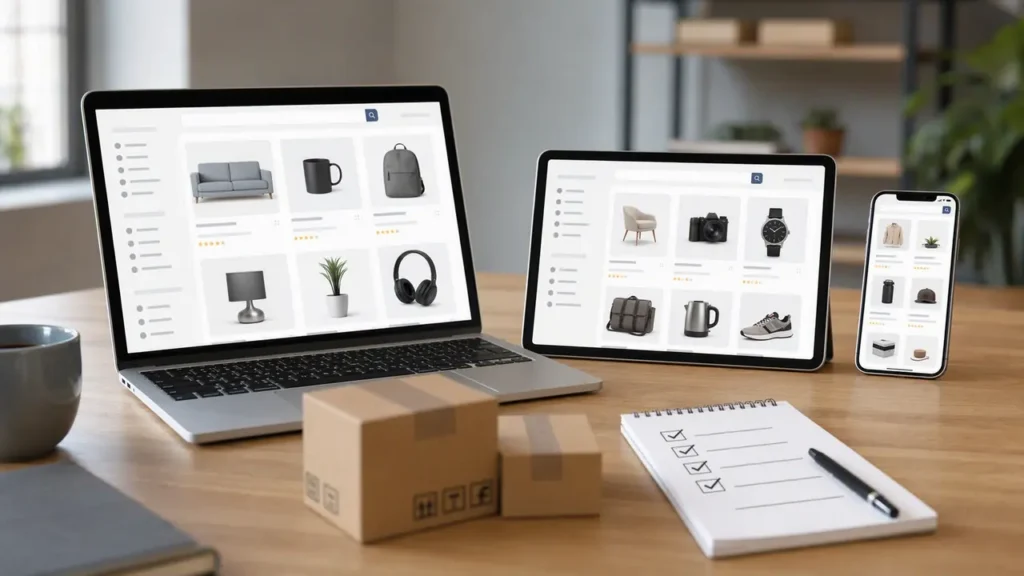
Comparison methodology
Compare one scenario with one evidence standard
Order size, deadline, product, and internal capacity.
Do not change criteria to favor one route.
Attribute features; label scenario-based interpretation.
Show the date and verify current policy.
Three sourcing models
Different routes assign work differently
Broad marketplace
Organizes many listings, sellers, and transaction flows. Often useful for discovery and controlled tests; listing- and seller-level variation remains important.
Supplier directory
Organizes supplier discovery and outreach. The buyer may need to manage verification, terms, payment, inspection, and logistics more directly.
Direct supplier relationship
Can support specification control and repeat production, with greater responsibility for commercial terms, quality, capacity, and continuity.
Comparison dimension selector
Show the dimensions that matter to this order
| Route | Price visibility | MOQ | Selection | Delivery | Protection | Customization | Supplier access | Workload |
|---|---|---|---|---|---|---|---|---|
| Broad marketplace | Often visible by listing | Often flexible | Broad | Varies by seller and route | Structured process may exist | Limited to moderate | Listing and seller access | Medium |
| Supplier directory | Often requires inquiry | Supplier-specific | Broad supplier pool | Arranged with supplier | Depends on transaction route | Moderate to high | Direct outreach | High |
| Direct relationship | Negotiated | Often higher or capability-led | Narrower supplier scope | Planned commercially | Contract and payment structure | Potentially high | Deep supplier access | High |
Best fit by scenario
Change the scenario and the route can change
First test order
Favor transparent checkout, manageable exposure, clear evidence, and a route the buyer can monitor.
Low budget
Compare minimum cash exposure and delivered cost—not only the lowest visible unit price.
Fast delivery
Local stock or distribution may outweigh breadth, customization, or nominal unit savings.
High customization
Direct capability, specification control, sampling, and corrective action become central.
Large repeat order
Capacity evidence, quality systems, continuity, commercial terms, and logistics coordination matter more.
Regulated product
Traceability, documentation, compliance capability, and clear responsibility can dominate the route choice.
Low internal sourcing capacity
A local wholesaler, structured marketplace, or scoped agent may reduce coordination work at a higher cost.
Speed · control · effort
Every route moves the workload
Editorial comparison rules
Prevent a convenient but misleading ranking
- Use the same comparison dimensions.
- Name the buyer scenario and order stage.
- Distinguish sourced facts from editorial judgment.
- Do not turn trade-offs into one absolute score.
- Show the data or policy review date.
- Describe uncertainty and listing-level variation.
- Do not force DHgate into scenarios where another route fits better.
Verified reading library
Marketplace and sourcing comparisons
The preview cards below use URLs verified from the live category page on July 29, 2026. The WordPress version replaces them with a dynamic category query.

Wholesale vs Dropshipping Platforms: How to Choose
Compare wholesale and dropshipping platforms on capital, margins, control, and shipping, then match the right sourcing channel to your small US ecommerce store.
Use when: comparing routes with the same buyer scenario and criteria
DHgate vs Other China Wholesale Options for UK Buyers
Compare DHgate with Alibaba, AliExpress, Temu, 1688 and agents for sourcing from China as a UK small business. See which mix fits your order size and risk.
Use when: comparing routes with the same buyer scenario and criteria
Venstore and Alternative E‑Commerce Platforms
Venstore is a small, mixed-signal option, not a major marketplace. See how it compares to larger platforms and which channels fit your shopping or sourcing.
Use when: comparing routes with the same buyer scenario and criteria

DHgate vs Other Channels for 24 Gauge Wire (Canada)
Compare DHgate with Amazon, AliExpress, distributors, and local Canadian stores to decide how to source 24 AWG wire and cable for DIY or small ecommerce.
Use when: comparing routes with the same buyer scenario and criteria

DHgate vs Other Alibaba-Style Channels for Mexico
Compare DHgate, Alibaba.com, AliExpress and sourcing agents for Mexico-focused sellers. See which channel fits test buys, scaling, and private label.
Use when: comparing routes with the same buyer scenario and criteria

Using DHgate Instead of Alibaba for Mexico-Focused Sourcing
Sourcing China-made products for Mexico? Compare DHgate and Alibaba by order size, product types, evidence quality, and fit for Mexico-focused demand.
Use when: comparing routes with the same buyer scenario and criteria
Continue the decision
Move to the next buyer task
Frequently asked questions
Questions that change the decision
Is there one best sourcing platform?
How should platform facts be separated from editorial judgment?
Why not rank every option with one score?
Where does DHgate fit in a comparison?
How often should comparisons be reviewed?
Which route fits a regulated product?
Editorial standard
How this hub should be maintained
Comparisons must use consistent dimensions and explicit buyer scenarios. Editors should date policy-sensitive inputs, distinguish sourced facts from judgment, and avoid a single overall score that hides trade-offs or implies a permanent winner.