
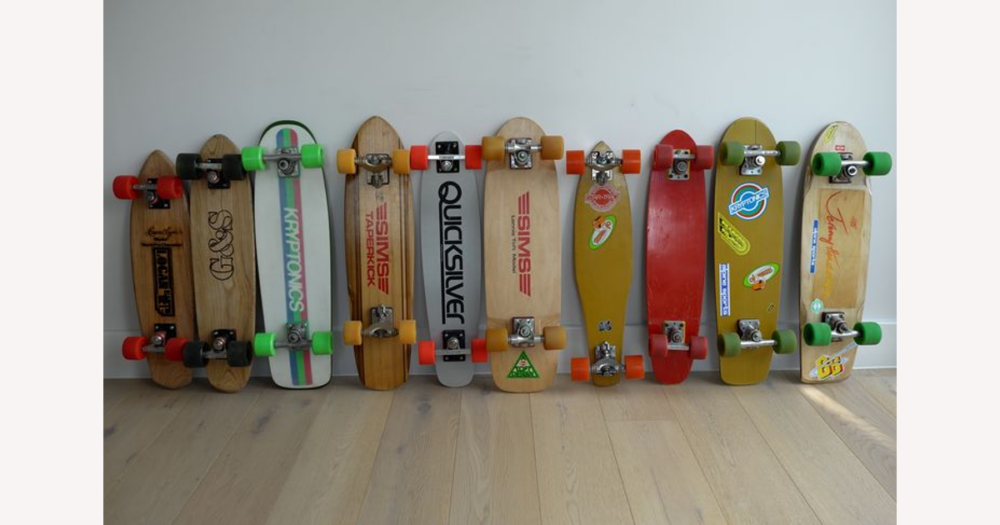
Vintage 1970s skateboards are collectible outliers, not everyday catalog items, so you’re most likely to encounter them as scattered listings on general marketplaces, specialist skate shops, and collector communities, with DHgate offering only occasional, unstructured “vintage” or “1970s style” boards. Because DHgate is geared toward new, mass-produced goods and doesn’t certify age or authenticity, any vintage claim there should be treated as a starting point for scrutiny—using clear photos, materials, hardware details, and seller behavior—as you decide whether a board is truly from the era or simply styled to look that way.
Where vintage 1970s skateboards typically show up online
Vintage 1970s skateboards sit in a niche corner of the market, so you’ll usually see them appear as one-off finds rather than a steady, searchable category. Individual owners list old boards on general marketplaces and auction-style sites, where stock comes and goes and condition can vary widely. Specialist skate shops, museum-style outlets, or dedicated collector businesses sometimes offer curated vintage inventory or occasional new old stock, but selection there tends to be limited and priced for collectors.
Boards also move through peer-to-peer collector channels—forums, social groups, and informal community marketplaces—where the focus is often more on history and condition than on polished ecommerce features. I would rather spend time in these better-documented channels, or in shops that provide clear photos and honest descriptions, even if that means fewer options and higher prices. Someone who prioritizes lower cost and wider choice might reasonably spend more time in general marketplaces with looser documentation and mixed-quality listings.
DHgate sits mainly on the mass-produced side of this landscape: most sellers focus on new, contemporary goods, so truly period-correct 1970s boards are unlikely to be common there. If you do see “vintage” or “1970s style” in a DHgate listing, treat it as a claim to investigate, not proof of age. The platform doesn’t certify the board’s history, and labels can cover everything from genuine vintage pieces to modern reproductions. That makes it especially important to lean on the authenticity, condition, and seller checks later in this guide whenever you evaluate a DHgate listing for a supposed 1970s board.
Recognizing typical 1970s skateboard designs and hardware
Most 1970s skateboards were noticeably smaller and narrower than modern street decks, often built on short wooden planks, molded plastic “banana boards,” or slim aluminum decks. Common examples run somewhere in the mid‑20‑inch range for length and roughly 5–7 inches wide, though there was plenty of variation; those figures are patterns, not strict rules. When you compare listing photos to these ranges, a compact deck with simple, flat geometry is more in line with 70s norms than a wide, double‑kick street board.
Hardware also carries strong era cues. Early-generation trucks were typically narrower and less refined than modern designs, with simpler geometry and smaller hangers. Wheels had shifted to urethane by this time, replacing earlier clay or metal styles, and they were often relatively small and sometimes showed period-style branding or shapes. Taken together, a short, narrow deck with era-consistent trucks and small urethane wheels looks visually plausible for the 1970s, even though photos alone can’t prove age or originality. By contrast, a full-size modern deck with contemporary trucks and big, soft cruiser wheels is more likely a later board or a reissue, regardless of how “1970s style” the listing claims to be.
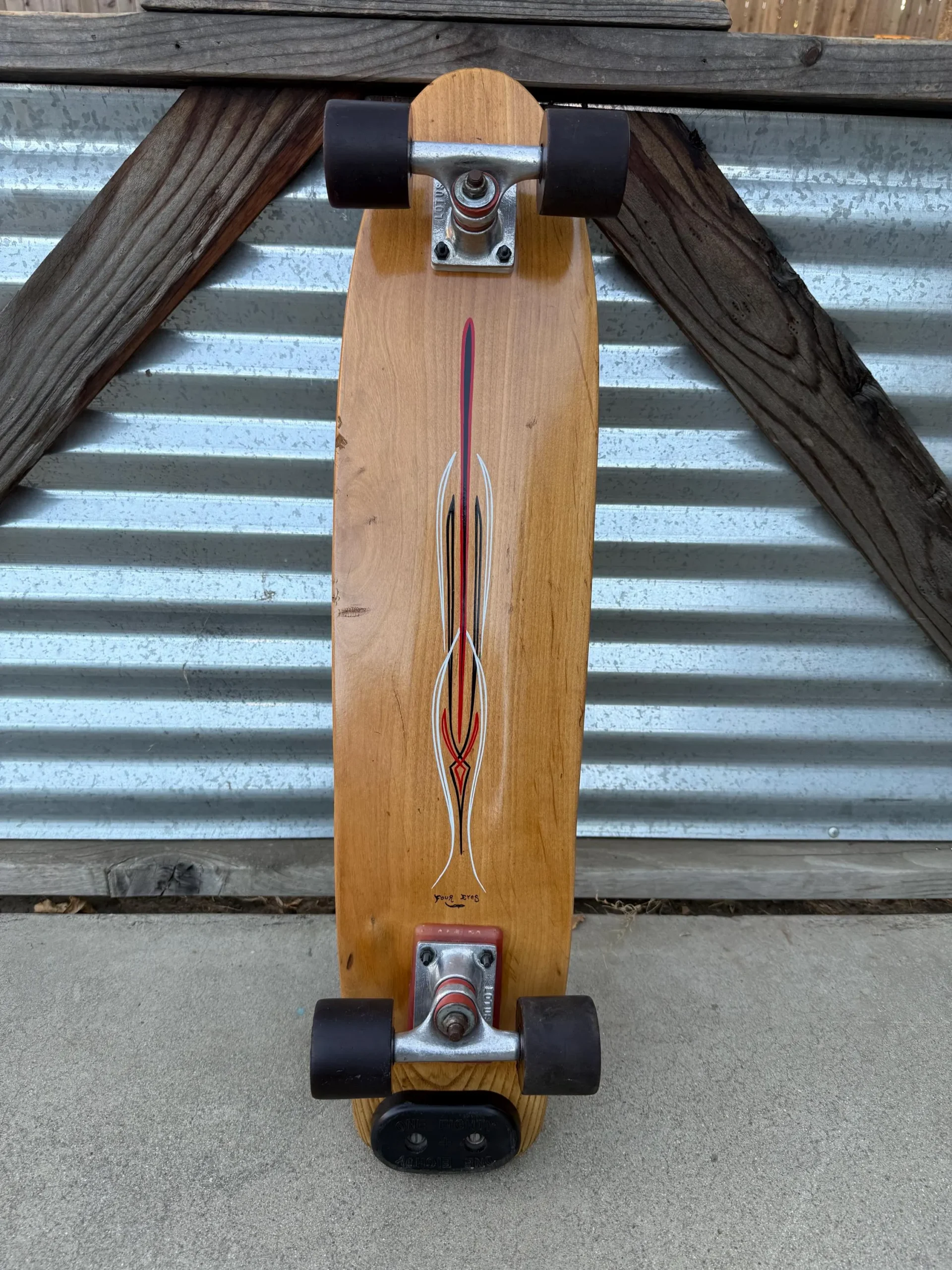
Notice how the trucks sit on a relatively narrow deck with small wheels—proportions like these are closer to typical 1970s setups than modern, wide street boards.
Buyer checklist for evaluating a vintage 1970s skateboard listing
- Start with the photos. Confirm the listing shows multiple clear images: full shots of the deck top and bottom, close-ups of trucks and wheels, and any branding, stamps, or graphics. Treat sparse, blurry, or heavily filtered images as a warning sign, especially for a supposed 1970s board.
- Compare what you see to typical 1970s traits. Check whether the deck looks short and relatively narrow, and whether the trucks and small urethane wheels match the rough era cues you’d expect. Note any obviously modern hardware and make sure the seller clearly explains replacements or restorations instead of presenting the setup as fully original.
- Check the dimensions. Review the stated length and width and see if they fall within common 1970s ranges rather than modern full-length street-deck proportions. If dimensions aren’t listed, ask the seller to measure the board—size alone can help distinguish a true small 70s deck from a contemporary board in “retro” graphics.
- Read the condition description closely. Look for mentions of age-appropriate wear such as scuffs, stress cracks, minor warping, rust on metal parts, or flat-spotted wheels. Some cosmetic wear is normal at this age, but an old board described as “perfect” with no flaws at all may simply be under-described, which raises questions about what isn’t being mentioned.
- Identify any restoration or modifications. Check whether trucks, wheels, hardware, or grip have been replaced and whether that’s clearly disclosed. Decide if you’re comfortable with a partially restored rider that mixes eras or if you’d rather hold out for a board that’s closer to all-original for display purposes.
- Evaluate the seller’s profile. Look at ratings, the number of past sales, written feedback, and how consistently they respond to questions. Favor sellers who provide detailed descriptions, period-aware language, and thoughtful answers over those with minimal information or mixed, vague reviews.
- Review policies and logistics. Confirm shipping costs, method, and estimated delivery time, and read the return or refund terms carefully. Make sure it’s clear what happens if the board arrives significantly different from the description, since that protection matters even more with higher-priced vintage-style purchases.
To see how this plays out, imagine a listing labeled “retro 70s style skateboard” with a short, narrow deck and modern trucks and wheels. The photos show clear close-ups, the seller notes that the hardware is newly added, and there’s an honest rundown of scuffs and small cracks. Working through the checklist, you’d treat this as a modern build inspired by the era rather than a collectible original, but the transparency and good images could still make it a reasonable buy for someone who mainly wants the look and a safe rider.
By contrast, a more concerning listing might claim “authentic 1970s skateboard” but offer only one distant photo, no dimensions, and a generic condition line like “good shape.” I would personally pass on that kind of offer, or at least ask for more photos and measurements before considering it, because thorough images and specific condition notes matter more to me than the lowest possible price. If your priority is budget and you’re comfortable with more uncertainty, you might make a different trade-off—but going through the checklist before paying helps you see clearly what risks you’re accepting.
DHgate-specific considerations for buying a “vintage” board
When you move from researching listings to actually placing an order on DHgate, start by reading the item page and confirmation details carefully. Double-check that the description matches what you expect, that any options for color, size, or configuration are set correctly, and that quantities and the total cost—including taxes and fees—look right before you pay. Some listings bundle multiple variations, so a quick review helps avoid ordering the wrong setup by accident.
Pay close attention to shipping. Skateboards are bulky and can be relatively heavy, so shipping costs and methods matter. Check the estimated delivery window and whether the board is shipping internationally, since long-distance transit can add time and handling steps that increase the chance of rough treatment. If the shipping price looks unusually low or the timeline is very vague, treat that as a prompt to read the fine print and consider whether you’re comfortable with the potential delays or risks.
Because vintage boards and older hardware can be more fragile, it’s worth asking the seller how they plan to pack the item. Look for mention of padding, sturdy boxes, and protection around trucks and wheels, or send a brief message requesting careful packaging. A seller who responds with a clear plan is generally a safer choice than one who gives only a generic answer for something this breakable.
Like other marketplaces, DHgate offers order and payment protections when items are significantly not as described, but those frameworks don’t guarantee a specific outcome in every case or certify that an item is truly vintage. You’ll improve your position by saving screenshots or copies of the original listing and keeping records of any messages about era, condition, or packaging. When the board arrives, take photos as you unbox it, especially if you notice damage or clear differences from the description; that documentation can be important if you need to raise a dispute or request a refund for a misrepresented or “retro” board sold as a 1970s original.
Common risks when buying “vintage” skateboards online
Vintage originals, reproductions, and mixed builds: which is right for you?
Genuine vintage boards are decks and hardware that were actually produced in the 1970s, usually with honest age-related wear: scuffed graphics, patina on metal, and period-correct wheel and truck designs. Their appeal is originality and historical value—owning a piece of skate history rather than a modern interpretation—and that often shows up in higher prices and more limited availability. If you plan to ride one, careful condition checks matter: look closely for cracks, warping, and fatigue in trucks and wheels, because parts designed decades ago weren’t built with today’s safety expectations in mind.
Modern reproductions and 70s-inspired boards are contemporary products that borrow the look of the era—slimmer decks, simple graphics, bright urethane-style wheels—but use current materials and construction. They’re usually much easier to source than true vintage setups, tend to be more predictable and durable for regular riding, and are often more affordable. The trade-off is that they don’t carry the same collector status; for many riders who mainly want the aesthetic and a reliable board underfoot, that’s a perfectly reasonable compromise.
Mixed builds, sometimes called “frankenstein” setups, sit between those two extremes. A typical example is a 1970s deck paired with later trucks and wheels, or a modern deck built up with some older components. When clearly described, these can offer a practical blend of originality and usability—period visuals with hardware that’s easier to trust on the pavement. The key is transparency: you should be able to tell which parts are genuinely from the 1970s, which are replacements, and how that mix affects both value and rideability.
Different goals point to different choices. Display-focused collectors who care most about period correctness usually gravitate toward fully vintage boards, accepting higher prices and some cosmetic wear in exchange for originality. Riders who primarily want 70s aesthetics with modern performance often do better with reproductions or well-built 70s-inspired completes. Budget-conscious buyers may lean toward reproductions, heavily restored boards, or mixed builds, as long as the description makes clear what’s original and what isn’t so they aren’t paying collector premiums for modern parts.
I personally lean toward period-correct hardware when the board is mainly for display—I’d rather have a slightly worn but genuinely 1970s setup than a flawless modern copy. For occasional riding, I would seriously consider a well-described mixed build that keeps the vintage look while relying on newer trucks and wheels. That’s my preference, not a rule; whichever category a reader chooses, the same earlier checklist around photos, materials, condition, and seller behavior still applies to avoid unpleasant surprises.
What evidence to request from sellers—and what it can’t prove
When you’re serious about a 1970s board, treat the listing as a starting point and ask for evidence that you can actually see. The most useful photo requests are specific: close-ups of the truck hangers and baseplates (to check the design and any casting marks), clear shots of wheel sidewalls that show branding and hardness markings, and full views of the deck from both top and bottom. On the deck, look for logos, stamps, serials, and the pattern of mounting holes or drill marks—those details help you judge whether the hardware and graphics make sense for the era rather than for a modern replica.
Beyond photos, documented context can add useful color. You can ask when and where the board was originally bought, roughly how long the current owner has had it, whether it spent most of its time in storage or was ridden regularly, and which parts (if any) have been replaced over the years. Stories about a board sitting in a garage for decades or being rebuilt at some point are helpful for understanding wear and originality, but they are still narratives, not proof in the way a dated invoice or catalog listing would be.
I would send polite, focused questions rather than a confrontational interrogation: for example, “Could you share close-up photos of the trucks and wheel logos?” or “Do you know if the wheels and trucks are original to the board?” Sellers who respond promptly, add extra images, and explain what they do and don’t know about the board’s history are, in my view, more reassuring than those who give brief, generic answers or ignore requests altogether. That responsiveness is itself a trust signal, especially on a marketplace where you can’t inspect the item in person.
Even with helpful photos and a plausible backstory, there are hard limits to what online evidence can prove. Manufacturing varied a lot in the 1970s, boards often changed hands, and parts were swapped or repaired over decades of use, so no set of pictures or messages can absolutely guarantee authenticity or show that every component is untouched and original. The realistic goal is to reduce obvious risk—by ruling out mismatched modern parts, hidden cracks, or vague descriptions—not to eliminate uncertainty entirely.
I personally prefer sellers who show imperfections and admit gaps in their knowledge over ones who promise perfection with minimal evidence. A listing that openly displays scuffs, patina, and replacement hardware, with clear photos and honest notes, gives me more confidence than a “mint vintage” claim backed only by a few distant shots. Online, buying a 1970s skateboard is always a matter of increasing your confidence step by step, knowing that evidence and good communication can lower the chances of a bad surprise but can’t turn any single listing into a guaranteed safe bet.
Frequently asked questions about buying 1970s skateboards
How often do genuine 1970s skateboards show up for sale online?
Supply is irregular. True 1970s boards tend to appear in waves: you might see none on a given marketplace for weeks or months, then several listings at once as collectors decide to sell. That’s normal for niche collectibles. If you’re serious about finding one, expect to check multiple channels over time—general marketplaces, specialist shops, and collector communities—rather than relying on a single, steady source.
Is it realistic to find a mint-condition 1970s skateboard at a low price?
The combination of genuine 1970s origin, near‑mint condition, and bargain pricing is uncommon. Most boards that have survived in excellent shape are treated as collectibles and priced accordingly. If a listing claims “mint vintage” at an unusually low price, take it as a prompt for extra scrutiny: examine photos closely, compare the hardware and materials to typical 70s traits, and look carefully at the seller’s reputation and past feedback before assuming it’s a lucky find.
Should I ride a decades-old 1970s board or keep it mainly for display?
Riding an original 1970s board always carries extra risk compared with modern hardware. Wood can be fatigued or warped, plastic can become brittle, and metal trucks and screws may have unseen cracks or corrosion. Many collectors treat highly original or fragile boards as display pieces and use modern or reproduction setups for regular riding. If you do plan to ride a vintage board, only do so after thorough condition checks and with the understanding that no guide can guarantee safety for an older deck and hardware.
How frequently are true vintage 1970s skateboards likely to show up on DHgate?
DHgate is not a dedicated vintage marketplace, and most sellers focus on new, mass‑produced goods. That means genuinely 1970s boards are likely to appear only as sporadic, one‑off listings rather than a consistent category. Availability can change quickly: a few boards may be listed at once, then none for a long period. If you come across a DHgate listing claiming to be vintage, treat the word “vintage” as a starting point for questions about age, provenance, condition, and modifications, not as proof that the board is truly from the 1970s.