
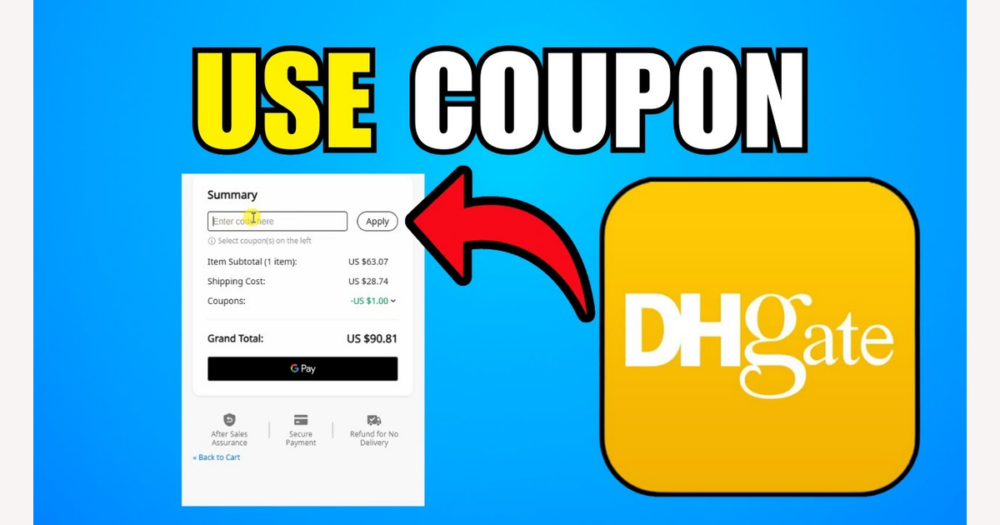
If you’re browsing lists of “Chinese coupon sites” to save money on DHgate, the most practical answer is that DHgate itself is your main coupon source. The discounts built into DHgate’s interface—platform campaigns, general coupons, and seller‑specific offers—are integrated with DHgate’s checkout and protections, while off‑site code portals that claim Chinese deals rarely offer clear, verifiable coverage for DHgate. This page explains how those native discounts really work with shipping, fees, and risks so you can lower total landed cost without losing control of your order.
Why DHgate itself is the most practical “Chinese coupon site” for international buyers
For an international buyer, DHgate itself is effectively your main “Chinese coupon site.” The coupons, platform promotions, and seller‑specific discounts you see inside DHgate’s own interface are the only discount tools you can reliably assume will work, because they are built into DHgate’s checkout and governed by DHgate’s rules.
Separate Chinese coupon portals and deal blogs do exist, and some may occasionally mention DHgate, but their coverage is patchy and often unverified. Codes can be expired, mislabelled, or never intended for DHgate at all, so I treat them as optional extras to test briefly rather than as core savings tools I depend on.
In practice, what really counts as a “popular” coupon option for a DHgate buyer is simple: a discount that is clearly visible on DHgate, easy to apply at checkout, and consistently reduces your order total when the stated conditions are met. A third‑party site that talks broadly about China deals but rarely produces a working DHgate code does not meet that standard of popularity in any meaningful, usable sense.
Because I care more about predictable savings than chasing obscure offers, I personally focus on DHgate‑native coupons and seller discounts that I can see and apply directly on the platform, and I skip off‑site codes when they start to look outdated, confusing, or disconnected from DHgate’s own terms and protections.
How DHgate coupons and discounts work with real landed cost
On DHgate, most usable discounts fall into three broad types: platform‑wide campaigns or promotions, general DHgate coupons, and seller‑specific discounts or vouchers. Campaigns and coupons usually apply to your order subtotal or to specific items, while seller discounts are tied to a particular store or product line. All of them show up in DHgate’s interface, with some indication of how and when they can be used.
These discounts almost always come with conditions. Common examples include a minimum order amount, limits to certain categories or items, “new user” or region‑specific eligibility, and expiry dates. A coupon might only work if your cart reaches a threshold, or if you buy within a promotional window, and it will simply not apply when those conditions are missed.
When a discount does apply, it typically reduces the item price or the order subtotal first. However, your real landed cost still depends on what sits outside that discounted subtotal: shipping charges chosen by the seller, possible customs or import taxes in your country, and any service or payment fees. A small coupon can be completely outweighed by expensive express shipping, while a larger percentage discount on a bigger, consolidated order may meaningfully offset both product cost and shipping.
The key is to look at where DHgate shows the discount in the checkout flow and which numbers it does not touch. I care far more about a clearly displayed, easy‑to‑apply discount that I can see reducing the total before payment than about a theoretical code from elsewhere. If the coupon barely moves the final amount once shipping and potential taxes are added, it’s not worth chasing; if it brings a noticeable drop in the full order cost while leaving seller reliability and protections intact, it’s a discount I’d actually use.
DHgate discounts vs external coupon sites and extensions
| Source | Reliability of codes | Effort required | Alignment with DHgate rules and protections | Typical issues |
|---|---|---|---|---|
| DHgate-native discounts | Codes and discounts are generated and enforced within DHgate, so eligibility and validity are shown on-screen and usually honored at checkout. | Moderate: you still need to read the terms and add items correctly, but everything happens inside the normal DHgate flow. | High: discounts follow DHgate’s order, payment, and buyer-protection rules, and any disputes are handled through DHgate. | Limited time windows or minimum spend rules, occasional confusion about category restrictions, and the need to watch expiry dates. |
| Generic coupon websites | Codes are often unverified, reused, or outdated, and DHgate coverage may be vague or only mentioned in passing. | Higher: you must search, copy, and test codes manually, and many attempts may fail or not apply to DHgate at all. | Low to uncertain: external promises may not match DHgate’s actual rules, and failed codes do nothing to improve buyer protections. | Expired or invalid codes, misleading claims about working “everywhere,” unclear minimum spend or category limits, and time wasted hunting small extra discounts. |
| Browser extensions claiming Chinese deals | Reliability is mixed: some extensions occasionally surface usable codes, but DHgate-specific support is rarely transparent or guaranteed. | Higher and ongoing: you install software, grant permissions, and let it run during checkout, which can slow the process or create distractions. | Unclear: extensions operate outside DHgate’s control, so they do not change DHgate’s protections and may interact unpredictably with the checkout flow. | Pop-ups or automatic code tests that interrupt checkout, privacy or permission concerns, attempts to apply non-DHgate codes, and extra complexity for savings that may not materialize. |
A simple workflow for using DHgate coupons without losing control of costs
- Check seller reliability first: review ratings, feedback, and seller history, and confirm key product details such as specifications, options, and estimated delivery.
- Within DHgate’s interface, look for visible platform-wide campaigns, store discounts, and coupons linked to the product or seller.
- Add the item to your cart and apply any eligible DHgate or seller coupons during the checkout flow, following the on-screen conditions.
- Calculate the full landed cost after discounts, including shipping charges and any likely taxes or fees, instead of focusing only on the reduced item price.
- Review DHgate’s dispute and refund terms for the order, including how returns, disputes, and refunds are handled if something goes wrong.
- Only finalize payment when the overall combination of price, discounts, shipping, and protections is acceptable, without depending on unverified external codes to make the deal worthwhile.
Risks of chasing random coupon codes and how to verify external offers
- Check that the external coupon explicitly mentions DHgate, not just “China deals” or another marketplace name.
- Enter the code in DHgate’s checkout for your actual order and see whether the system accepts it; do not assume it works until you see the discount applied.
- Read the coupon details shown on DHgate itself, looking for minimum spend, eligible categories, regions, and expiry date, rather than trusting only the off‑site description.
- If DHgate rejects the code or the on‑screen conditions remain vague, stop using that code and fall back to DHgate’s own visible coupons and seller discounts instead of trying risky workarounds.
When coupon savings are worth less than seller reliability and protections
Imagine two DHgate sellers offering the same type of item. Seller A charges a slightly higher base price but has strong ratings, consistent positive feedback, clear shipping timelines, and straightforward refund terms. Seller B advertises a lower price plus a coupon, yet their reviews are sparse or mixed, shipping information is vague, and policies around returns or disputes are hard to interpret.
On the surface, Seller B looks cheaper once you factor in the coupon. In practice, higher shipping charges, long or unpredictable delivery windows, and complicated refund processes can erase the apparent savings. If a parcel arrives much later than expected, costs extra to ship, or becomes difficult to return or refund, the time and hassle for an international buyer can outweigh a small discount on the item price.
For cross‑border orders, total landed cost includes both money and risk: item price, discounts, shipping and possible taxes, plus the likelihood that problems will be resolved quickly and fairly. I would rather pay a bit more to a seller with clear, reliable shipping and dispute handling than chase the lowest visible price with a coupon from a seller whose reliability is uncertain. The cheapest number on the screen is not always the lowest true cost once reliability and protections are taken into account.
DHgate coupon FAQs for international buyers
Can DHgate coupons usually be stacked with seller discounts?
Stacking is often limited and conditional. On DHgate, some promotions and seller discounts can work together, while others cannot be combined or only stack in specific ways (for example, one platform coupon plus one seller offer). The actual rule for your order is whatever DHgate shows on‑screen at checkout: if the system allows both discounts to apply, they stack; if one disappears or is marked ineligible, that combination is not allowed. Because stacking rules can change over time and differ by campaign, always rely on the current instructions and terms shown inside DHgate rather than assuming all coupons and seller discounts will combine.
Do my payment methods affect whether a DHgate coupon is valid?
For most international buyers using common methods such as major bank cards, the payment method itself does not usually decide whether a standard DHgate coupon is valid. Eligibility is more often based on order amount, product or category, user status, and region. However, DHgate can run occasional promotions tied to a specific payment method or region (for example, an extra discount for a particular card issuer or wallet). Those offers are time‑limited and depend on current DHgate campaigns, so check the wording of any coupon or banner on DHgate to see whether a particular payment method is required or gives extra benefits for that promotion.
What should I do if a DHgate coupon looks valid but fails at checkout?
First, check the basics inside DHgate: confirm the coupon has not expired, your order meets any minimum spend, and all items are within the eligible product or category range. Make sure the code, if you are entering one, is typed correctly and that you are logged into the account the coupon belongs to. If the coupon still will not apply, treat it as unavailable for that order: look for a different DHgate coupon or seller discount that clearly works, or proceed only if the price is acceptable without it. If the coupon comes directly from DHgate (not an off‑site list) and appears to meet all conditions, you can contact DHgate support or the seller for clarification instead of trying risky off‑site fixes or third‑party tools to force the discount.