
Quick answer
A DHgate makeup listing cannot prove that a product is authentic, authorized, properly labeled, or suitable for your use merely because it appears on the marketplace. Treat brand names, packaging photos, ratings, and low prices as claims to verify. If you cannot confirm the exact product identity, ingredient and warning label, seller, and intended market, the lower-risk choice is to buy through the brand or an authorized retailer.
“Authentic” can describe different questions: whether a named brand made or authorized the product, whether an unbranded formula is accurately described, and whether the package has information appropriate for the destination. A marketplace listing alone does not settle any of those questions.
What “authentic makeup” can mean
- Genuine branded product: the named brand made or authorized the item and its distribution.
- Accurately described unbranded or private-label product: the item is not presented as another company’s product and its identity, quantity, ingredients, and responsible business are accurately disclosed.
- Properly labeled for the destination: the package gives the information required for the market where it will be used or sold.
One kind of evidence does not establish all three. A logo does not establish formula identity. An ingredient list does not by itself prove who made the product. A seller rating reflects marketplace activity, not brand authorization, laboratory testing, or regulatory approval.
What U.S. buyers should know about cosmetic labels and claims
For products marketed in the United States, FDA’s Cosmetics Labeling Guide explains that cosmetics, including imported cosmetics, must meet applicable U.S. labeling requirements. It describes label information such as identity, responsible business information, net quantity, warnings where needed, and ingredients. Use a readable image of the exact product label to compare the listing with what you intend to buy; do not rely on a generic description copied from another variant.
FDA states that, under U.S. law, cosmetic products and ingredients generally do not need FDA approval before marketing, except for color additives. FDA also says manufacturers have legal responsibility for product safety and labeling. See FDA’s current guidance on prohibited and restricted cosmetic ingredients. Therefore, “FDA approved makeup” is not a normal trust badge for an ordinary cosmetic or proof that a marketplace item is genuine.
A product that claims to treat or prevent disease, or affect the body’s structure or function, may be regulated as a drug as well as, or instead of, a cosmetic. FDA’s labeling guidance explains this distinction. Do not treat medical-sounding marketplace claims as a substitute for appropriate product information or professional advice. Requirements differ by destination; this section is U.S.-focused and is not legal or medical advice.
Evidence to request before ordering
| Check | Useful evidence | What it does not prove |
|---|---|---|
| Product identity | Clear photos of the exact front, back, base, seal, and outer carton. | Photos alone do not prove the shipped item will match. |
| Ingredients and warnings | A readable label for the exact shade, size, or variant. | A copied ingredient list does not verify the formula. |
| Brand authorization | Information that can be independently checked with the brand or an authorized distributor. | A marketplace badge or seller statement is not brand confirmation. |
| Traceability | Manufacturer or distributor identity plus a lot or batch code when used. | A code is useful only if it can be connected to the product. |
| Order match | Written confirmation of product, quantity, shade, packaging, and destination. | General store reviews do not confirm the exact order. |
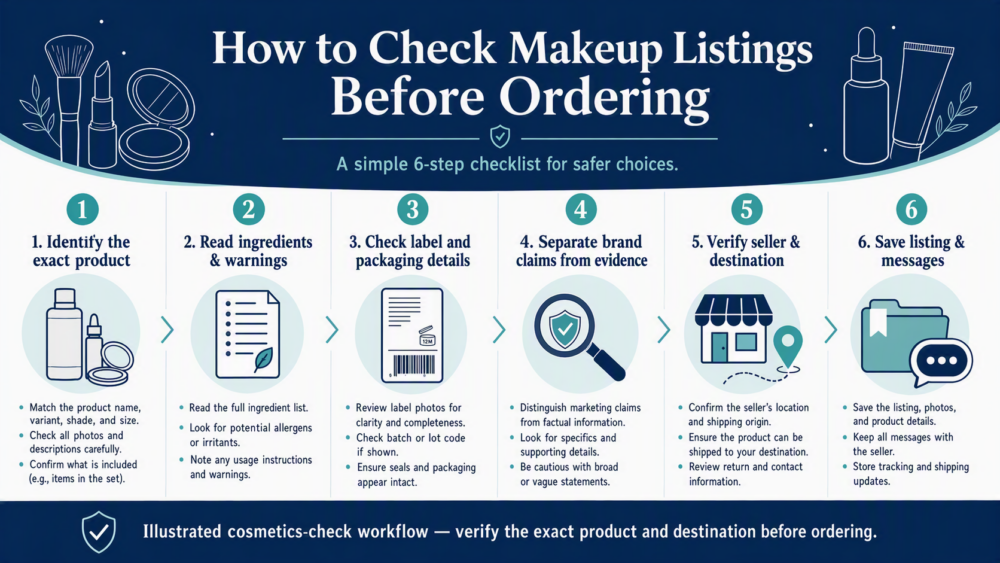
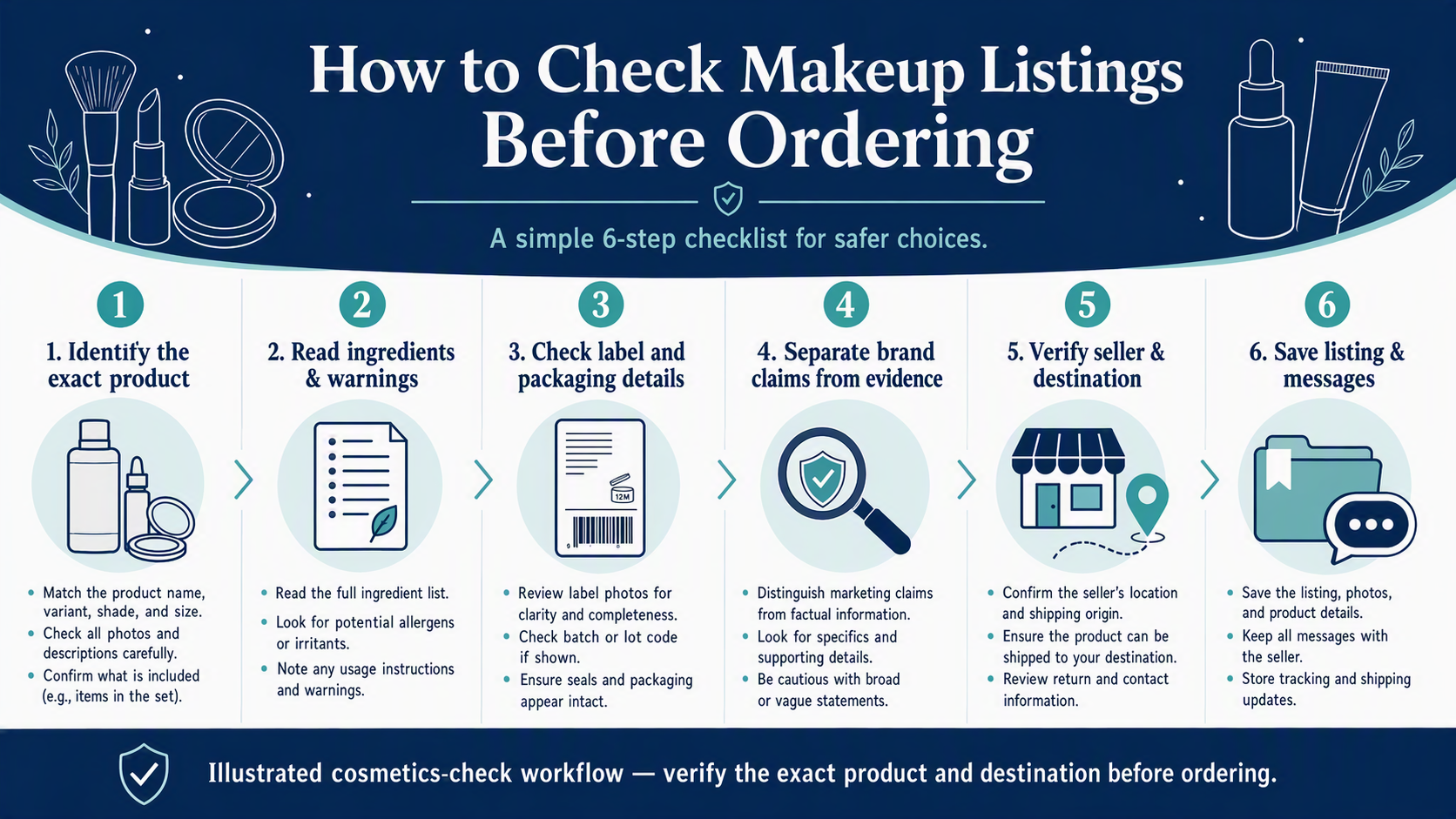
A six-step decision workflow
- Identify the exact product and variant. Confirm the shade, size, quantity, packaging, seal, seller, and what is included. Variant selectors can change the item details.
- Read ingredients, directions, and warnings. Look for a readable label for the exact version—not a generic image or an unrelated product listing.
- Check label and packaging details. Compare the visible identity, business information, quantity, and warnings with the listing. Missing, blurred, or contradictory information is a reason to pause.
- Separate brand claims from evidence. Similar colors, boxes, and logos are not independent confirmation of authorization. If brand authenticity matters, use the brand’s official retailer or distributor information.
- Verify seller and destination fit. Confirm the seller can ship the exact product to your destination and that the product information makes sense for that market.
- Save the order evidence. Keep the listing, selected variant, label photos, seller messages, quantity, shipping promise, and payment record before checkout.
For a broader checkout pre-check, see the DHgate order-readiness checklist. For help assessing seller evidence, see How to Find Trusted Sellers on DHgate.
When DHgate may or may not fit
DHgate may fit a buyer comparing generic packaging, tools, empty containers, or clearly identified unbranded products when the specification is verifiable and the buyer can tolerate sourcing risk. It is a poor fit when the purchase depends on guaranteed brand authorization, a sensitive-use formula, local professional advice, immediate recall support, or a supply chain that must be documented for resale.
For resale, do not assume that a marketplace invoice, listing, or shipping record establishes authorization or compliance. The seller and importer may have additional responsibilities that depend on the product and destination. FDA’s MoCRA overview describes U.S. cosmetics requirements that apply to industry, including responsibilities related to safety substantiation, adverse-event reporting, facilities, and product listing. A consumer checklist is not a substitute for legal, regulatory, or professional safety advice.
What to do when the order arrives
- Photograph the unopened parcel, shipping label, outer carton, seals, product label, lot or batch information, and all units together.
- Compare the received identity, shade, size, ingredient label, warnings, and quantity with the saved listing and seller confirmation.
- Do not use a product that is leaking, unsealed, contaminated, materially different, or missing information needed for safe use.
- If a cosmetic causes a reaction, stop using it and seek appropriate medical advice.
- Preserve the packaging and order evidence if you use the platform’s current support or dispute process. See how to prepare a DHgate dispute record.
FAQ
Does a high seller rating prove makeup is authentic?
No. Ratings may help assess transaction history, but they do not prove brand authorization, formula identity, labeling compliance, or the condition of the exact unit shipped.
Does “FDA approved” prove a cosmetic is genuine?
No. Under U.S. law, cosmetics and their ingredients generally do not need FDA approval before marketing, except for color additives. Check the exact claim and label rather than treating the phrase as a trust badge.
Can packaging photos prove authenticity?
No. They can help compare the listing with the received item, but packaging can be copied or changed. If authorization matters, use evidence that can be independently checked with the brand or an authorized distributor.
Is unbranded makeup automatically counterfeit?
No. An accurately presented unbranded or private-label product is different from an item falsely claiming another brand’s identity. It still requires reliable product, label, seller, and safety information.
What is the lower-risk alternative?
When product identity, ingredient confidence, professional advice, or brand authorization is essential, use the brand, an authorized retailer, or another traceable local channel with appropriate support.
Related guides
- How to Review DHgate Seller Ratings Before You Buy — how to use seller-page and product-page evidence without relying on a rating alone.
- How to View DHgate Review Photos — how to compare buyer images with the exact variant you plan to buy.
Primary sources and related guidance
- U.S. FDA: Cosmetics Labeling Guide
- U.S. FDA: Prohibited & Restricted Ingredients in Cosmetics
- U.S. FDA: Modernization of Cosmetics Regulation Act of 2022 (MoCRA)
- DHgate — verify the current listing, seller, order record, and support options for the exact transaction.
Last reviewed: August 21, 2026. Product listings, seller evidence, platform tools, and regulatory requirements can change. Recheck the exact product and destination before ordering.
One thought on “Are Makeup Products on DHgate Authentic?”