

On DHgate, you can’t plug Threadbird directly into your orders, but you can use Threadbird’s publicly advertised model—full‑service custom printing, packaging, and shipping with defined timelines—as a benchmark for what a clear, trustworthy service offer looks like. This guide explains that model and turns it into practical checks you can use when vetting DHgate suppliers who say they can handle custom merch and fulfillment for you.
What services does Threadbird actually advertise?
In its own marketing, Threadbird presents itself as a full‑service custom merch provider: it prints apparel and other merchandise (for example T‑shirts, hoodies, hats), offers additional decoration options such as embroidery, and handles packaging and shipping, including e‑commerce order fulfillment in which it picks, packs, and ships orders to end customers. Its site describes a defined process with published turnaround windows and the option to use its fulfillment service rather than organize logistics yourself.
Those statements come from Threadbird’s public descriptions, so they should be treated as general marketing claims, not as guarantees this DHgateWiki page can verify in detail or endorse for quality, print methods, or strict service‑level agreements. What matters for a DHgate buyer is the pattern: Threadbird explains, in writing, what it prints, how long production usually takes, how orders are packed, and which shipping options are available.
Threadbird is an independent custom merch and fulfillment provider, not a DHgate‑native service. You cannot add Threadbird to a DHgate order, and DHgate sellers are not required to match its exact capabilities. Instead, you can use Threadbird’s model as a benchmark for clarity: it shows what a complete, well‑documented service stack looks like—scope of printing and decoration, turnaround times, fulfillment options, and shipping choices with basic terms spelled out.
If I were sourcing on DHgate, I would rather pay a little more or wait slightly longer for a supplier who documents their printing, packaging, and shipping services with similar precision than gamble on a cheaper but vague listing. Treat Threadbird’s level of documentation as a reference point, and evaluate each DHgate seller on their own written offer instead of assuming anyone advertising “printing and shipping” automatically delivers Threadbird‑style fulfillment.
The rest of this guide breaks that benchmark model into concrete workflow stages—quoting, proofing, production, packaging, and shipping—so you can turn each stage into specific questions for any DHgate supplier claiming Threadbird‑like services.
How does a Threadbird-style workflow translate into DHgate supplier checks?
A full‑service custom merch provider like Threadbird typically follows a structured workflow: they move from your initial inquiry and quote through artwork approval, production, packaging, and finally shipping. As a DHgate buyer, you can mirror this structure in your messages with any supplier, using each stage as a checklist of details to confirm instead of assumptions you hope will be covered.
- Stage 1 – Initial inquiry and quote: you share artwork, the product type (for example specific T‑shirt or hoodie models), quantities, and print locations. On DHgate, ask the supplier for detailed written specs—fabric, colors, print positions, decoration methods—and line‑item pricing for each variant so you know exactly what you’re paying for.
- Stage 2 – Pricing, MOQs, and setup fees: a provider clarifies per‑unit pricing, minimum order quantities, and any setup or artwork fees before you commit. On DHgate, insist that MOQs, bulk discounts, and extra charges are spelled out clearly in chat or a formal quotation, not just hinted at in the listing.
- Stage 3 – Artwork proofing and approvals: they produce digital proofs or sample prints and wait for your approval. With a DHgate supplier, ask for digital mock‑ups and either clear photos of real samples or a small paid sample order before authorizing full production, especially for complex designs or branding.
- Stage 4 – Production with stated turnaround: once approved, the job moves into production with quoted turnaround windows and sometimes rush options. On DHgate, get the production timeline in writing, including what counts as “business days,” when the clock starts, and how delays will be communicated.
- Stage 5 – Packaging decisions: the provider decides between standard packaging (simple bags or boxes) and custom or branded packaging, labels, and inserts. Ask your DHgate supplier exactly what packaging they include—plain polybags, branded boxes, hang tags, size stickers, inserts—and confirm any extra charges for custom packaging before you rely on it for customer‑facing orders.
- Stage 6 – Shipping and fulfillment setup: they set ship‑to addresses, determine whether they ship directly to end customers or only in bulk to you, and choose carriers or shipping accounts. On DHgate, clarify whether the supplier offers only bulk shipment to your warehouse or store, or can actually handle individual customer orders; confirm which carriers they use, whether you can use your own accounts, and how tracking numbers will be shared.
- Treating each workflow stage as a checklist item in DHgate messages reduces the chance of hidden gaps between what you expect and what the supplier will actually do. Shipping and fulfillment arrangements often carry the most assumptions and risk, so focus particular attention on the questions that test those promises.
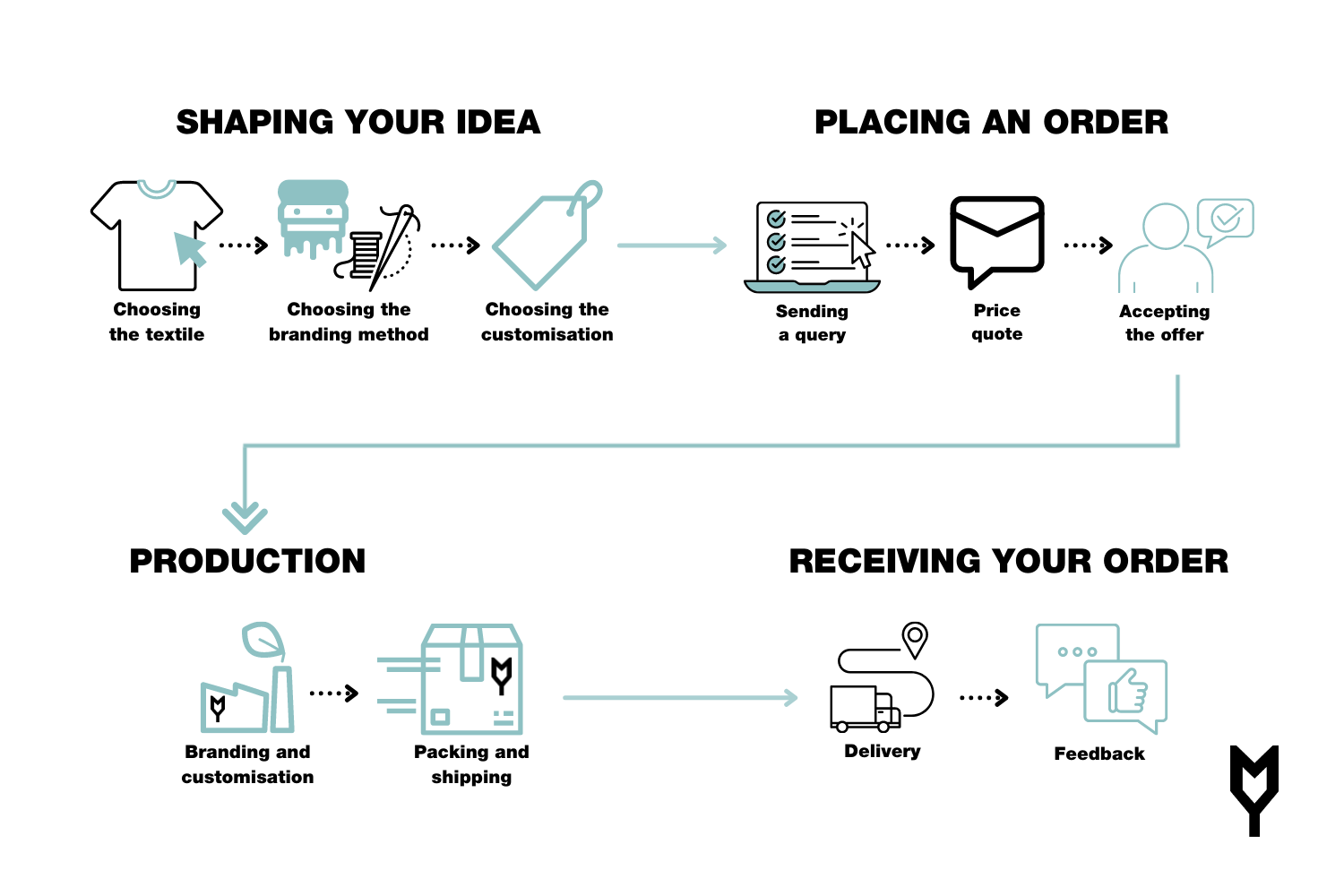
A simple left‑to‑right diagram showing a product’s journey from ordering through production, packaging, and delivery can help you visualize how quote, pricing, proof, production, packaging, and shipping form one continuous workflow that your DHgate questions should follow.
How should I confirm shipping and fulfillment promises?
- Ask which carriers or logistics partners the supplier uses for different regions—for example whether they rely on major services like DHL, UPS, FedEx, EMS, or local couriers—and whether carrier choice changes by destination country.
- Confirm whether they ship individual parcels directly to your end customers (true dropshipping or e‑commerce fulfillment) or only bulk cartons to a single address such as your warehouse or store.
- Request details on branding: can parcels be shipped under your brand name with your logo, sender/return address, and custom inserts, or will shipments show the supplier’s identity and use only plain, generic packaging?
- Ask whether you can use your own shipping accounts, prepaid labels, or third‑party fulfillment rules, or if you must use the supplier’s negotiated rates, chosen carriers, and label formats.
- Verify how tracking works in practice: when tracking numbers are generated, how they are sent to you (DHgate messages, spreadsheet, fulfillment dashboard), what information each number includes, and how the supplier reports lost, delayed, or misrouted shipments.
- Clarify shipping coverage and extra costs: which countries and regions they can ship to, how they handle customs, duties, and taxes, and whether any surcharges or import fees are quoted and agreed in writing before orders are dispatched.
What does DHgate protect in a custom-printing and fulfillment order?
DHgate’s buyer protection framework is built around an escrow‑style payment flow: you pay through DHgate, the platform holds funds until you confirm receipt or a set time passes, and then releases payment to the seller. If goods are not received or are significantly different from the listing description, you can open a dispute within DHgate’s dispute window and request a refund or partial refund. Platform policies typically distinguish between two broad dispute types: non‑delivery and items that are not as expected.
These protections are platform‑wide and are not designed specifically for complex custom printing and fulfillment workflows. DHgate can help when a shipment never arrives or when the products clearly do not match basic listing claims, but it does not automatically enforce detailed service standards like a dedicated provider’s terms might. A standalone merch and fulfillment company such as Threadbird may publish explicit rules about misprints, acceptable defect rates, turnaround guarantees, return eligibility, and how late or damaged orders are compensated. DHgate does not mirror those policies by default for every seller.
Because of that gap, you need to negotiate and document the details that matter for your custom order directly with the supplier in DHgate messages: artwork approval steps, proof requirements, acceptable color and print tolerances, packaging and branding expectations, agreed turnaround windows, and what happens if shipments leave late or arrive after a key date. Those written agreements become your reference if you later need to argue that an order is “not as described.”
Be aware that nuanced issues—such as small color shifts, minor differences in packaging style, or delays that fall within a loosely defined timeline—may be hard to resolve through DHgate if you never spelled out your expectations. The platform is more likely to support you when there is a clear mismatch against written terms than when the problem is a vague feeling that the service was not as polished as a Threadbird‑level operation.
Given these limits, review DHgate’s current buyer protection and dispute policies yourself before placing a complex custom order, and structure your orders conservatively: shorter timelines, smaller batches, and milestone checks instead of one huge commitment. I would personally trade speed for clarity here and insist on detailed written agreement inside DHgate messages before trusting a supplier with Threadbird‑style printing, packaging, and fulfillment. Once you understand what the platform protects and what relies on your own documentation, you can move on to a step‑by‑step vetting process for any supplier who claims Threadbird‑level services.
How do I vet a DHgate supplier claiming Threadbird-level services?
- Shortlist suppliers: search DHgate for custom-printing listings that match your merch type, then prioritize sellers with strong ratings, consistent positive feedback, and visible order history in similar products.
- Send targeted questions: message those shortlisted suppliers with specific questions drawn from the Threadbird-style workflow—artwork format, print method, MOQs, size and color options, turnaround times, packaging style, and whether they can ship directly to your customers or only to one address.
- Evaluate communication: compare how quickly and clearly each seller replies, noting whether they give concrete, detailed answers (with examples or photos) or rely on vague assurances like “no problem” and “we can do everything.”
- Agree on detailed specs in writing: before placing any order, lock down artwork files, print placements, sizes, color codes, quantity per size, packaging requirements, and shipping arrangements in DHgate messages or an attached spec sheet, so both sides have the same reference.
- Place a small test order: start with a limited, low-risk run that follows those written specs, and set clear success criteria for print quality, correct sizes and colors, packaging presentation, and delivery timing.
- Review results and scale carefully: compare the test order against the agreed details, and only consider bulk or ongoing fulfillment if the supplier meets expectations; if they fall short, either adjust your requirements or move on to another seller.
- Treat red flags seriously: at any stage, vague, inconsistent, or reluctant answers should either disqualify the supplier or confine them to a very small experiment, not full Threadbird-style fulfillment.
- Overall, this sequence turns Threadbird’s benchmark clarity into practical DHgate checks, helping you prove a supplier’s real capabilities before trusting them with your main customer orders.
Why you shouldn’t assume every printer offers Threadbird-level fulfillment
FAQ: Applying a Threadbird-style model to DHgate suppliers
Can I fully replicate Threadbird’s model using DHgate suppliers?
You can often approximate parts of a Threadbird-style setup on DHgate—such as custom printing plus some packaging and bulk shipping—but you should not expect a complete copy of Threadbird’s automation, policies, or branding by default. Each DHgate supplier decides what they offer, and many focus only on bulk printing and shipment to a single address. Treat Threadbird’s model as a benchmark for clarity: ask sellers to spell out in writing which services they actually provide (printing scope, packaging, shipping methods, service rules) and assume anything not confirmed is absent.
Can I split services between different providers, like printing with one DHgate supplier and fulfillment with another or an external partner?
Yes, you can split services, but it increases complexity and cost. If one provider prints and another handles warehousing and customer shipping, you have to manage stock transfers, extra shipping and customs steps, timelines between providers, and who is responsible for packaging quality and delivery problems. Map the Threadbird-style workflow to your setup and clearly define, in writing, who handles each stage—printing, inspection, packaging, labeling, customer shipping, returns—so gaps are visible before you launch, not discovered after orders go wrong.
What should I do if a DHgate supplier’s service falls short of their Threadbird-style promises?
First, gather evidence: save DHgate messages where the supplier described their services, take clear photos or screenshots of what you actually received, and note dates and tracking information. If the problem fits DHgate’s dispute rules—such as non-delivery or goods that are clearly not as described—open a dispute within the platform’s time window and present that documentation. For issues that are more about vague or missing promises, focus on learning from the experience: tighten your future requirements, insist on more detailed written terms, run smaller test orders before scaling, or move to a more transparent supplier. Use Threadbird-level clarity as your benchmark, but remember that DHgate protections and each seller’s written offer set the real limits of what you can enforce.