
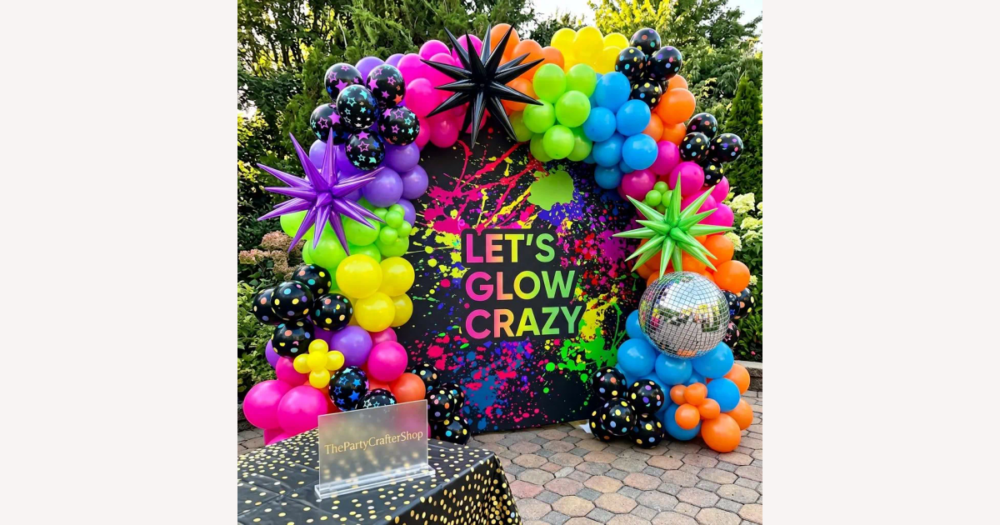
DHgate hosts many independent sellers, so you can find a wide range of 1980s-themed party supplies if you know how to search and compare listings. Instead of looking for a single “best” store, focus on using 80s-related search terms, scanning photos for on-theme designs, and checking each seller’s details so your decorations look retro at a glance and still meet your basic quality expectations.
How DHgate works for finding 1980s-themed party supplies
DHgate is an online marketplace where many independent sellers list their own products, including 1980s-themed party supplies. It is not a single store with one consistent quality standard, so selection, prices, and materials can vary widely from listing to listing.
For 80s party decor, your job on DHgate is less about finding one “right” store and more about learning how to search and then compare what you see. Broad terms such as “80s party decorations,” “1980s backdrop,” “back to the 80s,” or “retro neon party” can surface relevant options, and you can add words like “balloons,” “tableware,” or “costume” when you already know which type of item you need.
Once you have some search results, open a few listings side by side and look closely at their photos, dimensions, materials, and reviews instead of assuming the first result is best. Because many different sellers share the same marketplace, you should treat each 80s-themed listing as its own offer and review its details carefully rather than assuming that all similar-looking items have the same quality or contents.
Common 1980s-themed party supplies you’ll see on DHgate
- Backdrops and banners: Large printed pieces, often fabric, vinyl, or thicker paper, usually with “Back to the 80s” or similar slogans. Expect them to be lightweight party decor rather than heavy stage sets, and always check the listed dimensions so the backdrop is big enough for your wall or photo area.
- Balloons and garlands: Latex and foil/mylar balloons in neon or metallic tones, sometimes shaped like cassette tapes, stars, or numbers. Most are single-use and may need a separate helium source or hand pump, so check how many pieces come in a set and what inflation method the seller mentions.
- Tableware sets: Paper or thin plastic plates, cups, napkins, and tablecovers printed with retro 80s patterns. These are typically designed for one-time use, so scan for the number of guests a set is meant to serve and whether the tablecover size matches your table.
- Photo booth props: Cardstock signs, glasses, microphones, cassette or boombox cutouts, usually on sticks. They are often printed on lightweight card that can bend after a night of use, so look for photos that show all included designs and note how many props you get in each pack.
- Small decor and favors: Hanging swirls, confetti, centerpieces, cupcake toppers, and mini toys that add extra 80s touches around the room. These pieces are usually small and light, sold in multi-packs, so confirm the quantity per pack and check close-up photos to see the actual size.
- Simple costume accessories: Neon sunglasses, headbands, wristbands, leg warmers, and plastic jewelry for casual dress-up. Materials are typically basic plastic or stretch fabric that works well for a one-off party rather than premium, long-term costume quality; check the sizing notes and any mention of adjustable parts.
- When you scan any 80s-themed listing on DHgate, look for clear dimensions, the quantity included in each pack, and photos that show the exact items you’ll receive rather than only a fully styled party scene.
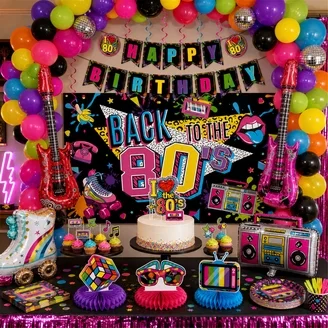
A mix of 80s-themed party supplies—neon backdrop, balloons, tableware, and small props—arranged together as they might appear in a finished party setup.
How to tell if party supplies really look 1980s
To check whether DHgate party supplies really look 1980s, start with the color palette. Classic 80s designs lean on loud, high-contrast combinations—hot pink, electric blue, lime or neon green, and deep black—rather than soft pastels. Look for bold geometric shapes, grids, zigzags, and lightning bolts scattered across the background instead of gentle swirls or watercolor-style blends.
Icons are just as important as colors. Strong 80s themes often feature cassette tapes, VHS cassettes, boomboxes, arcade machines, pixelated graphics, roller skates, joysticks, early computer or console motifs, and retro ‘laser’ or chrome effects. Fonts that mimic arcade titles, sci‑fi movie logos, or chunky block lettering usually read more 80s than generic cursive or basic sans-serif text.
Use these cues to avoid off-theme designs. Disco balls with rainbow swirls and very fluid, psychedelic patterns often feel more 1970s than 1980s. Emoji-heavy prints, kawaii pastel gradients, and smartphone or social-media motifs belong more to the 1990s or 2000s and can dilute an 80s look if they dominate your decor.
When you open a DHgate listing, scan all available photos—not just the first one. Look for at least one full shot that shows the entire banner, backdrop, or set, plus close-ups that reveal the actual print. Make sure any key text such as “Back to the 80s” is large, bold, and readable from across a room rather than tiny in a corner. Check that the main icons and patterns are repeated clearly, not stretched or blurry.
Titles and descriptions can confirm the theme. Phrases like “80s party,” “Back to the 80s,” “1980s retro,” “80s neon,” “arcade,” or “synthwave” are stronger signals than generic labels such as “retro,” “vintage,” or “neon.” If the wording only mentions “colorful party decor” without specific 80s references, treat the listing as potentially off-theme and rely more heavily on the photos before deciding.
For most casual home parties, it is reasonable to prioritize designs that scream 80s visually, even if the plates, banners, or props use basic disposable materials. As long as the colors, icons, and fonts clearly read 1980s at a glance, your guests will notice the theme; you can reserve higher budgets and sturdier materials for professional events or photo-heavy occasions where durability and perfectly crisp prints matter more.
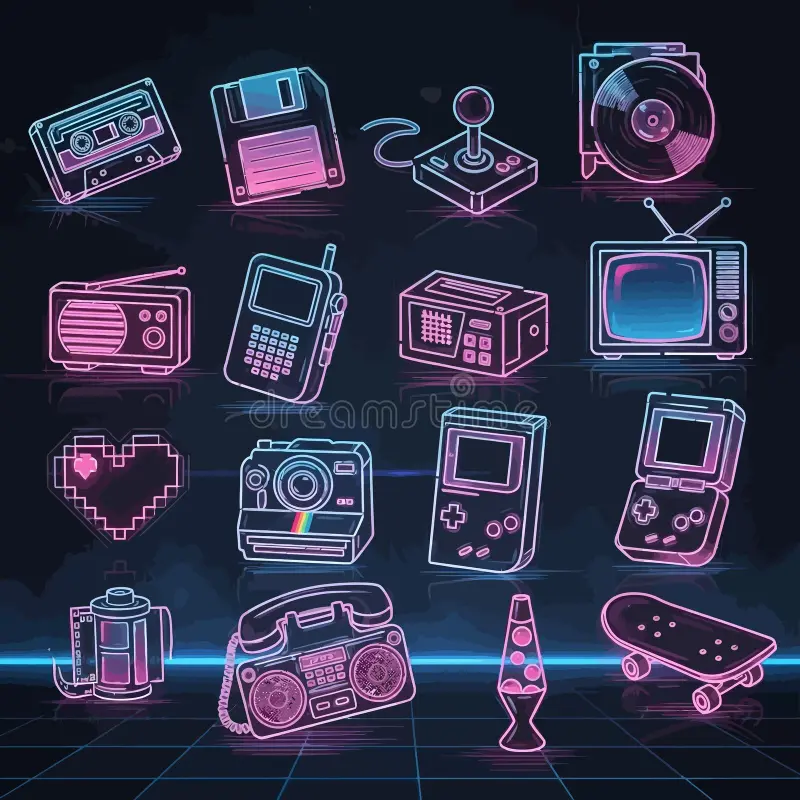
This illustration shows a grid of neon-outlined retro icons—a cassette tape, floppy disk, joystick, vinyl record, radio, mobile phone, TV, and pixelated heart—on a dark background, capturing the bright, tech-focused look typical of 1980s-inspired designs.
Balancing budget materials vs durable 80s party supplies
80s-themed party supplies on DHgate usually rely on a few common materials. Paper and cardstock are widely used for plates, cups, napkins, banners, and photo props; thin plastic or foil appears in tablecovers and balloons; polyester or vinyl is common for printed backdrops; and lightweight plastics show up in glasses, headbands, and other accessories. These materials can all work well if you match them to how you plan to use the items.
Budget-friendly listings tend to use thinner paper, light cardstock, and very lightweight plastics that are meant for single use. For a one-night home party, that can be perfectly acceptable: the plates, props, and tablecovers only have to survive a few hours, and the main value comes from bold 80s visuals rather than long-term durability. You may see slightly softer edges or less rigid props, but your guests will mainly notice the neon colors and retro icons.
Sturdier options include thicker polyester or vinyl backdrops that hang more smoothly, heavier cardstock props that keep their shape in photos, and more solid plastic accessories that feel closer to costume pieces than novelty favors. These typically cost more but can look crisper on camera, handle being moved and reused, and feel more substantial if you plan to host multiple 80s events or need decor for a more formal setting.
In practice you can choose between two main approaches. One is to lean into lightweight, disposable pieces—paper tableware, simple props, thin plastic decor—to maximize variety and strong visuals on a tight budget. The other is to invest in a smaller set of higher-quality, reusable items like a durable backdrop, sturdy props, and solid accessories that anchor several parties or a professional event. Both paths can work if they match your priorities and timeline.
My own preference for most home 80s parties is to prioritize on-theme visuals and accept basic materials, as long as the prints are clearly 1980s and the items can last through the night. If you are planning a recurring event, photo booth, or professional setup, it’s worth spending more on listings that specify thicker polyester or vinyl, heavier cardstock, or better plastics, with clearer spec details and more careful quality control.
As you browse DHgate descriptions, look for named materials (paper vs cardstock, polyester vs generic fabric, PVC or ABS plastics), any mentions of GSM or thickness, and close-up photos that show how sharp the print is and whether the material looks opaque or flimsy. These details help you quickly tell whether a listing is closer to lightweight party decor or something built to last beyond one 80s-themed celebration.
Quick checklist for evaluating 80s party listings on DHgate
- Theme check: confirm that photos and the title clearly show 80s motifs—neon color combinations, bold geometric shapes, cassette tapes or boomboxes, arcade or video game icons, or wording like “Back to the 80s,” not just generic “retro” text.
- Contents and size: read the description to see exactly what is included, check dimensions for banners, backdrops, tablecovers, and props, and note quantity per pack for balloons or tableware so you’re not surprised by very small or single-piece sets.
- Materials: look for whether each item is paper, cardstock, plastic, foil, or fabric and decide if that matches your plans—lightweight, disposable pieces for a one-off party versus sturdier materials you might want to reuse.
- Seller reputation: check the seller’s overall rating, how many orders or reviews the listing has, and recent reviewer photos or comments for clues about print sharpness, color accuracy, and whether the set matches the listing pictures.
- Shipping and timing: review the estimated delivery window and make sure it comfortably fits your party date, leaving buffer time in case of delays or customs slowdowns.
- Returns and disputes: if you’re placing a larger order or feel uneasy, skim DHgate’s buyer protection or help pages in advance so you generally understand how refunds or disputes work if items arrive significantly different from the description or damaged.
Common pitfalls when ordering 1980s party supplies online
- Low-resolution prints: large backdrops or banners can look sharp in listing images but arrive blurry or pixelated. Reduce this risk by checking close-up photos and user-uploaded review images, especially for text and detailed graphics.
- Color differences: neon designs may arrive duller or in slightly different shades than the listing photos because of lighting, editing, or printing variation. Compare reviewer photos with the product images and note whether the description mentions fluorescent or bright colors versus softer pastels.
- Smaller-than-expected sizes: banners, backdrops, and tablecovers can be much smaller than staged photos suggest. Always rely on the stated measurements, imagine them against your wall or table, and size up if you need full coverage for a photo area.
- Fewer pieces than the scene suggests: styled listing photos may show more balloons, props, or table items than the pack actually includes. Avoid this by reading the item list and quantity details line by line before assuming the full scene is included.
- Shipping delays: long shipping times or unexpected delays can clash with your event date. Mitigate this by ordering earlier than you think you need and avoiding last-minute orders for key pieces like backdrops or full decor sets.
- Overall reassurance: these issues are possible with any online marketplace, but paying attention to dimensions, contents, materials, reviews, and timing usually keeps an 80s-themed party on track and prevents major surprises.
Quick answers: timing and what if something goes wrong
Is DHgate a good option for last-minute 1980s party planning?
DHgate orders often ship internationally, so many listings have longer delivery windows than local stores. It works best when you have at least a few weeks of lead time. If your party date is close, check each listing’s estimated delivery window carefully, favor options with faster shipping, and plan simple local backups for essentials like plain neon tableware or basic balloons in case a parcel is delayed.
What should I do if my 80s-themed items arrive off-theme, incorrect, or damaged?
Start by documenting the problem with clear photos of what you received, including the packaging and any damaged or wrong pieces. Then contact the seller through DHgate with a polite explanation and a specific request—such as a partial refund, replacement, or another reasonable remedy. If you can’t reach a solution, review DHgate’s buyer protection or dispute guidance in its help section and follow the platform’s steps for opening a case, keeping all communication and evidence organized. Outcomes depend on the situation, so avoid assuming a particular result in advance.
Can I mix DHgate 80s-themed items with local store supplies to finish my party setup?
Yes. A practical approach is to use a few standout 80s pieces from DHgate—such as a themed backdrop or props—to establish the retro look, then fill in with basics from nearby stores, like solid neon plates, cups, tablecovers, and balloons. This mix lets you keep the 1980s theme while covering any gaps quickly if shipping times or stock limits make it hard to get everything from one place.