
For patterned shower curtains on DHgate, choose checkerboard for a clear square grid, houndstooth for a broken-check texture, or leaves for an organic motif. Compare the print’s scale and colors with your existing tile before checking the actual curtain’s dimensions, attachment method and liner requirements. A pattern you like is only a shortlist: the selected size, finish and care instructions still need to suit your bathroom.
Reviewed September 14, 2026. This guide compares design choices and listing checks; it does not verify current DHgate stock or endorse a particular seller.
Compare checkerboard, houndstooth and leaf motifs
The three patterns solve different decorating problems. Treat the combinations below as starting points for your taste, rather than rules about what every bathroom should look like.
| Motif | Visual character | A useful starting point | What to inspect in a listing photo |
|---|---|---|---|
| Checkerboard | Alternating squares in a regular grid | Plain walls or tile where you want one graphic focal point | Square size, contrast and whether the grid looks consistent across the panel |
| Houndstooth | Repeated broken checks with pointed edges | A restrained palette where you want more detail than a simple square check | A close-up of the print and a full hanging view; a small repeat may read as texture from a distance |
| Leaf | Recognizable foliage or abstract leaf shapes | A room where curved shapes and a botanical accent appeal to you | Leaf size, spacing, background color and how much empty space separates the motifs |
Checkerboard: Black and white creates a pronounced contrast; two closer tones can make the same grid less conspicuous. If you already have a checkerboard floor, compare the two repeat sizes before adding another grid. They do not have to match, but an accidental near-match may be less satisfying than a deliberate difference.
Houndstooth: Do not confuse it with plain checks in a small thumbnail. Ask for a detail showing the pointed, broken shapes. A fine print and an oversized version of the same motif can have very different effects when the curtain covers most of a wall.
Leaves: Compare the background as carefully as the foliage. Sparse outlined leaves on a pale ground leave more visual space than overlapping tropical foliage. Green is an option, not a requirement; monochrome or muted leaf designs may connect more easily with existing towels or fixtures.
Match the pattern to the room you already have
Start with the surfaces you will keep: floor tile, wall tile, paint, wallpaper and vanity. Choose one or two colors from those surfaces or your towels to repeat in the curtain. Then decide whether the curtain should stand out or blend in.
In a small bathroom, a bold pattern is still an option. What matters is whether you enjoy seeing it alongside the other surfaces. A patterned curtain does not physically enlarge the room. For busy wallpaper or intricate floor tile, compare a lower-contrast curtain or a design with more background showing. For plain walls, a larger graphic can become the main decorative feature.
Pattern mixing is easier to judge when you vary one element at a time. Keep a shared color while comparing a geometric curtain with organic wallpaper, or keep the motif family while changing its scale. Photograph your bathroom from the doorway and compare that view with the full curtain image. A close-up swatch alone will not show how much of the room the print will occupy.
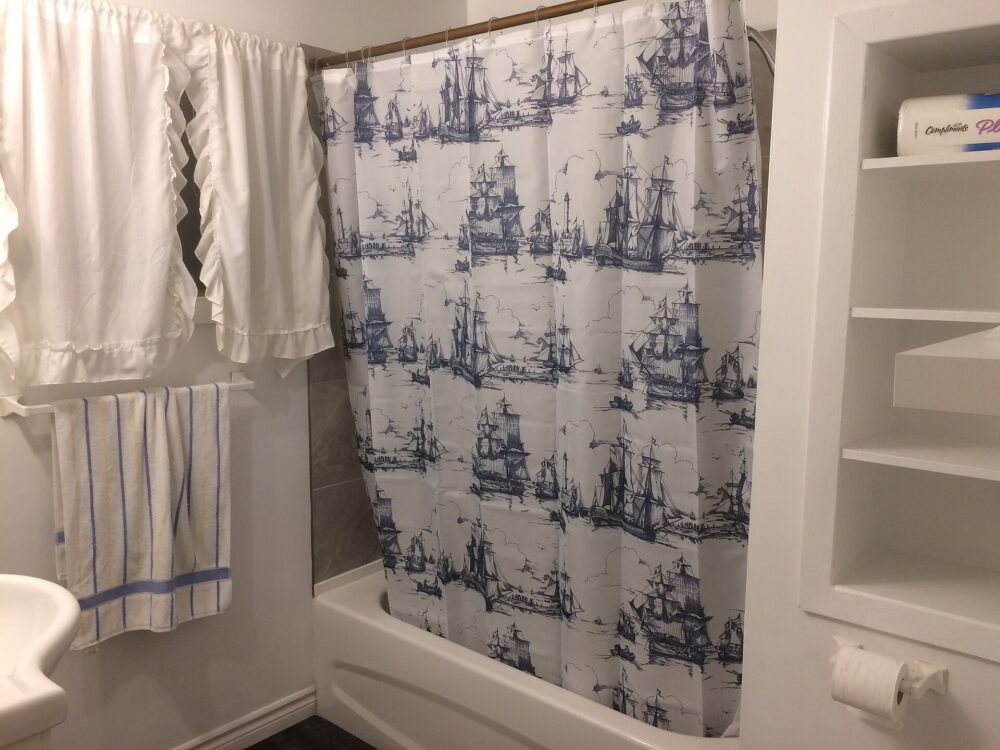
Featured photograph: IKEA shower curtain, by Paulo O, Wikimedia Commons, CC BY 2.0. Resized. This sailing-ship print illustrates coordination with a plain window curtain and striped towel; it is not a DHgate listing or an example of checkerboard, houndstooth or leaves.
Judge the print both flat and hanging
A seller’s flat product image may show the repeat clearly, but folds can interrupt or hide parts of it. Ask for a full hanging view as well as a close-up of the selected design. For a large leaf or oversized check, this helps you judge whether the visible section still looks balanced when the curtain gathers.

Fold reference: Shower curtain, by Dean Hochman, Wikimedia Commons, CC BY 2.0. Resized. The stripes show how folds alter a repeated pattern; this is not a DHgate product photo.
Do not calculate the true print size from an unidentified tile or hook in a photograph. Ask for a repeat measurement or a photo with a ruler if scale is important. Different lighting and screens can also change the apparent shade. A seller photo and a buyer photo, where available, provide comparison points rather than a guarantee of an exact color match.
Confirm dimensions, attachments and the water barrier
Measure the opening you need to cover and the distance from the actual hanging point to the intended lower edge. Allow for the way the hooks or rings suspend the curtain, and check the manufacturer’s guidance on coverage and placement. Do not order by a familiar size label alone: compare width and length separately, including the units. If a DHgate option gives dimensions in centimeters and your measurements are in inches, convert both width and length to the same unit before comparing them.
Look closely at the top edge. Reinforced holes may take separate hooks or rings; some designs have integrated attachments or openings intended for a particular rod. A metal eyelet by itself does not establish how the curtain hangs. Confirm the hole arrangement, attachment compatibility and what the package includes before buying accessories. The DHgate accessory listing checklist offers additional checks for specifications and compatibility.
Separate the decorative curtain from the layer intended to contain water. Ask whether the exact model requires a liner and what use the manufacturer specifies. “Fabric,” “plastic” or a photograph does not settle that question. If you use a separate liner, check its dimensions and attachment arrangement too; an attractive outer curtain cannot compensate for an unsuitable water barrier.
Shortlist the exact DHgate variant and its care requirements
Search DHgate with the motif plus “shower curtain,” then add your preferred color or required dimensions. If filters are available, use them to narrow the results, but confirm the details on the selected option. Save the design name, size and included items together so a different thumbnail or default variant does not change your intended purchase.
Before ordering, resolve these questions with the seller:
- Does this selected option match the full-panel and close-up photos?
- What are its finished width and length, and which units are used?
- Which hooks, rings or rod arrangement does it require, and what is included?
- Is a separate liner required for the stated use?
- What do the care label and manufacturer’s instructions permit?
The guide to contacting a DHgate seller can help organize the exchange. Use the DHgate listing and seller risk guide for broader checks beyond the print and fit.
IKEA’s shower-curtain care guide distinguishes care by material and emphasizes following product instructions. Apply that principle to the curtain you buy: do not assume machine washing, a particular temperature or a cleaning chemical is suitable without its care directions. Keep the label, inspect the curtain during cleaning, and address damage or persistent soiling rather than relying on a universal replacement calendar.
If color matching is critical, seeing a curtain locally may be more useful than comparing more online photos. If a DHgate option remains your choice, order only once the motif, actual dimensions, attachment and care information describe the same selected product.