
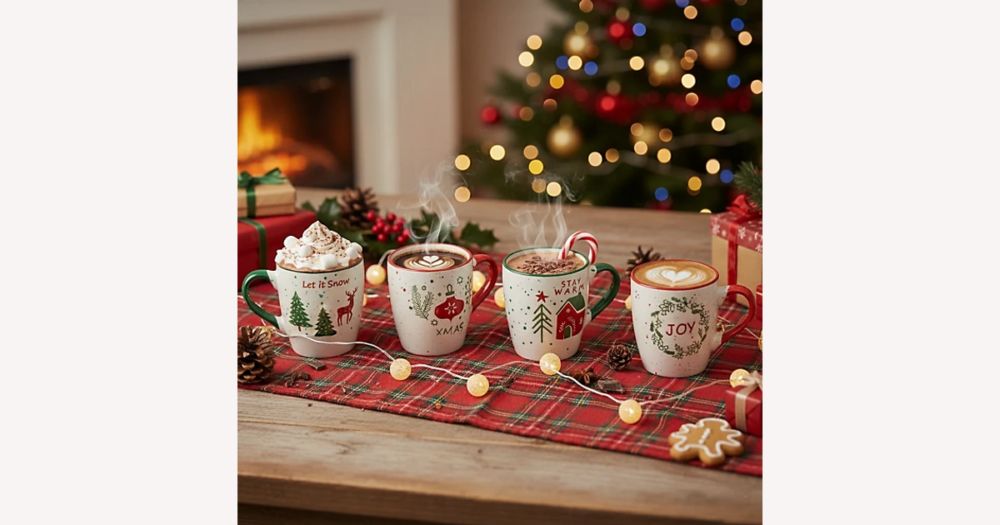
If you’re hosting holiday guests and browsing Christmas mugs on DHgate, your safest path is to treat durability as non‑negotiable and style as the variable. Start by locking in thick, well‑glazed ceramic or stoneware mugs with clearly stated capacity, material and microwave/dishwasher notes, backed by solid seller feedback and realistic shipping times. Once that foundation is in place, you can use colours, motifs and wording to build the festive look you want without worrying that your cocoa bar will be let down by chipped rims, faded prints or late arrivals.
Start with durable materials before choosing festive designs
For repeated holiday hosting on DHgate, I would start with thick, well-glazed ceramic or stoneware Christmas mugs that clearly state their capacity and care instructions. These materials are widely used for Christmas mugs, and when the walls are reasonably thick and the glazing is smooth and even, they usually handle hot drinks, stacking and regular washing more reliably than thin glass or very fine porcelain.
Durability on DHgate still depends on details you can only partly see online, so focus on listings that name the material precisely (for example, “stoneware” rather than just “ceramic”), show close-up photos of rims, interiors and handle joints, and include clear notes about whether the mugs are microwave- and dishwasher-safe. Capacity in ml/oz helps you avoid tiny novelty cups or oversized bowls that are awkward for guests.
With that sturdy base in place, treat festive style as the flexible layer you add afterward: choose holiday colours, motifs like trees, snowflakes or reindeer, and wording that match your cocoa bar or table theme, as long as they’re applied to a well-built mug. Different materials and finishes explain why I favour robust ceramic or stoneware and when alternatives can still work if you’re willing to handle them more carefully.
How mug materials and finishes affect durability for Christmas use
Ceramic and stoneware are the default for many Christmas mugs and, when they’re reasonably thick with smooth, even glazing, they tend to balance sturdiness, heat handling and easy care for hot drinks and frequent washing. Thinner walls, rough or patchy glaze, or visible flaws around the rim and handle can make these mugs more prone to chipping or fine surface cracking over time.
Porcelain usually feels lighter and finer, which can look elegant on a Christmas table but is less forgiving during busy hosting. Very thin rims or delicate handles are more vulnerable if mugs are stacked, knocked against each other or carried in large groups, so porcelain is better when you expect gentler, sit‑down use and careful handling.
Glass behaves differently depending on construction. Tempered or double‑wall glass mugs are designed to cope with heat and everyday use, and can be a good choice when a clear, modern look suits your setup. Thin decorative glass or sculpted novelty shapes, like tree‑shaped mugs, are more fragile and often work best as occasional accent pieces rather than your main serving workhorses.
Enamel‑coated metal cups have a strong metal core, but the enamel surface can chip if they’re banged against hard surfaces or dropped; exposed areas can feel rough and may eventually show rust. They fit casual or rustic Christmas themes and are fine when you accept some patina over time, but they’re not ideal if you want a pristine, uniform set for several seasons.
Stainless steel is structurally very durable and handles heat well, yet visually it reads more like a camp or travel mug than traditional Christmas china. It can be practical for outdoor gatherings, kid‑focused events or situations where you prioritise toughness over appearance, but may not match a classic indoor cocoa bar aesthetic.
Across all materials, thickness, weight and finish matter as much as the label. Slightly heavier mugs often indicate thicker walls, while close‑up photos of rims, interiors and handle joins help you judge how smooth and complete the glazing or coating is. Care instructions—such as “handwash only,” “avoid abrasives” or “not microwave‑safe”—are tied to how long decoration and finish will last under real use.
Decoration method also affects longevity. Artwork that’s baked into the glaze generally holds up better than surface decals or prints, which can scratch or fade more quickly if scrubbed hard or run through aggressive dishwashing cycles. For most DHgate Christmas mug purchases I’d still favour sturdy, glazed ceramic or stoneware, but I’d consider tempered glass, enamel or stainless steel when the listing clearly describes construction and the hosting context fits their look and care needs.
Hosting-friendly specs to check in DHgate mug listings
- Capacity: Use the stated capacity in ml or oz to judge how generous each serving will be. For most Christmas cocoa, coffee or tea, around 300–400 ml (10–14 oz) feels comfortable; tiny novelty cups can leave guests needing constant refills, while very large mugs can become heavy and spill‑prone when full.
- Mug dimensions: Check the listed height and diameter, plus any comparison photos, to see how the mugs will sit on trays, shelves and place settings. Taller, narrower mugs fit more easily on crowded trays; very wide mugs take up more space and may be harder to arrange neatly for a big group.
- Handle size and shape: Look closely at photos to make sure there’s enough room for fingers and that the handle doesn’t have sharp angles or edges. For hosting, a handle that lets most adults fit two to three fingers comfortably is easier to grip when carrying multiple hot drinks.
- Rim thickness and interior shape: Use close‑up images to judge whether the rim looks slightly thick and smooth, without obvious bumps or rough glaze. A gently rounded interior and rim usually feels more comfortable to sip from and tends to be more forgiving of minor knocks than a very thin, sharp edge.
- Set quantity and extras: Confirm how many mugs are included and compare that with your expected guest count and hosting style. It often helps to have a few more mugs than guests to cover second servings or late arrivals; check whether the seller offers matching add‑on pieces from the same listing if you might expand the set later.
- Stackability or nesting: If the listing mentions stackability or shows mugs neatly stacked or nested, consider how that will work in your cupboards or on your cocoa bar. Stackable designs make it easier to store and carry several mugs at once, which can reduce clutter and effort during busy hosting.
- Overall hosting comfort: Read these specs together and picture a real gathering—mugs that are a practical size, easy to grip and available in sufficient numbers keep serving smoother and less stressful. Exact preferences vary by household, but on DHgate I would still favour well‑described, functional specs over purely cute novelty shapes when buying for repeated holiday use.
Choosing festive designs that still hold up in use
For Christmas hosting, the base material and construction do most of the durability work, while colours, patterns and artwork mainly affect care requirements and how the mugs age visually. Under‑glaze or integrated motifs that are part of the ceramic surface usually resist scratching and fading better than surface decals, which can wear faster if scrubbed hard or run through aggressive dishwashing cycles.
Design elements can still change how gently you need to treat the mugs. Metallic foiling, gold rims and iridescent finishes often conflict with microwave use and may show wear sooner if they’re run through dishwashers against the care instructions. Raised text, sculpted shapes and 3D decorations introduce more edges that can chip and can be trickier to clean, so they’re better as occasional statement pieces than as the primary workhorse set. When you’re choosing a theme—classic red and green, winter whites with subtle patterns, or whimsical characters—aim for a simple, clearly described finish for the main serving mugs, then add a few intricate or heavily decorated pieces as accents if you’re comfortable with extra handwashing or potential cosmetic wear.
Step-by-step: assessing a Christmas mug listing on DHgate
- Check material and care notes first. On DHgate, look for specific material names such as stoneware, ceramic, or tempered glass, and read any microwave or dishwasher guidance or warnings like “handwash only” or “not for microwave.” I wouldn’t skip this step for a hosting-critical order.
- Confirm capacity and set size. Use the stated ml/oz figure and the number of mugs to see whether each serving will feel generous enough and whether you have enough pieces for your guest count and drink style.
- Inspect listing photos for construction details. Zoom in on rims, handles, and interiors to judge apparent wall thickness, how smooth and even the glazing looks, and whether the handle attachment appears clean and solid rather than rough or flimsy.
- Review seller ratings and buyer feedback. Consider overall scores, the number of orders, and text reviews, and prioritise listings with buyer-uploaded photos that show the mugs in everyday use rather than only stylised product images.
- Verify shipping estimates against your event date. Check the delivery window to your location, note any shipping method options, and make sure you have a comfortable buffer so delays don’t leave you without the set on hosting day.
- Treat this as a quick, repeatable sequence: it won’t remove all uncertainty, but it meaningfully reduces the chance of fragile, mismatched or late-arriving Christmas mugs while keeping the decision process manageable. For low-stakes, one-off styling, you might choose to relax parts of it; for real hosting, it’s worth running through every step.
Risks to watch for in DHgate Christmas mug listings
- Construction risk: Be cautious of mugs with very thin-looking walls, exaggerated novelty shapes or handles that appear narrow or poorly attached in photos, especially when the listing doesn’t mention thickness, weight or sturdiness. These designs are more likely to chip, crack or feel awkward when serving guests.
- Care and finish risk: Treat missing or inconsistent microwave/dishwasher information as a red flag, particularly for metallic, glittery or heavily decorated surfaces. Without clear guidance, you may either damage the finish in normal use or feel forced to handwash and avoid the microwave, which can slow down hosting.
- Functional size risk: If capacity isn’t stated, or buyer reviews mention that the mugs are smaller than expected, assume they may feel more like novelty cups than practical hot-drink vessels. That can mean constant refills and guests juggling undersized portions at your gathering.
- Seller and shipping risk: Listings with very few orders, sparse or low-quality reviews, no buyer photos, and wide delivery windows that run close to your event date carry more uncertainty. They’re more likely to arrive late or feel different from how the photos suggest.
- For a hosting-critical purchase, it’s sensible to walk away from listings that combine several of these unclear points and instead choose better-documented options with solid specs, care notes and buyer evidence—even if that means picking a slightly less novel design on DHgate.
Which listing signals really help verify durability and reliability?
On DHgate, listings with precise, consistent product details are the strongest starting point when you care about durability and reliable hosting. Specific material names such as “stoneware,” “porcelain,” or “tempered glass,” mentions of wall thickness or approximate weight, and capacities that match across bullets and the main description all suggest the seller has defined the mug set more carefully than a vague label like “ceramic cup.” When I’m ordering for a holiday event, I treat this kind of clear, internally consistent spec as a basic requirement rather than a bonus.
Visual evidence matters just as much. Multiple high-quality photos that show the mugs from several angles—especially close-ups of rims, interiors, bases and where the handle joins the body—give you a better sense of glazing smoothness and construction quality than stylised lifestyle shots alone. Smooth, even glaze, clean lines around the handle attachment and rims that don’t look rough or wavy are all positive signs; heavily filtered or distant photos that never show these details leave more uncertainty about how the mugs are actually finished.
Good care information is another meaningful signal. Listings that explicitly say whether the mugs are microwave or dishwasher safe, mention any temperature limits, or recommend handwashing for metallic or heavily decorated surfaces show that the seller has thought about everyday use. Clear guidance helps you avoid damage from mismatched care, and it usually pairs with more deliberate material and finish choices than listings that say nothing about how the mugs should be used or cleaned.
Buyer feedback can support what the listing claims, especially when reviews include context and photos from real kitchens. A reasonable number of reviews, star ratings backed by comments about sturdiness or appearance, and buyer-uploaded photos that look like the listing images all make it more likely that the mugs arrive as described. I pay more attention to patterns—several buyers mentioning that the mugs feel solid or that colours match the photos—than to any single rating in isolation.
Even the best signals have limits, though. Detailed specs, close-up photos, clear care notes and substantial buyer feedback can reduce uncertainty and make it more likely that the set is thoughtfully made and accurately represented, but they can’t prove how the mugs will hold up over many years or eliminate the chance of occasional defects or shipping delays. For a hosting-critical event, I would favour listings with strong, consistent information and robust buyer evidence, order with enough time to handle any hiccups, and keep a modest backup plan rather than assuming that any single set is guaranteed to be perfect.
Coordinated sets vs mix-and-match mugs for hosting
| Approach | Hosting advantages | Trade-offs and considerations |
|---|---|---|
| Coordinated set from one DHgate listing | Uniform material, capacity and colours make it easy to give every guest a similar mug and create a cohesive table or cocoa bar. You only need to vet one listing, track one order and follow one set of care instructions, which simplifies both serving and storage. | If the set disappoints, your whole mug plan is affected, and you have fewer chances to correct for size or style differences. You may have slightly less visual variety than with mixed pieces, so it helps to choose a design you’re happy to see across the whole table. For a key hosting event, I would start with a well-reviewed coordinated set that shows strong durability signals. |
| Mix-and-match mugs from several DHgate listings | Mixing designs can create a charming, personalised look, with different motifs or colours at each place setting. It lets you combine a sturdy core of everyday-friendly mugs with a few more decorative statement pieces for special guests or display. | You have to check specs, materials and seller reliability for every listing involved, and sizes or colours may not match perfectly. Different materials can mean different care rules, and multiple sellers increase shipping complexity and the chance of uneven arrival times. This approach suits hosts who enjoy managing those details; I would add mix-and-match pieces only after my main serving needs are covered by a reliable core set. |
Quick answers: microwave safety, extras, and order issues
Can I microwave Christmas mugs from DHgate if the listing doesn’t say they’re microwave‑safe?
Rely on the listing’s care instructions and any markings on the mug. If “microwave safe” isn’t clearly stated, or the mugs have metallic accents, gold rims, glitter, very glossy or unusual coatings, treat them as non‑microwave items to avoid safety issues and damage to the finish. For hosting, I would heat drinks in a clearly microwave‑safe container and pour into decorative mugs rather than risk microwaving an uncertain design.
How many extra Christmas mugs should I order for holiday hosting on DHgate?
Treat extras as a small hosting buffer rather than a strict formula. Once you’ve matched the set size to your expected guest count, adding a couple of extra mugs gives you cover for breakage, last‑minute guests or someone wanting a fresh cup. For a larger gathering, you might choose a slightly bigger margin, but I’d still focus on a well‑described, durable set first, then add a modest number of spare mugs rather than over‑ordering.
What should I do if the Christmas mugs I receive from DHgate look different from the listing photos or description?
Start by comparing the mugs carefully against the listing: check colours, motifs, capacity, quantity and any promised features like microwave safety. Take clear photos of what you received, including any differences or defects. Then contact the seller through DHgate’s messaging system, explain the discrepancy and share your photos. If you can’t resolve it directly, use DHgate’s order resolution or dispute tools within the platform’s time limits to request a refund, replacement or other remedy based on how the item differs from what was advertised.