
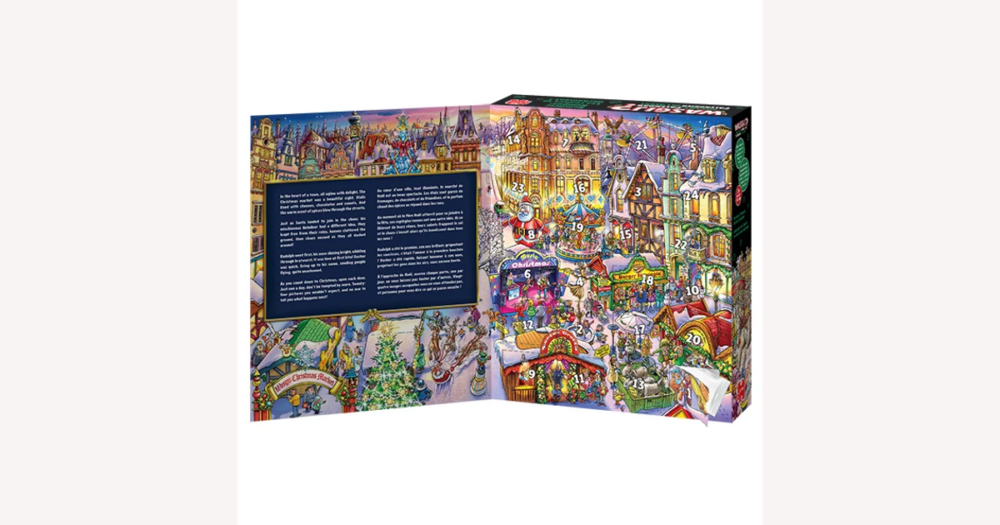
If you’re browsing DHgate for a jigsaw advent calendar under $50, start by working out exactly what you’re buying: how many days, how many pieces, how large the finished puzzle is, and how those pieces are divided across the month. Once you can spot listings that clearly explain this basic structure, it becomes much easier to avoid vague, time‑sensitive purchases and focus on calendars that will actually be fun to build.
What a jigsaw advent calendar usually includes
On DHgate, a jigsaw advent calendar is a seasonal puzzle set built around 24 (sometimes 25) days. Each day you open a compartment, envelope, or bag and receive puzzle pieces that gradually form one or more complete jigsaw images by the end of the month. Some calendars give you sections of one large puzzle that you finish near Christmas, others offer a new small standalone puzzle each day, and a few mix mini-puzzles with pieces of a larger scene.
For any calendar under $50, a transparent DHgate listing should spell out the basics: the number of days, the total piece count across the whole calendar, the approximate finished dimensions of the main image, how many pieces or mini‑puzzles you get per day, and the packaging format (for example, a rigid box with numbered doors, envelopes in a sleeve, or cloth bags). Listings that only show a final artwork and a vague “24 days” line, without telling you how many pieces you’ll actually build or how large the finished puzzle is, leave you guessing about difficulty, play time, and table space.
Even at a budget price, you’re entitled to clear core specs on DHgate. If a listing won’t tell you the total piece count, finished size, number of days, and whether you’re getting one big puzzle or multiple small ones, treat that as a warning sign. In that situation, it’s safer to message the seller for details or skip the listing altogether than to buy based on cute artwork alone and discover later that the calendar is too flimsy, too small, or not the format you expected.
How to judge material and print quality from a DHgate listing
Once you know the basic format, the next question is whether the puzzle pieces will feel solid and look clear in person. For a budget jigsaw advent calendar on DHgate, the key quality factors are the material, thickness, and cut of the pieces, plus the print surface. You want reasonably rigid cardboard or wood that doesn’t bend like thin paper, pieces that lock together cleanly instead of shedding lots of dust, and printing that looks sharp rather than blurry or muddy when you’re up close.
Under $50, it’s normal to see simpler finishes, lighter cardboard, and fairly basic packaging, but the pieces still shouldn’t appear flimsy or easily creased in the photos. Acceptable trade‑offs are things like a plain box or a straightforward matte or light gloss finish; unacceptable signs are pieces that look almost like printed paper, warped edges, or obviously miscut shapes that don’t line up. If the calendar is meant to be used every day for weeks, weak materials can make the whole experience feel cheap and frustrating.
Because you only have the listing to go on, pay close attention to the wording and images. Phrases such as “thick cardboard,” “high‑definition printing,” or “clear patterns” accompanied by close‑up photos of real pieces and their edges are good signals. In contrast, generic marketing lines with no material details, only stylized or clearly digital mock‑ups, or photos that show the artwork and closed box but never the actual pieces are weaker signals. Zoom in on photos to check for fuzzy outlines, visible pixelation, strange color banding, or misaligned cuts; if you can’t see the pieces properly or the description never mentions what they’re made of, it’s better to ask the seller specific questions or move on to a listing that is more transparent about quality.
Choosing the right piece count and size for your household
Specs are your best tool for matching a jigsaw advent calendar to how your household actually puzzles. In general, more pieces and smaller pieces mean a longer, more challenging build; fewer pieces and larger pieces are quicker and easier, especially for kids or casual puzzlers. If you like sitting down for a focused hour in the evening, a higher piece count can be satisfying. If you only have 20 minutes or are puzzling with younger children, a simpler layout with larger, easier-to-grip pieces will feel more relaxed.
Advent calendars handle those pieces in different ways. Some divide one big puzzle into daily portions, so each day you add new pieces to the same growing image; others give you multiple small standalone puzzles, one per day, that you build and then put away. A clear DHgate listing should say which approach it uses and roughly how many pieces you get per day. If that’s missing, you won’t know whether each evening’s puzzle time will feel like a meaningful session or a few minutes of very light activity.
You can use rough ranges to judge whether a calendar suits your preferred challenge. A total of a few hundred pieces across the month is modest and manageable for most households. Once a calendar approaches 800–1,000 total pieces, it skews toward a longer, more involved challenge that suits puzzlers who enjoy spending more time on the image and don’t mind smaller, more detailed pieces. For a solo adult with limited time each evening, a moderate daily piece load is usually more enjoyable than either a tiny handful that feels trivial or a large stack that starts to feel like pressure.
Finished dimensions matter just as much as piece count. The listing should state the size of the completed puzzle (for one-big-puzzle formats) or of the typical daily puzzle. Compare those measurements to your available table or desk space and remember that you may need to keep that surface free for the puzzle throughout December. If you’ll be building on a shared dining table, for example, a very wide or long puzzle could be awkward to leave assembled between sessions.
Treat specs as a filter, not an afterthought. Avoid listings that omit total piece count or finished size, because they make it impossible to judge difficulty or space needs. When a DHgate calendar gives you clear numbers for total pieces, approximate daily pieces, piece size, and finished dimensions, you can quickly decide whether it fits your household’s time, space, and preferred challenge level before you get carried away by the artwork.
Picking a theme and image that are fun to assemble
Once the specs feel right, the image and theme decide whether you’ll actually enjoy working on the calendar all month. Themes range from traditional Christmas scenes and winter landscapes to pop‑culture franchises and neutral designs like patterns or abstract art. Choose something you won’t get tired of seeing and handling day after day; if you’re sharing the puzzle, think about what everyone in the household will find appealing rather than picking a niche theme that only one person enjoys.
Practical image traits have a big impact on how it feels to assemble. High contrast between areas, distinct color blocks, and clear shapes make it easier to spot where pieces belong. Very dark, low‑contrast scenes or extremely detailed images with lots of similar tones—like night skies, dense forests, or crowded, tiny-detail artwork—are significantly more challenging and can feel frustrating if you’re expecting a light, cosy activity. If you prefer a gentler challenge, look for images with brighter colors, clear outlines, and obvious visual sections.
Budget printing can also affect how certain designs behave as puzzles. Very fine text, tiny logos, or small character faces may not print crisply at this price point, which can turn what looks like a sharp design on screen into a blur of similar shapes in real life. For an advent calendar you’ll handle repeatedly, it’s safer to choose artwork where the main interest comes from larger, well‑defined elements rather than microscopic details.
Daily reveals should relate sensibly to the final picture. Some calendars show mini images or marked sections that correspond clearly to parts of the big puzzle, so you can see how each day’s pieces add to the whole. Others use more abstract or repetitive imagery, which can make it harder to understand where each day’s pieces fit until late in the month. Listing photos should give you a clear view of the full final image and, ideally, a sense of how the daily compartments map onto it.
Before deciding, study the listing’s photos of the actual printed image rather than relying on stylized mock‑ups. Look for a clear, uncropped view of the whole picture and close‑ups that show real print texture, not just digital art. Be wary of listings where the final image appears only as a tiny thumbnail, looks heavily edited, or is shown at odd angles that hide details. An image you can see clearly in the photos is far more likely to match your desired challenge level and enjoyment once the pieces are on your table.
Listing red flags that should make you walk away
- No total piece count, finished puzzle dimensions, or clear number of days. A listing that only says something like “24 days” without explaining how many pieces you get in total or how big the completed puzzle is leaves too much to guess and is a strong warning sign.
- Advent format never explained. If it’s not clear whether you’re building one big puzzle over the month or getting multiple small daily puzzles, you can’t tell how the calendar will actually work in practice.
- Very few, low‑resolution, or generic stock photos. Be cautious when you only see one or two blurry images, when there are no close‑ups of real pieces, edges, or opened compartments, or when the pictures look like mismatched digital mock‑ups rather than photos of the actual product.
- Obvious inconsistencies in the text. Red flags include different piece counts in the title and description, or conflicting material claims such as calling the puzzle “wooden” in one place and “paper” or “cardboard” in another without any clarification.
- Vague, over‑the‑top promises with no real detail. Phrases like “premium quality,” “high‑end,” or “luxury” mean little if the listing doesn’t also specify materials, piece thickness, or show clear photos of the print and packaging.
- No clear description of what’s inside each daily compartment. For a multi‑part, time‑sensitive product like an advent calendar, it’s not acceptable if you can’t tell what you’re opening each day—pieces of one big puzzle, separate mini puzzles, or something else entirely.
- Shipping and refund information that is vague or easy to overlook. If estimated delivery cuts too close to the start of December, or refund terms are unclear, that’s a serious risk for a product that only makes sense in a specific season.
- Any combination of these red flags. When key details are missing or contradictory, it’s safer to message the seller with specific questions about piece count, materials, format, and shipping—or walk away and look for a clearer listing—no matter how perfect the artwork or tempting the price seems.
Checking seller reliability and value on DHgate
Seller signals matter as much as the calendar design. On a marketplace like DHgate, start by looking at the overall rating, but don’t stop there: a solid score backed by a meaningful number of completed orders and a steady flow of recent reviews is more reassuring than a perfect rating from just a handful of old purchases.
Read the written reviews for clues about reliability. Comments that mention on‑time delivery, accurate descriptions, and intact packaging are good signs, while repeated complaints about late arrivals or missing items are a warning. Reviews with buyer photos are especially useful for jigsaw advent calendars because they show whether the pieces, artwork, and packaging actually match the listing images.
Check what else the seller offers. A storefront that regularly sells puzzles, games, or other seasonal items suggests more experience with similar products than a random mix of unrelated goods. If you have questions about piece count, materials, or shipping timelines, send a concise message; prompt, specific replies are another positive signal that the seller is paying attention.
Within a $50 budget, it’s reasonable to expect clear specs, decent materials, and reliable shipping, but not collector‑level packaging or multiple high‑end extras. If one calendar is priced noticeably lower than similar listings yet comes from a seller with few orders, patchy reviews, or vague descriptions, treat that as a caution flag rather than a bargain. I would rather choose a slightly more expensive calendar from a transparent, well‑reviewed seller than gamble on the absolute cheapest option and risk it arriving late or not as described during the holiday season.
Why DHgate’s buyer checks matter more for advent calendars
On DHgate, advent products like jigsaw calendars are tied to a fixed season. If your calendar turns up after December 1—or much later—it has missed the window when opening a new compartment each day feels special. That’s why estimated delivery dates and the presence of tracking information matter more here than for a generic puzzle you could use any time of year.
Jigsaw advent calendars also carry more risk of something going wrong in transit or packing than a single boxed puzzle. Each calendar includes many pieces and often multiple compartments, envelopes, or bags. If a section tears open, a bag splits, or a compartment is mispacked, you can end up with missing, duplicate, or damaged pieces that affect the whole month’s experience rather than just one evening of puzzling.
DHgate-style buyer protections and store policies are meant to give you a path forward when timing or completeness become a problem. Before you order, you can check the estimated delivery window, confirm that tracking is provided, and note that there is a dispute process if the calendar arrives late, incomplete, or noticeably different from the description. Buyer protection summaries and each store’s refund or replacement terms outline how issues such as undelivered or not-as-described items are usually handled, but they do not replace clear listing information or a responsive seller.
Taken together, seasonal timing and multi-part contents mean you benefit from treating buyer checks as part of the product decision, not an afterthought. Put these ideas into a simple pre-purchase checklist—covering specs, materials, seller signals, shipping to Canada, total cost under $50, and basic protections—so you can run through concrete actions before you commit to a calendar.
Pre-purchase checklist for DHgate jigsaw advent calendars
- Confirm the basics in the listing. Check the total piece count across the whole calendar, the finished puzzle dimensions, the number of days, and how pieces are divided by day or into mini-puzzles. Make sure the theme is clearly described and there is at least one clear photo of real pieces and packaging, not just artwork mock-ups.
- Scan for material and print clues. Look for mentions of sturdy cardboard or similar puzzle-appropriate materials, and study any close-up photos for reasonably clean cuts and sharp printing. Avoid listings that rely only on stylized images or that make conflicting statements about what the pieces are made of.
- Check seller signals. Review the seller’s overall rating, the number of completed sales, and how recent and detailed the reviews are. Give extra weight to reviews where buyers share photos of the actual calendar and comment on whether it matched the description and arrived in good condition.
- Confirm that the total cost stays under $50 CAD. Factor in the item price, shipping charges, and any visible fees so your final amount—not just the headline price—fits your budget.
- Verify the estimated shipping timeline to Canada. Check the projected delivery date and make sure it comfortably precedes December 1, leaving a buffer for possible customs processing or busy-season delays.
- Review DHgate’s buyer-protection summary and the store’s own refund or replacement terms. Pay particular attention to how they say they handle items that arrive late, incomplete, or not as described, so you have a rough sense of what support you can expect if something goes wrong.
- Message the seller if anything important is unclear. Ask specific questions about piece count, finished size, materials, daily format, or delivery timing. If the responses are vague, inconsistent, or never arrive, treat that as a signal to move on to a better-documented listing.
- Keep quality and clarity ahead of marginal savings. It’s usually wiser to choose a clearly described, reasonably priced calendar from a reliable DHgate seller than to chase the absolute lowest price or flashiest artwork when key details and protections are uncertain.
Common questions about jigsaw advent calendars on DHgate
Can I reuse a jigsaw advent calendar from DHgate?
Most jigsaw advent calendars can technically be reused if you keep all the pieces, compartments, and packaging intact. As long as nothing is lost or damaged, you can rebuild the puzzle in future years or refill compartments with pieces again. The trade-off is that the surprise factor is reduced once you already know the image and daily sequence, and budget-level packaging—thin cardboard doors, simple envelopes, or basic boxes—may not hold up well after being opened and closed many times. If you want to reuse a calendar, handle the packaging gently, store the pieces in clearly labelled bags, and check that the box or compartments are still sturdy enough before relying on it for another season.
How much space and daily setup will a jigsaw advent calendar usually require?
Even under $50, most jigsaw advent calendars take up a modest but noticeable amount of space. You’ll need room both for the packaging itself and for the area where you assemble each day’s pieces. Use the finished puzzle dimensions given in the listing as a guide to your table or desk footprint, and plan for the surface to stay relatively clear for the whole month if you’re building one large puzzle over time. If you share the space—for example, a dining table—think about how often you’ll need to move or protect the puzzle so it isn’t disturbed. For calendars with separate mini-puzzles, you can often complete and pack away each day’s image on a smaller surface, but you still need somewhere to keep the box and any in-progress sections out of the way.
Are jigsaw advent calendars noisy or disruptive to use every day?
Assembling jigsaw pieces is generally very quiet, especially if you’re working on a stable surface. The main noise comes from handling the packaging: opening cardboard doors, rustling paper envelopes, or searching through small bags for the right pieces. This is usually just light rustling, but in very quiet households, shared workspaces, or bedrooms, it can be noticeable if you do it late at night. If you’re concerned about noise, choose a calendar whose packaging looks reasonably sturdy and easy to open without tearing, and plan your daily puzzling for times when a bit of rustling won’t bother others.
What should I do if a DHgate listing has artwork I love but incomplete specs?
Start by reading the listing carefully, including any longer description sections and all photos. Sometimes details about piece count, finished size, or daily format are buried in small text or shown in a diagram rather than highlighted in the title. If key specs are still missing, message the seller with specific questions: ask for the total piece count, finished puzzle dimensions, materials used for the pieces and packaging, and how pieces are divided across the days. Clear, prompt answers are a good sign; they also give you written confirmation you can refer back to. If the seller can’t or won’t provide straightforward information, or replies with vague marketing phrases instead of numbers and materials, it’s safer to skip the listing and look for a calendar with more transparent specs, even if the artwork is appealing. For a seasonal, multi-part product like an advent calendar, clarity matters more than looks.