
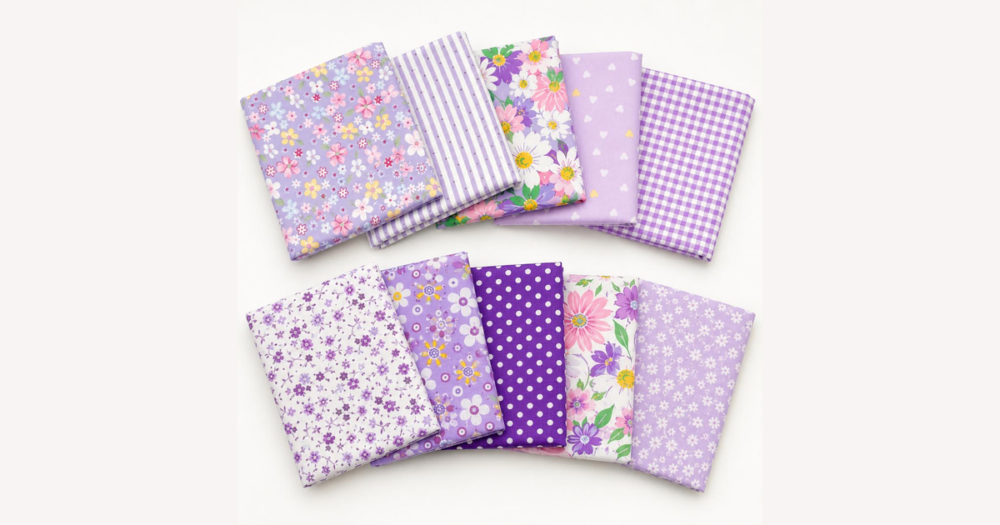
On DHgate, the best starting point for most purple quilts is simple: look for mid-weight, tightly woven 100% quilting cotton and be cautious about plush or stretchy “purple fabric” that’s really minky, fleece, or knits. This guide explains how different purple fabric types behave in piecing and quilting and shows you which DHgate listing details—fiber content, weave, and fabric type names—help you avoid buying material that’s hard to sew or too bulky for the quilt you have in mind.
Choose the right purple fabric materials for quilting
For most purple quilts you’re piecing on a home machine, mid‑weight, tightly woven 100% quilting cotton is the safest default—especially on DHgate where you can’t touch the fabric first. Listings that say “100% cotton,” “quilting cotton,” or “cotton woven fabric” usually point to stable fabric that feeds evenly under the presser foot, presses flat, and holds quilting stitches cleanly. I would personally choose this kind of cotton for any pieced top where I care about accurate seams.
Within cotton, different fabric types behave a little differently. Solid purple quilting cotton shows every quilting line and any puckers, which can be beautiful if you want your stitching to be a main design element but unforgiving if your tension varies. Blenders and tonals (subtle mottled or textured prints in mostly one color) are great workhorses: they read as “purple” but quietly hide small piecing imperfections. Busier florals, geometrics, or novelty prints can look like overall texture from a distance, so individual blocks may blend more; they’re useful when you want movement rather than crisp, graphic shapes. Batiks—often described as “batik cotton” or “hand‑dyed batik”—tend to have a tighter weave and crisper hand, which makes seams very precise but can feel slightly stiffer and require a bit more care when easing bulky intersections.
In contrast, many purple fabrics you’ll see on DHgate are plush or stretchy: listings may mention “minky,” “cuddle,” “fleece,” “polar fleece,” “velvet,” “stretch knit,” “jersey,” or simply “polyester fabric.” These are usually synthetic, can be quite thick, and often have noticeable stretch or a fuzzy pile. That combination makes them awkward for pieced quilt tops: layers shift, seams grow bulky, and it’s harder to match points. I would only choose these for backings or special cuddle‑style quilts where the goal is softness and warmth rather than sharp piecing, and where I’m ready for extra handling challenges.
As you skim DHgate listings, treat fiber content and fabric type as non‑negotiable checks. Clear phrases like “100% cotton,” “cotton woven,” or “batik cotton” generally signal quilting‑friendly stability. Words like “minky,” “fleece,” “knit,” “spandex,” “polyester blend,” or very shiny, fuzzy photos tell you the fabric will stretch more, feel thicker, or behave differently under the needle. If a listing just says “purple fabric” with no fiber content, or the photos look extremely glossy with no close‑up of the weave, that’s a red flag—either pause and ask the seller for details or choose a listing with clearer specifications.
Match purple shades and values to your quilt design
In quilting, “value” is just how light or dark a fabric is, and it often matters more than the exact shade of purple for whether your blocks stand out or blend together. If all your purples sit in the same medium value, the quilt can read as one flat field; mix light, medium, and dark values and suddenly the pattern becomes clear.
Purple itself comes in different undertones. Some violets lean brown and can feel more muted or even muddy if you were expecting a crisp, clear purple. Bluish purples can sit very close to true blues, while red‑violet purples can blend into reds. None of these undertones is “wrong”—they just change which neighboring colors they support. I personally prefer clear, distinct values and would avoid a pile of mid‑value purples that all blur together, especially when I can’t see the fabric in person.
Because you’re choosing from photos on DHgate, use a few simple tactics. Look for listings with more than one photo and, ideally, at least one image where the fabric sits near something neutral (background, props, or other colors); compare the purple against any white, grey, or black in the image to judge how light or dark it really is. Be wary of heavily filtered or inconsistent photos where the purple shifts drastically between images, and favor listings that give a color name, code, or chart rather than only “purple.” Remember that screens differ, so expect some variation, but clear, repeatable photos usually translate better than stylized ones.
When planning a palette, think in value steps: for example, soft lavender for light, a mid violet for medium, and deep eggplant for dark. That trio alone can support many patterns. You can mix textures within each value—solid, blender, and subtle print—to keep the surface interesting without losing clarity. Reliable combinations include purple with neutrals (grey, cream, black), purple gradients from light to dark, and nature‑inspired mixes like purple with green. High‑contrast pairs such as purple with yellow can create striking, modern quilts, but they can feel loud if you use them in large areas, so reserve them for accents unless you’re deliberately chasing a bold look.
Decide between yardage and purple precuts
| Format | Typical piece size or description | Best uses in quilts | Tradeoffs and limits | Key DHgate checks |
|---|---|---|---|---|
| Continuous yardage | Sold by the yard or meter in one length; width often around 42–45″ for cotton, wider for some synthetics | Backgrounds, borders, sashing, large repeat blocks, and patterns needing specific cut sizes or fussy cutting | Most flexible but requires more cutting and planning; easier to keep one consistent purple for large areas but less instant variety | Confirm unit (yard vs meter), fabric width, whether the cut is continuous, and total length included; check that the fabric type suits quilting and that the shade matches your plan. |
| Fat quarters | Approximately 18″ x 21″ pieces cut from the full width of fabric | Scrappy patchwork, variety in purple prints and solids, small to medium blocks, sampling multiple purples | Great variety with minimal cutting, but pieces are too small for wide borders or large single-piece blocks; planning backing from fat quarters is inefficient | Check approximate dimensions and how many fat quarters you receive; verify whether pieces are all one purple or mixed prints/shades, and that fiber content and fabric type fit quilting. |
| Charm squares | Small squares around 5″ x 5″ | Quick patchwork, postage-stamp and grid quilts, small blocks, and accent pieces with many different purples | Very fast piecing and coordinated variety, but limited to small pieces; not suitable alone for large blocks, borders, or backings | Confirm square size, total number of pieces, and how many distinct prints or shades are included; check that the listing really shows fabric squares, not paper or other materials. |
| 10″ squares (layer‑cake style) | Large squares roughly 10″ x 10″ | Fast large blocks, sub‑cutting into smaller units, and sampler quilts with bold purple pieces | Good balance of speed and flexibility, but still limited to 10″ on the shortest side; wide borders and backings still need yardage | Verify the actual square size, piece count, and whether all squares share the same purple or form a coordinated gradient; check fiber content and thickness so they handle well when layered. |
| 2.5″ strips (jelly‑roll style) | Strips about 2.5″ wide, typically cut the full width of fabric | Strip quilts, rail‑fence patterns, bindings, and quick borders with repeating purple motifs | Saves time on cutting and gives very consistent strip width, but locks you into narrow pieces; less useful for large blocks or complex shapes that need wider cuts | Confirm strip width, length (often full width of fabric), total strip count, and number of different purples; check that strips are fabric, not ribbon, and that they’re pre‑cut rather than offcuts of uncertain size. |
Use a checklist to evaluate purple fabric listings on DHgate
- Start with the fiber content. Favor listings that clearly state something like “100% cotton” or another specific fiber, and treat vague labels such as “fabric,” “textile,” or “mixed material” with caution if you want predictable quilting behavior.
- Next, identify the weave or fabric type. Look for terms like quilting cotton, batik, poplin, knit, fleece, minky, or satin and relate them to how the fabric behaves: stable woven cottons suit pieced tops, while stretchy knits and plush minky or fleece are better reserved for backings and specialty projects.
- Weight or GSM deserves a close look, along with words such as lightweight, mid‑weight, heavy, or sheer. Very thin or sheer purples can be tricky for pieced blocks, while very thick or plush fabrics add bulk; keep those for backing unless your pattern specifically calls for them.
- Confirm fabric width and unit of sale. Check whether measurements are in yards or meters and that the width fits typical quilting uses (around 42–45″ for many cottons, wider for some fleece and minky), so you can calculate how many strips or blocks you can cut.
- Clarify cut style. See whether the listing promises continuous yardage or pre‑cut pieces, and note the size and count of each piece. This helps you match the format to your pattern and avoid surprises like many small pieces when you needed one long length.
- Evaluate shade information and photos. Note how many images are provided, how consistent the purple looks across them, and whether the fabric appears near neutral colors like white, grey, or black, which makes judging value (light, medium, dark) easier.
- Look for any mentioned quality or safety certifications and treat them as a plus when present. Certifications can support trust in the fabric, but they don’t replace basic specs like fiber content, width, and weight.
- Check seller ratings and the number of completed orders to gauge reliability. Higher ratings and more sales generally suggest more consistent service and fabric that matches its description.
- Read buyer reviews and examine customer photos. Pay attention to comments about true‑to‑color, fabric weight, stretch, and shrinkage, and give more weight to detailed, specific feedback than to short, generic praise.
- Favor listings with clear, specific specifications and multiple photos, and be ready to pass on or question those that lack fiber content or show only one low‑quality image—especially when you’re relying on that purple to anchor a quilt design.
Avoid common purple fabric pitfalls when buying online
Tell solid specs from marketing language
Go-to purple fabric combinations for common quilts
- All‑purpose pieced quilts: I gravitate toward quilting cotton solids and subtle blenders in a clear gradient of light, medium, and dark purples, sometimes with a dark neutral like charcoal to frame everything. On DHgate, look for listings that say “100% cotton” or “quilting cotton,” offer multiple coordinated purple shades in one bundle, or let you choose several solid colors with specific shade names and fabric widths so you can build your own palette.
- Vintage or romantic quilts: For heirloom or cozy bed quilts, soft lavenders, dusty lilacs, and small‑scale floral prints in quilting cotton pair beautifully with creams, warm beiges, or soft pinks. Search DHgate for floral cotton fabric collections, “pastel purple” or “lavender” bundles, and coordinated purple‑and‑cream sets where the photos show gentle, slightly muted colors rather than very bright neon tones.
- Bold modern quilts: If you want drama, deep amethyst, eggplant, or magenta‑leaning purples in solids or very subtle tonals pop against high‑contrast neutrals like white, charcoal, or black. I especially like clear, saturated purples with crisp white for graphic designs. Look for DHgate listings that specify “solid color” or “tonal print,” show consistent color across multiple photos, and offer enough yardage for large background or negative‑space areas.
- Tactile cuddle or kid quilts: For quilts meant to be hugged and dragged around, I’d keep a stable quilting‑cotton top (in fun purple prints or solids) and use plush minky or fleece only on the backing. On DHgate, focus on backing listings that clearly state “minky” or “fleece,” give weight or GSM and thickness information, and include care instructions, then pair them with cotton purple fabrics that match or complement the backing shade.
- Pick your profile: Treat these combinations as starting points, not strict rules. Think about the style you and the quilt’s recipient prefer—soft and vintage, bold and graphic, or ultra‑cuddly—then pick the profile that fits and apply the DHgate checklist and spec‑versus‑marketing guidance you’ve already seen to whatever purple fabrics catch your eye.
FAQ: Practical questions about purple quilting fabric on DHgate
Can I mix plush or other non-cotton purple fabrics with quilting cotton in the same quilt?
You can, but it’s safest to keep very different fabrics in separate roles. Use stable quilting cotton for the pieced top and reserve plush fabrics like minky or fleece for the backing or a separate cuddle throw, so their stretch and thickness don’t distort your blocks. If you add non-cotton to the top, keep it to small accents with similar thickness and stretch to the cotton, and test a sample block first.
How much purple fabric do I need for a lap-size or throw quilt?
It depends heavily on the pattern, block size, and how much of the quilt is purple versus other colors. As a rough idea, many lap or throw tops that are mostly one color use somewhere around 3–5 yards of quilting cotton in total, but some designs need less (scrappy, precut-heavy) and some need more (large blocks, wide borders). Check the yardage chart for your specific pattern, add a margin for mistakes, and if you’re buying precuts on DHgate, make sure the piece sizes and counts line up with those requirements.
What should I do if the purple fabric I receive looks different from the DHgate photos?
First, look at the fabric in natural daylight and compare it to your screen and the listing photos—some difference is normal, but it should still be recognizably similar. Decide whether the shade can work in another project or as a border or backing instead of the main focus. If it seems clearly misrepresented (for example, very brown instead of purple), take clear photos of what you received and the listing images, then message the seller politely to discuss options. DHgate offers buyer protection tools, but procedures can change, so follow the current guidance you see in your account if you need to open a dispute.
Do I need to pre-wash purple quilting cotton or plush fabrics from DHgate, and how should I care for them?
Pre-washing is optional but helpful if you’re worried about shrinking or bleeding. For purple quilting cotton, wash in cool or warm water with similar colors, use a mild detergent, and dry in the way you plan to treat the finished quilt; deep purples are safest washed with dark loads. For plush fabrics like minky or fleece, follow any care instructions in the listing or on labels, use gentle cycles, avoid very high heat, and skip harsh products that might damage the pile.
What’s a safe way to use more experimental purple fabrics without risking the whole quilt?
Treat clearly specified quilting cotton as your foundation for the pieced top and use more experimental materials—stretch knits, shiny synthetics, or very plush purples—in roles where surprises are easier to absorb, such as backings, borders, accent pillows, or small art pieces. On DHgate, prioritize listings with solid specs and multiple photos for the main quilt elements, and keep adventurous choices to areas you can replace or re-purpose if the fabric behaves or looks differently than you expected.