

The best platform stack for a Canadian private-label cosmetics brand is usually one manufacturer-discovery channel plus one selling channel. Use a specialist cosmetic lab or B2B marketplace to build a shortlist, but select the manufacturer on documented formula, sanitation, testing, traceability and Canadian labelling support—not on its marketplace badge. Sell through an owned Shopify store when brand control matters; add Amazon only when you can support marketplace operations, and use Etsy only when the product meets Etsy’s creativity and production-partner rules.
For cosmetics, platform choice comes after regulatory fit. A low-price supplier is not a usable manufacturer if it cannot provide the ingredient, production and label information needed for Canada.
Separate the sourcing platform from the selling platform
Private label means a third party manufactures a product that is sold under your brand. The sourcing channel helps you discover and communicate with manufacturers. The selling channel presents the finished product to customers. One platform rarely does both jobs well.
| Platform type | Best use | What it does not prove | Practical first step |
|---|---|---|---|
| Specialist cosmetic lab | Formula, filling, packaging and documentation discussions | That every formula or claim is compliant in Canada | Request a complete document pack for one sample formula |
| B2B marketplace | Building a broad supplier and packaging shortlist | Factory identity, sanitary production, formula safety or Canadian compliance | Verify the legal manufacturer before ordering samples |
| Supplier directory or trade show | Finding regional or category-specific labs | Current capacity or the accuracy of every profile | Cross-check the company outside the directory |
| Shopify or another hosted store | An owned direct-to-consumer storefront | Product compliance or customer demand | Model checkout, tax, fulfilment and return workflows |
| Amazon or another mass marketplace | Reaching marketplace shoppers | That the product will be accepted, rank or remain eligible | Check the current category and product requirements before inventory is made |
| Etsy | Products that satisfy Etsy’s creativity rules | That relabelling an unchanged commercial product is allowed | Confirm design contribution and disclose a qualifying production partner |
The useful question is not “Which single platform is best?” It is “Which pair of sourcing and selling channels gives this formula, batch size, compliance burden and brand model the fewest unresolved risks?”

Cosmetics production line by JagiellońskieJCI, Wikimedia Commons, CC BY-SA 4.0. Illustrative only; it is not a facility endorsement.
Clear the Canadian compliance gate before comparing prices
Health Canada’s cosmetic notification guide says manufacturers and importers must notify Health Canada within 10 days after first sale in Canada. The notification requires information including the product, manufacturer or importer contacts, ingredients and concentrations. The guide also tells filers to check classification, the Cosmetic Ingredient Hotlist and bilingual labels before submitting.
This responsibility cannot be outsourced by saying the overseas supplier is “certified.” Health Canada’s current definition can treat the Canadian business selling a cosmetic under a name or trademark it controls as the manufacturer, depending on the circumstances. A Canadian importer also has defined responsibilities. Obtain advice for the actual business structure rather than assuming the contract factory carries every obligation.
Health Canada’s cosmetics regulatory information states that cosmetics sold in Canada must be manufactured, prepared, preserved, packed and stored under sanitary conditions. Its cosmetic GMP guidance recommends practices covering facilities, equipment, personnel, raw materials, production, laboratory controls, records, labelling and complaints.
Before paying for a production run, require the manufacturer to answer these fields in writing:
- Legal company name, manufacturing-site address and the party that actually formulates and fills the product.
- Full ingredient list in INCI terminology, with concentrations or the concentration information required for notification.
- Formula version and a change-control process so the supplier cannot silently substitute an ingredient.
- Batch coding, production records and finished-product traceability.
- Raw-material and finished-product testing appropriate to the formula, plus the laboratory and method used.
- Sanitation and quality procedures, including how complaints and non-conforming batches are handled.
- Stability, packaging-compatibility and microbiological evidence relevant to the product type.
- Draft bilingual label content, warnings and the Canadian label contact information.
- Who will supply documents for the Cosmetic Notification Form and future amendments.
- Sample, pilot-batch, production, payment and defect-remedy terms.
If a seller will not identify the actual manufacturing site or provide a complete formula record, remove it from the shortlist. A platform profile, star rating or sales count cannot replace this evidence.
Choose the manufacturer with a staged verification process
Use the same sequence whether the lead comes from a Canadian lab, Alibaba, DHgate, a directory or a trade show.
1. Send one comparable request
Give every candidate the same product brief: formula type, intended claims, package format, target batch, destination, required documents and sample quantity. This prevents one quote from appearing cheaper only because it excludes filling, packaging, testing or artwork.
2. Verify identity and scope
Ask whether the contact is the manufacturer, an agent or a trading company. Record the factory address, legal entity, production steps performed onsite and any subcontracted work. Cross-check the details in business records and on the documents provided.
3. Review documents before samples
Documents should match the exact formula and facility, not a generic certificate with no product or site connection. Check validity dates, issuing bodies, scope and model or formula identifiers. Health Canada encourages cosmetics manufacturers to follow GMPs and endorses ISO 22716 as a cosmetics GMP guideline, but a certificate should still be verified with its issuer and read for its actual scope.
4. Test a sample and a pilot batch
A presentation sample shows colour, texture, fragrance and packaging fit. It does not establish repeatable production. Define written acceptance criteria, then compare a pilot batch with the approved sample. Use an appropriate independent laboratory when the product risk and claims require it.
5. Put change control and remedies in the contract
The agreement should identify the approved formula, ingredients, packaging, artwork, tolerances, batch records, inspection rights and remedy for non-conforming goods. It should prohibit unapproved substitutions and state who supplies notification and label information.
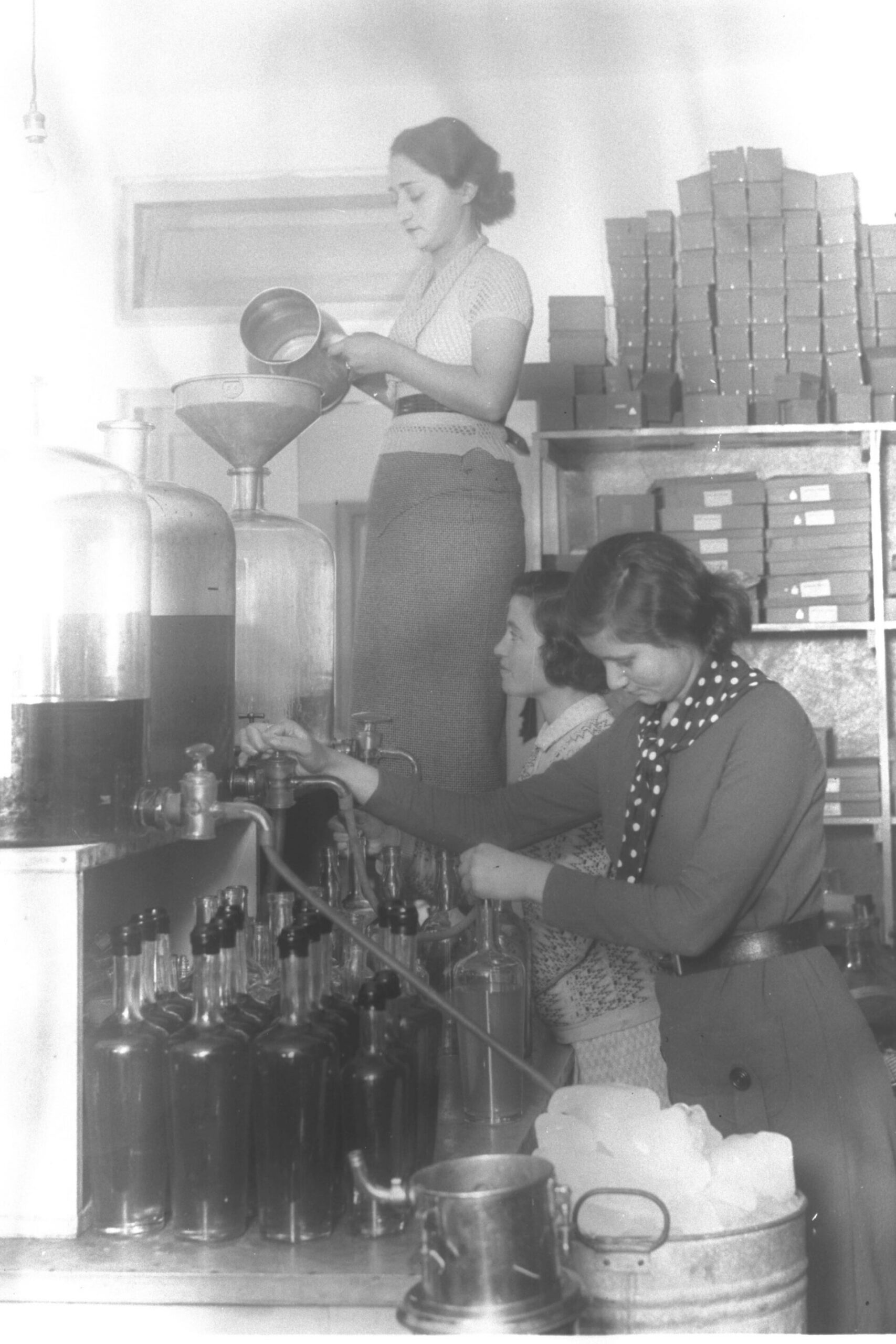
Historic perfume bottling photograph, Israel Government Press Office, public domain. Illustrative only.
Where DHgate fits in this workflow
DHgate can be considered as a discovery channel for beauty tools, cosmetic bags, organizers, printed boxes and other non-formula components. The marketplace listing is only a lead: independently identify the business that will manufacture or supply the specified item and check the documents relevant to that item and destination.
For formula development, testing, notification support or controlled pilot production, use a specialist cosmetic lab capable of supplying the required records. For a neutral overview of DHgate’s marketplace model, see how DHgate works.
Match the selling platform to the brand model
Shopify for an owned brand experience
Shopify is the most flexible starting point when the brand needs its own domain, product education, bundles, subscriptions or customer journey. Shopify’s current private-label guide describes the model as selling third-party-manufactured products under the retailer’s brand and outlines research, supplier selection, customization, sampling, production and launch. Treat that guide as commerce context, not Canadian regulatory authority.
An owned store also means the brand must generate its own traffic and operate payments, fulfilment, customer service and returns. Model those costs before choosing it solely for design control.
Amazon for marketplace demand
Amazon may fit a standardized product with adequate margin, stable inventory and a team able to maintain current listing and category requirements. Verify the exact Canadian requirements before committing inventory. Do not manufacture a large batch based on an old approval checklist or a US-only help page.
Etsy only when the product qualifies
Etsy’s production-partner guidance allows a disclosed partner to produce items based on the seller’s original designs, subject to Etsy’s Creativity Standards. Etsy separately says reselling commercially available products that the seller did not make or design is not allowed in the Handmade category. A ready-made cosmetic with only a new label may therefore be a poor fit unless the seller’s design contribution and partnership satisfy the current rules.
Retail, salon and professional channels
A local salon or spa brand may get better evidence from controlled in-person sales and repeat clients before expanding online. The selling platform decision can wait until the product, label, complaint process and replenishment economics are stable.
Three practical platform stacks
| Brand situation | Sourcing route | Selling route | Main reason |
|---|---|---|---|
| Canadian salon launching a small skincare line | Canadian specialist lab with a documented formula and pilot batch | In-salon sales plus an owned store | Easier collaboration and controlled initial demand |
| Creator-led colour cosmetics brand | Verified contract manufacturer with custom shade and packaging controls | Owned store first; selected social or marketplace channel later | Brand control and staged proof of demand |
| Accessories-led beauty shop | Marketplace or manufacturer for non-formula tools and packaging | Marketplace or owned store based on margin | Lower regulatory complexity than creams or colour formulas |
Do not choose the full stack at once. First validate one formula or accessory, one manufacturer and one sales channel. Record the delivered cost, usable-unit rate, complaint rate, replenishment lead time and document gaps. Expand only after those observations replace assumptions.
For additional DHgate platform context, use Compare online marketplaces and shopping platforms, and Compare DHgate with AliExpress, Alibaba and Temu.
The best platform combination is the one that preserves evidence from formula to customer: an identifiable manufacturer, controlled batch and label data, a selling channel whose rules fit the product, and enough margin to manage testing, fulfilment and problems. Platform reach matters only after the product can legally and reliably be sold in Canada.