

DHgate is a China-based cross-border marketplace that Canadian buyers can use to order directly from overseas sellers, but it only works smoothly if you understand who handles each step of the journey—platform, seller, carrier, and customs. This guide walks through the practical flow from creating an account and placing an order to paying, shipping into Canada, customs, tracking, and buyer protection, so you can decide whether DHgate’s processes and timelines fit your expectations before you commit to a purchase.
How DHgate orders work for buyers in Canada
Basic DHgate buyer journey illustrated as a series of steps, from account setup through order placement and confirmation.
DHgate is a China-based cross-border marketplace, not a Canada-only online store, so the order flow for Canadian buyers follows a global pattern. You start by creating a DHgate account, adding your Canadian shipping address, and signing in. From there you browse or search listings, open individual product pages to read the description, and review seller ratings, feedback, and order history before deciding whether to buy.
Once you’re comfortable with a seller, you add items to your cart and move to checkout. DHgate provides the interface that shows prices, totals, and the address you’ve chosen, and it processes your payment and creates the order record. If you buy from more than one seller in a single session, DHgate treats these as separate orders with their own shipment details and timelines, even if you paid in one combined checkout.
I care most about knowing who is responsible at each step. DHgate’s role is to run the marketplace: it hosts listings, collects payment, displays order status, and offers basic buyer protection tools. Individual sellers control the content of their listings, actual inventory, processing or handling times, and which shipping options they offer to Canada. Carriers handle the physical delivery. Because DHgate operates from China, you can’t assume local stock, domestic delivery speeds, or uniform policies like you might on a Canadian marketplace; treating DHgate as a viable option means accepting this division of responsibilities up front and checking each seller’s details carefully before you place an order.
Paying for DHgate orders from Canada
For Canadian buyers, DHgate generally supports familiar payment methods such as major credit and debit cards and, at times, certain digital wallets, but the exact options can change by region and over time. You only see the methods available to you at the checkout screen, so it’s important to check what’s currently supported for your account rather than assuming a specific option will be there.
Prices on DHgate may appear in US dollars or another currency. Your bank or card issuer usually performs the actual currency conversion when the charge is processed, and may add foreign transaction or conversion fees on top of the amount you see on‑screen. DHgate itself processes the payment, typically holds the funds during the order protection period, and releases money to the seller when the order is confirmed, but it doesn’t control your bank’s exchange rate, fee structure, or any extra charges your financial institution decides to apply.
If cost and predictability matter, it’s sensible to read any DHgate checkout notes about supported payment methods for Canada and, if you’re using a card, to ask your issuer whether foreign transaction fees apply. I would only be comfortable paying through DHgate if I’ve checked these cross-border conditions in advance; if someone wants strictly CAD-native, fee-free, local payment options, they may find domestic Canadian marketplaces more aligned with that preference, while DHgate can still be acceptable for buyers who are willing to work within international payment rules.
Shipping DHgate orders to Canada
For most DHgate orders shipped to Canada, the parcels originate from overseas—often from China—and move through international postal networks, express couriers, or other third‑party logistics providers chosen by the individual seller. You don’t select a DHgate‑run delivery service; instead, each listing offers one or more carrier options such as economy post, registered airmail, or express services, and the seller is the one who configures which of these are available for Canadian addresses.
On the product page, sellers set their own handling time and shipping methods, and DHgate uses that information to display an estimated delivery window. The platform hosts the order, shows the shipping status, and applies some time limits through its buyer protection rules, but it does not operate its own fleet or control how quickly a carrier moves the parcel once it has been handed over.
It helps to separate three stages: preparation, transit, and platform oversight. Preparation and dispatch time are seller‑controlled—they need to pick, pack, and hand your order to the carrier. Transit time is controlled by the postal service or courier, and can stretch as the parcel passes export processing, international hubs, and Canadian import facilities. DHgate’s role is mainly to show the latest status the seller or carrier reports and to define when you can open a dispute if the parcel appears late or missing.
Economy or low‑cost shipping methods to Canada are typically slower than the domestic services many buyers are used to; multi‑week delivery windows are common, and delays around busy seasons or customs processing can extend that further. If you need a more predictable arrival date, it’s better to look for premium or express services where they are offered, understanding that these usually cost more.
Before placing an order, pay close attention to the shipping method names, the estimated delivery range shown on DHgate, and any buyer reviews that mention how long delivery actually took for Canadian addresses. I would only treat DHgate as a viable option for a time‑sensitive purchase if I understood exactly which parts of the timeline the seller controls, which belong to the carrier, and what DHgate can and cannot do if those logistics break down, especially if I’m used to the faster, highly predictable shipping offered by domestic marketplaces.
Tracking shipments from DHgate to Canada
Once a DHgate seller ships your order, they normally upload a tracking number within their stated handling time, and you can see it in the order details page in your DHgate account. In many cases you can click through from DHgate to the carrier’s own tracking site, but both views rely on the same underlying carrier information.
Tracking events don’t always appear immediately. For parcels heading from overseas to Canada, the first scans may only show after the package passes origin facilities or international hubs, so it’s common to see a gap of several days between “dispatched” and the next detailed update. As the shipment moves through export processing, air transport, and Canadian import and local delivery networks, the frequency and clarity of scans depend on the specific postal service or courier and the service level chosen.
Many economy or unregistered methods offer only limited visibility—sometimes just a few high‑level milestones such as “accepted,” “in transit,” and “delivered,” rather than a full route history. DHgate and the seller do not control how often these events are recorded or how precise they are; they can only pass on what the carrier’s system reports.
If parcel visibility matters to you, choose a shipping option that is explicitly described as trackable or registered, and expect that better tracking usually comes with higher shipping costs. I would personally favour paying a bit more for a well‑tracked service if I were ordering something important from DHgate to Canada; if highly predictable, scan‑by‑scan tracking is absolutely essential, then a domestic marketplace with local carriers may align more closely with that preference than a cross‑border platform where logistics and tracking depend so heavily on third‑party services.
Customs, duties, and taxes on DHgate orders into Canada
DHgate buyer protection and disputes for Canadian shoppers
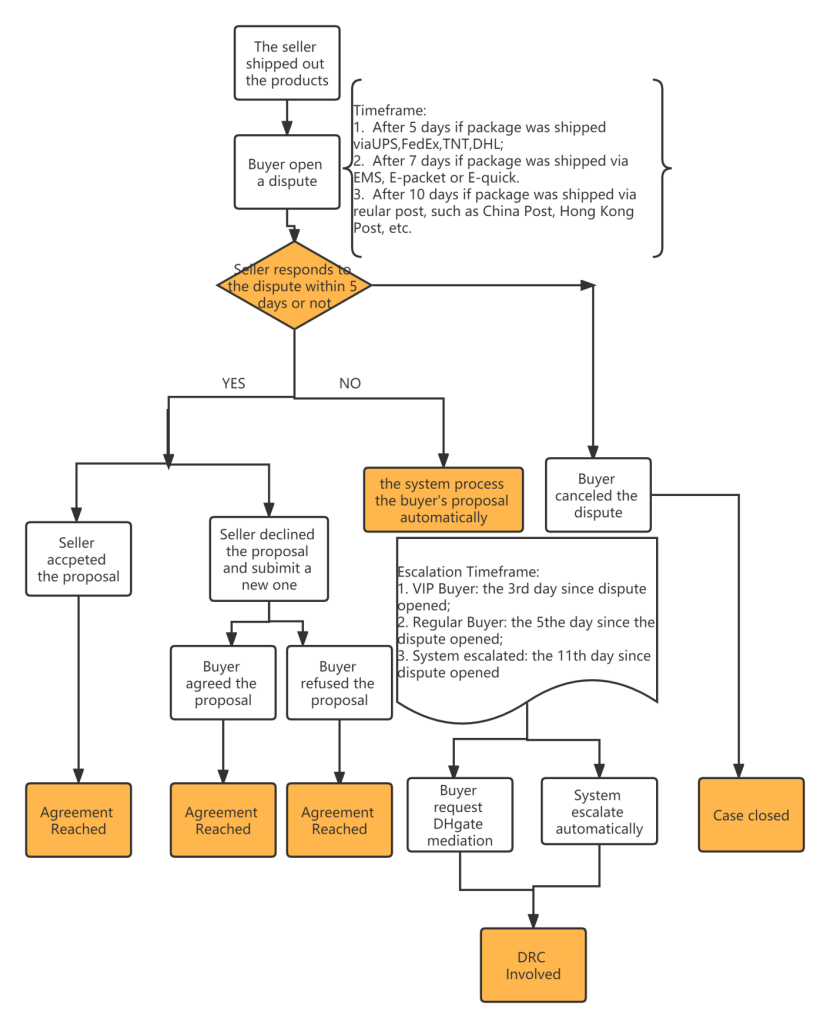
For Canadian buyers, DHgate’s buyer protection revolves around an order protection period and a structured dispute process for problems such as items not received or not as described. During this protection window you can ask for help if something goes wrong with the order.
The usual sequence is to message the seller through DHgate first, describe the issue clearly, and try to reach an agreement on solutions such as reshipment or a refund. If the problem is not resolved and the protection period is still active, you then open a formal dispute from the order page so DHgate can review the case.
When a dispute is opened, DHgate may ask you for evidence, including photos or videos of the item, tracking information showing non‑delivery or delay, and the message history between you and the seller. Possible outcomes range from full refunds to partial refunds or other arrangements, depending on the evidence, the timing, and the platform’s case‑by‑case judgment; nothing is guaranteed in every scenario.
Because international shipping to Canada can be slow, it is especially important to watch the order timeline, track the parcel’s progress, and raise unresolved issues before the protection period expires. DHgate can be workable for Canadian buyers who understand these rules and actively use the messaging and dispute tools; if you prefer effortless, no‑questions‑asked returns and immediate decisions, domestic marketplaces with local return desks and simpler policies may align more closely with that preference.
Handling common after‑sales issues from Canada
For Canadian DHgate buyers, most after‑sales issues fall into a few patterns: shipments that run past the estimated delivery window, tracking that seems stuck or stops updating, parcels that arrive with visible damage, and products that are missing parts or don’t match the listing description.
Because DHgate is a cross‑border marketplace, these problems are handled through the platform—tracking checks, messages with the seller, and disputes—rather than a local return counter. You compare the order’s estimated delivery date with the latest tracking events, contact the seller through DHgate’s messaging to describe what’s wrong, and, if the issue is not resolved in time, use the dispute tools within the order protection period.
Outcomes in these situations depend heavily on how responsive the seller is, what the carrier’s tracking shows, and how clear your evidence is. Detailed photos of damage, clear pictures of missing components, screenshots of tracking showing a long delay or non‑delivery, and message records all strengthen your case, but DHgate’s final decision is still made case by case, which means results can be less predictable than a simple local return.
- Check the order details and confirm the estimated delivery window and current tracking status to see whether the parcel is still moving toward Canada or appears significantly delayed.
- If the shipment looks late or tracking is unclear, message the seller through DHgate with a concise explanation of the problem and any relevant tracking screenshots, asking for an update or solution.
- When an item arrives damaged or incorrect, immediately take clear photos of the product, packaging, and labels, and share them with the seller so they can see exactly what went wrong.
- If the seller does not resolve the issue within a reasonable time and before the order protection period ends, open a dispute from the order page, attaching photos, tracking details, and key parts of your message history as evidence.
- Once the dispute is open, monitor the case, respond promptly to any questions from DHgate, and keep an eye on deadlines so the dispute stays active until a resolution is reached.
- Use this structured response to improve your chances of a fair outcome, but remember it doesn’t guarantee results; if you prioritize instant, in‑person returns and simple policies above all else, domestic marketplaces may fit that preference better than DHgate’s cross‑border model.
Pre‑purchase checklist for Canadian DHgate buyers
- Review the seller’s ratings, number of completed orders, and recent feedback, paying particular attention to comments about item quality and shipping reliability to judge how consistently they deliver as promised.
- Confirm that the listing explicitly ships to Canada and read the available shipping options, noting which methods include tracking and what delivery windows are quoted for your address.
- Think through potential customs, duty, and tax exposure based on the item’s value and type, and decide whether you are comfortable with possible extra costs at the border on top of the DHgate price and shipping.
- Check the seller’s stated return or refund terms and any notes on how problems are handled, keeping in mind that sending items back across borders can be slower, costlier, and more complex than using a local Canadian return desk.
- Note the length of the order protection period and make sure you understand how to contact the seller and open a dispute from the order page if the parcel is late, missing, or not as described.
- I would personally treat this checklist as a baseline before paying for a DHgate order from Canada and lean toward sellers with clear information and realistic delivery estimates; if your priority is fast shipping and easy, local returns, you may reasonably give more weight to domestic marketplace options instead.
How DHgate differs from Canadian online marketplaces
| Aspect | DHgate cross-border marketplace | Domestic Canadian marketplaces |
|---|---|---|
| Shipping time and predictability | International shipping from overseas sellers with methods chosen per listing; delivery windows are often longer and can vary widely, with extra delays possible at customs. | Inventory is typically already in Canada or shipped domestically, so delivery times are usually shorter and more predictable with standardized shipping options. |
| Customs and taxes | Orders are treated as imports into Canada and can be assessed customs duties, GST/HST, and brokerage fees at the border, on top of the item price and shipping shown on DHgate. | Most orders are domestic purchases that mainly involve GST/HST and any provincial taxes charged at checkout, with no separate customs clearance for typical shipments. |
| Returns and dispute handling | Problems are handled through on-platform messaging with the seller and DHgate’s dispute process; returning items across borders can be slower, costlier, and more complex. | Issues are usually managed under local return policies with in-country customer service, and returning items is often more straightforward, sometimes with prepaid labels or simple drop-off options. |
| Overall fit for Canadian buyers | May suit buyers who are comfortable with longer, less predictable logistics and more involved after-sales steps in exchange for access to overseas goods and pricing. | Often better aligned with buyers who prioritize fast, predictable shipping, clear tax treatment, and simple local returns, even if that means fewer overseas options. |
DHgate Canada FAQ: warehouses, customs, returns, and cancellations
Does DHgate have warehouses in Canada or nearby countries, and how does that affect shipping and customs for Canadian buyers?
DHgate itself is a marketplace rather than a single warehouse operator, so most orders to Canada are shipped from overseas locations chosen by individual sellers, often in China. Some sellers may list items as shipping from non‑China or “local” warehouses (for example, in North America or Europe), which can shorten transit times and may simplify customs handling if the goods are already inside Canada. However, these local‑warehouse options are not guaranteed for every product and can change over time. Always check the shipping section of the specific listing to see the origin country, available methods, and estimated delivery window, and confirm whether customs charges could still apply based on where the parcel is actually shipped from.
What typically happens if Canadian customs returns or refuses a DHgate parcel?
If a DHgate parcel to Canada is refused entry or returned by customs, the next steps depend on the shipping terms, how the carrier handles the return, and what the seller’s policy says. In some cases the package is sent back to the seller, who can then decide whether to reship or arrange a refund; in others the parcel may be delayed, held, or even abandoned if fees are not paid. DHgate’s buyer protection focuses on whether you ultimately receive the goods as described within the protection period. If customs issues prevent delivery, you usually need to gather evidence (such as carrier tracking showing a customs return or refusal), contact the seller through DHgate to request a solution, and open a dispute within the platform’s timelines if you can’t reach an agreement. Outcomes—such as full or partial refunds—are decided case by case based on the available proof and the platform’s rules.
Can Canadian buyers cancel DHgate orders after payment, and how are refunds handled?
On DHgate, cancellations after payment are usually easiest before the seller ships the order. If you change your mind or spot a mistake, you should immediately contact the seller through DHgate and request cancellation; if the seller has not dispatched the goods yet, they may agree and the platform can process a refund back through the original payment method. Once the seller marks the order as shipped and a tracking number is provided, cancellation becomes much harder, and you may need to wait for the parcel and then resolve any issues through the dispute process instead of a simple cancellation. Refunds are generally processed through DHgate’s system and can take time to appear on your card or account, depending on your bank. Because exact rules, time limits, and options can change, always review DHgate’s current help center guidance on order cancellation and the specific seller’s terms before you place or try to cancel an order.
What should Canadian buyers keep in mind about changing DHgate policies, warehouse locations, and cancellation options?
DHgate’s platform rules, seller tools, and logistics arrangements can evolve, and individual sellers may update their warehouse locations, shipping methods, and cancellation policies without notice. Conditions for Canadian buyers—such as which payment methods are offered, whether local or regional warehouses are used, and how quickly orders can be cancelled before shipment—are therefore subject to change. To avoid surprises, check the latest information in DHgate’s help center, read the shipping and service terms on each product and seller page, and confirm key details like origin country, estimated delivery time, and order‑change options right before you commit to payment.