
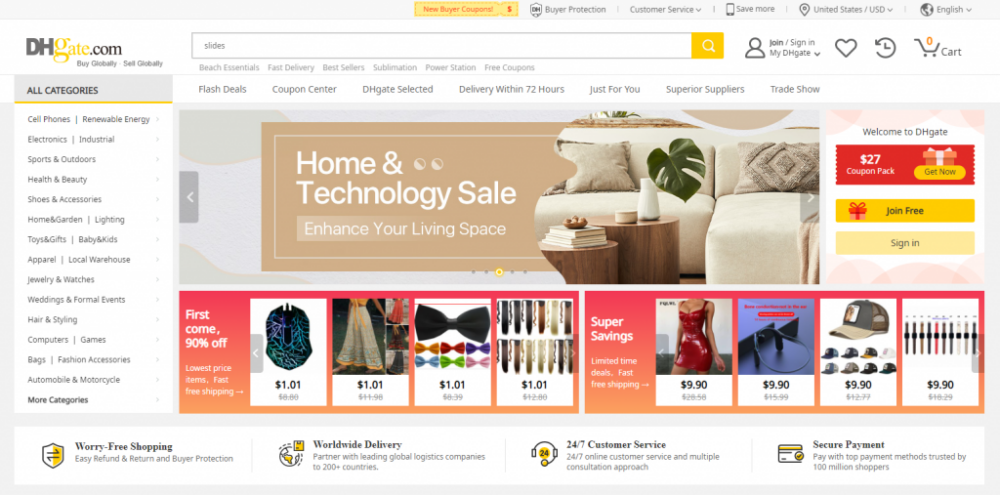
DHgate import duties are not a universal fee charged at checkout. Customs authorities and carriers may assess duties, taxes or handling charges according to the destination, product classification, declared value, shipping route and current local rules.
Quick answer: treat the listing price and shipping price as only part of the landed cost. Before paying, check the shipping origin and method, ask the seller what documentation accompanies the order, and confirm current rules with the destination customs authority or carrier.
Do you pay import duties to DHgate, or separately when the order enters your country?
DHgate checkout generally covers the item price and shipping. Import duties and customs taxes are usually assessed separately by the receiving country or the carrier, not paid as a universal import duty to DHgate at checkout.
For U.S. buyers and small-business readers, the practical takeaway is simple: do not assume the checkout total is the full landed cost. If customs applies, the charge is typically tied to the destination country’s rules and the shipment details, not just the DHgate listing price.
What does DHgate checkout usually cover, and what does it not?
DHgate’s own guidance says the item cost and delivery cost do not include customs taxes. That means the amount you pay on DHgate is not the same thing as the amount customs may later assess.
The documented factors that can affect customs charges include:
- the country the order ships from
- the product category
- the item’s value
- the package weight
- the shipping method
- the destination country’s customs rules
DHgate also notes that shipping carriers often collect import taxes, tariffs, and other customs-related fees upon delivery. So if a charge appears later, it may come from the carrier or customs process rather than from DHgate checkout itself.
There is one important exception in DHgate’s guidance: if a seller ships from a warehouse in your country, you may not be asked to pay additional customs duties and taxes. That is not something to assume automatically for every listing, so it still needs to be checked on the current product or shipping page.
Which order details should you check before you estimate customs exposure?
To estimate customs exposure without guessing, review the current DHgate listing and order details for the information customs usually depends on.
Check these fields first:
- shipping origin or warehouse location
- declared value on the listing or invoice details
- product category or description
- shipping method and carrier
- any customs, tax, or import notes from the seller
- whether the seller says the order ships from a local warehouse
If the listing or seller message does not clearly show these details, ask before you buy. DHgate’s own guidance recommends checking with the vendor or your local customs office when you need clarity on import taxes and fees.
For a small-business buyer, the declared value and product description matter especially because customs authorities use shipment documentation to assess duties and taxes. If the value or description is unclear, your estimate will be less reliable.
How do you estimate import duties without guessing a fixed fee?
Use a rule-based estimate, not a fixed number.
Start with the destination country’s customs rules. Then narrow the estimate using the shipment details DHgate and customs authorities rely on:
-
Destination country rules
Customs treatment varies by country. Check your local customs office or postal authority for the current rules that apply to your shipment. -
Product category or HS code
Duties are often tied to how the item is classified. If you know the HS code or product category, you can get a more accurate customs reference. -
Declared value
Customs commonly uses the declared value shown on the invoice or shipping documents. If the value is understated or unclear, the estimate may be wrong and the shipment may be delayed for review. -
Shipping method and carrier
Some carriers collect customs-related charges on delivery. Others may route the shipment differently. Check the shipping method shown on the DHgate order or shipping calculator. -
Warehouse origin
If the seller ships from a warehouse in your country, DHgate says additional customs duties and taxes may not be charged. Confirm that this applies to the exact listing you are viewing.
If you still need an exact amount, DHgate’s own guidance points you to the seller, the shipping calculator, the carrier, or your local customs office. That is the right place to confirm a precise charge because customs fees are not fixed across all orders.
What should you do on DHgate before you place the order?
Use this pre-order checklist on DHgate:
- Open the product listing and confirm the shipping origin.
- Review the shipping method and carrier shown for your destination.
- Look for any customs, tax, or import notes in the listing description.
- Ask the seller whether there are additional import taxes, levies, or customs-related fees.
- Check whether the seller ships from a warehouse in your country.
- Compare the item price, shipping cost, and any customs exposure separately.
- If the value or product category is unclear, contact your local customs office or postal authority before ordering.
If you are buying for a small business, keep a screenshot or copy of the listing details, shipping method, and seller messages. That gives you a cleaner record if customs later asks for documentation or if you need to reconcile landed cost.
The safest operational habit is to treat DHgate checkout as the purchase total for the item and shipping, then verify customs separately before you commit. That keeps your estimate grounded in the actual order details instead of a guessed fee.
Quick answer
DHgate checkout usually covers the item price and shipping, while import duties and customs taxes are typically assessed separately by the destination country or carrier. To estimate them, check the shipping origin, declared value, product category, carrier, and your local customs rules before you buy.
FAQ
Does DHgate collect import duties at checkout?
Usually no. DHgate’s guidance says item and delivery costs do not include customs taxes.
Who charges the customs fee if one applies?
It is usually assessed by the destination country or collected by the carrier during delivery.
Can I estimate duties from the product price alone?
Not reliably. You also need the shipping origin, product category, declared value, and destination rules.
What if the seller ships from a warehouse in my country?
DHgate says additional customs duties and taxes may not be charged in that case, but you should confirm the exact listing.
Where should I confirm an exact amount?
Check with the seller, the shipping calculator, the carrier, or your local customs office.
Next step
Before placing an order, compare the listing price, shipping cost, and possible customs exposure separately, then save the listing details and seller messages for your records.
Sources and further reading
- DHgate blog: https://www.dhgate.com/blog/?p=15013
- DHgate blog: https://www.dhgate.com/blog/?p=12586
- DHgate blog: https://www.dhgate.com/blog/?p=15014
- DHgate blog: https://www.dhgate.com/blog/?p=6420
- DHgate blog: https://www.dhgate.com/blog/?p=14660
- U.S. Customs and Border Protection, Basic Importing and Exporting: https://www.cbp.gov/trade/basic-import-export
- FedEx, Packing guidance: https://www.fedex.com/en-us/shipping/packing/how-to-pack.html
Notes: The DHgate blog sources above were used as first-party grounding for customs, duties, and shipping-related guidance. They are article-level references, not live order-specific quotes, and should be treated as general guidance rather than a guarantee for any individual shipment.
Related reading
Important Limits on Any Duty Estimate
This guide provides general shopping information, not customs, tax or legal advice. Rates, thresholds, product classifications and carrier charges change and can differ by destination. Do not rely on a seller’s informal estimate or a generic online calculator as a guarantee. For a precise current answer, use the destination customs authority’s guidance and the carrier’s published import process for the exact product and shipment.