
For beading wire in Canada, start by looking across four channel types: local craft stores, specialist bead retailers, general marketplaces, and cross-border marketplaces. Treat these as places to investigate—not as confirmation that a particular seller has the wire you need. Before buying, make sure you have the right kind of wire for your project, compare the package or listing details with your beads and findings, and check the final delivered cost for your actual location. If durability matters, evaluate a sample in your own design rather than relying on a channel name or a simple at-home check as proof of performance.
First, choose the right kind of wire
“Beading wire” and “craft wire” are not interchangeable terms. The distinction matters because each is designed for a different role in a project.
Beading wire is a flexible stringing material made from multiple fine strands. Some types have a coating. It is used as the line that passes through beads, rather than as wire intended to hold a shaped form. For a basic explanation of beading wire, see Beadage’s glossary entry.
Craft wire is generally a single strand of soft metal, sometimes plated or coloured, used for shaping, wrapping, and forming decorative or structural elements. It does not serve the same purpose as a flexible multi-strand stringing line. Beads.co’s discussion of wire gauge in beading and craft wire explains why the terms and gauges need to be considered in context.
A useful first question is: Will the wire mainly pass through beads, or will I bend it into a shape? For a necklace or bracelet strung along a flexible line, look for beading wire. For a wrapped pendant, formed loop, or decorative frame, look for craft wire. If a listing says only “jewelry wire,” do not assume which kind it means; read the description and check the product photographs and package details.
Read diameter and strand count as project specifications
For beading wire, diameter and strand count are among the details to compare. Diameter describes how wide the wire is; strand count describes how many fine strands make up the cable. Those details can affect how the wire behaves, so they should be considered alongside the project and its components. Beading Nest’s guide to choosing beading wire by diameter and strand count offers further context.
Avoid choosing a size based on a vague label such as “heavy duty” or “strong.” Those words do not tell you whether the wire will pass through your beads or work with your findings. Nor does a higher strand count, by itself, establish how a particular finished piece will perform.
Before ordering, compare the stated diameter with the openings in your beads and the crimp tubes or other finishing components you plan to use. Check that the construction and finish match the intended use. When a listing omits a measurement or uses unclear terminology, do not fill in the gap by inference: ask the seller for the missing specification or choose a listing that states it plainly.
Where to look: four channel types
The categories below are starting points for a search, not a directory of confirmed Canadian stockists. A store or marketplace may carry different items over time, and a product category does not establish that any particular listing is suitable. Verify the product itself before purchasing.
A checked Canadian catalog example
Canada Beading Supply’s online catalog lists both stringing wire and Artistic Wire. On November 13, 2026, its product page for Beadalon 7-strand black wire, .015 in / 30 ft (item 5206012) displayed CA$6.75 and “Available: 1.” A separate listing for Artistic Wire, 18 gauge, 10 yd, antique brass (item 65615618240) displayed CA$15.05 and “Available: 3.” These are dated page snapshots from one seller, not guaranteed current stock or a like-for-like performance comparison. Confirm the item, quantity, and current terms with the retailer before buying.
Local craft stores
Local craft stores are one channel to check if you want to inspect packaging in person or would rather ask a staff member about a product label. Call or check the store’s current listing before travelling; this guide does not verify any specific location’s stock.
When comparing an item in-store, look for the wire’s stated type, diameter, strand count where applicable, and finish. If the label does not identify whether the material is multi-strand beading wire or single-strand craft wire, do not infer it from the display location alone.
Specialist bead retailers
Specialist bead retailers are another channel to investigate when you need to compare beading materials with beads, crimp tubes, or other findings. Review the product details and, if the information is incomplete, ask whether the seller can clarify the construction and dimensions.
A specialist label is not a guarantee that a specific item will suit your design. Use the same checks you would use elsewhere: confirm the product type, compare the dimensions with your components, and establish what you are actually ordering before you pay.
General marketplaces
General marketplaces bring together listings from sellers that may describe products differently. Search terms can help you find candidates, but the title alone is not enough to make a choice. Open the individual listing and check its specifications, photographs, quantity, and stated finish. If you cannot tell what the wire is made for, treat that as an information gap rather than filling it in yourself.
For any listing, distinguish between details about the platform and details about the individual product. A marketplace page does not independently establish the material or performance of every item offered through it.
Cross-border marketplaces
Cross-border marketplaces such as AliExpress and DHgate may appear in a search, but each is a multi-seller platform where product details depend on the individual listing. Verify the specific wire type, measurements, quantity, finish, and seller-provided information rather than treating platform membership as proof of a product’s specifications or suitability. For general context about marketplace types, see this overview of online marketplaces and shopping platforms.
For Canadian buyers, review the checkout information for your actual address. Confirm the displayed shipping terms and whether any import-related charges may apply before placing an order. Do not rely on a general estimate for a different province, territory, seller, or order.

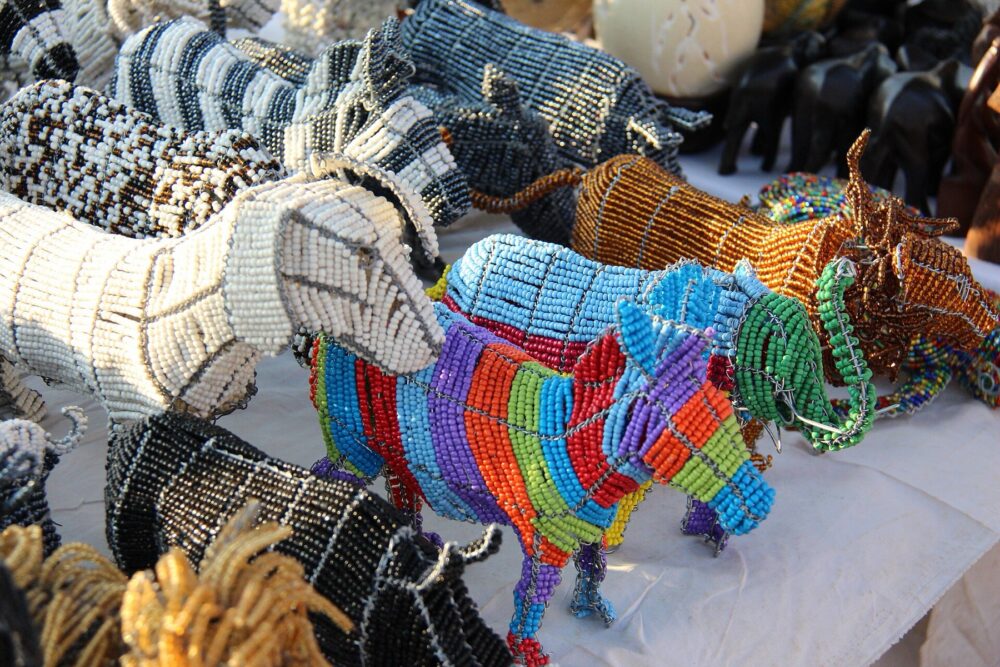
Image: “Beadwork Wire Art and Crafts (23)” by Aurobindo Ogra, via Wikimedia Commons source page, licensed under CC BY-SA 3.0. The image has been resized for display; it is illustrative and does not identify a retailer or confirm product availability.
Compare channels by the questions they let you answer
Use the table to organize your search. It does not rank channels or make claims about current stock, pricing, or product quality.
| Channel type | Questions to answer before buying |
|---|---|
| Local craft store | Can you confirm the specific item is available at your location? Does its package state the wire type and relevant dimensions? |
| Specialist bead retailer | Are the diameter, strand count, and finish stated? Can you compare the wire with the beads and finishing components you plan to use? |
| General marketplace | Does the individual listing clearly identify the product, quantity, and specifications? Can you resolve any unclear or conflicting details? |
| Cross-border marketplace | Are the listing details sufficiently clear? Does checkout show the terms and total for your actual location, including any applicable shipping or import costs? |
A practical buying sequence
A consistent process makes it easier to compare different sellers without assuming one channel is automatically more suitable than another.
- Name the job. Decide whether the wire is a flexible line for stringing beads or a single strand to bend, wrap, or shape. Search using that product type.
- Write down the components. Note the bead-hole sizes and the dimensions of the crimp tubes or other finishing parts you intend to use. Use those measurements when reviewing wire listings.
- Compare stated specifications. For beading wire, record the listed diameter, strand count, and finish. For craft wire, check the stated material, size, and finish where provided. Do not treat an omitted detail as a known one.
- Resolve uncertainty before ordering. If the product type or a required dimension is unclear, ask for clarification or select a listing with more complete information. Avoid relying on a product title or a promotional descriptor alone.
- Review the actual checkout. For an order shipped to Canada, use the checkout page for your own address to review the displayed total and delivery terms. If the order crosses a border, check whether additional import costs may apply; do not assume a particular amount.
- Try a sample in the intended design. When possible, test a small quantity before committing to more. Use the beads and finishing components you expect to use in the final piece.
What a sample check can—and cannot—tell you
A small test can answer practical fit questions: Does the wire pass through the beads? Can it be finished using the components and method in your design? Does the result suit the way you plan to wear, handle, or display the piece? Keep notes about the exact listing, dimensions, finish, and components used so that you can repeat or revise the test.
These are informal project checks, not certification, laboratory testing, or a verified measure of load capacity or long-term performance. A sample that fits together successfully does not establish that all pieces from the same listing or a later order will behave identically. For work where failure would have significant consequences, do not treat an informal check as a substitute for suitable professional testing or other evidence appropriate to that use.
The most dependable starting point is not a particular store name; it is a clear match between the wire type, stated specifications, and the components in your design. Compare listings on those terms, confirm the actual Canadian checkout details, and use a sample when you need to assess fit before buying more.