
You’re really looking at two very different products that happen to share the word “cart.” For a small retailer, a secure shopping cart usually means a standard grocery-style cart that’s harder to steal and that protects your merchandise and customers. For electronics work, an ESD-safe cart is a technical trolley built to control electrostatic discharge so sensitive components don’t get zapped. Your best choice depends on whether your main risk is shrink and cart loss at the store perimeter or damaged boards in an electronics handling area.
If you’re running a neighborhood convenience store, supermarket, or discount shop, you care most about theft, cart loss, and child safety. You’ll be choosing between basic carts and secure systems that lock wheels near the parking-lot boundary. If you’re assembling, repairing, or packing electronics—even in a tiny EPA (Electrostatic Protected Area) carved out of your warehouse—you’ll need carts with conductive surfaces, grounded casters, and accessories that keep your workflow ESD-safe.
What “Secure” and ESD-Safe Shopping Carts Actually Are
The phrase “secure shopping cart” gets confusing because it’s used both for online checkout software and physical store carts. Here we’re talking about physical carts: metal or plastic frames on wheels used to move goods and, often, kids.
In retail environments, secure carts focus on loss prevention and safety:
- Anti-theft features to reduce carts being taken off-site or loaded with unpaid goods.
- Systems that work with a perimeter—wheels that lock when a cart crosses an invisible boundary or leaves a defined area.
- Designs and add-ons that reduce accidents, especially with children riding in the seat.
Loss-prevention vendors describe systems where the cart’s wheels lock if it moves past a store’s boundary line, helping keep carts and merchandise on your property and out of the surrounding streets and parking lots. Providers like Rocateq show typical implementations: buried wire loops or transmitters define a perimeter, and the cart’s wheel unit locks when it crosses that line.
ESD-safe carts are completely different. They’re used in Electrostatic Protected Areas (EPAs)—electronics production lines, repair benches, test labs, and packing zones. Sources like CH-ESD’s cart guide explain that these trolleys are built from conductive or static-dissipative materials with a continuous path to ground, often through special casters or drag chains. The goal is to keep the cart, the shelves, and the parts you place on it at controlled potential, so charge doesn’t build up and discharge into a board or device.
Who actually needs what?
- Small retailers and grocers: Secure retail carts and, where budget allows, a perimeter-locking system to reduce cart loss and unpaid merchandise leaving the store.
- Electronics workshops, repair shops, and ecommerce sellers handling boards, modules, or devices: ESD-safe carts so you can move work-in-progress, packed orders, or returned goods without violating your ESD control rules.
If your business never has customers pushing carts in a parking lot, the retail security systems are probably irrelevant. If you never touch sensitive electronics, ESD-safe carts are likely overkill.
Cart Types and Features: Theft Security vs ESD Protection
To make a practical decision, it helps to map specific cart types to specific risks.
Retail cart security and safety features
Common secure retail cart options include:
- Standard carts with wheel-lock units: These look like traditional wire carts but have a special wheel assembly. When a cart crosses the store’s defined perimeter, the wheel locks, making it difficult to push further. This targets both cart theft and shoppers rolling unpaid goods into the parking lot.
- Boundary-based cart security systems: Vendors such as Rocateq illustrate systems that use in-ground wires or transmitters to mark the store’s property line. The cart’s wheel electronics respond when they enter the signal zone.
- Local anti-theft options: Physical barriers, cart corrals, and staff monitoring complement technical locks. These aren’t “smart” features but may matter if you can’t invest in electronic systems yet.
On the customer-safety side, you have design and add-on decisions:
- Child seating and restraints: Research summarized by Nationwide Children’s Hospital notes that falls and tip-overs can injure kids when carts are misused. Carts with proper seating, restraint belts, and clear usage graphics help lower risk, especially if you encourage parents to buckle children and avoid standing or climbing.
- Cart stability: A wider wheelbase and lower center of gravity reduce the chance of tipping, especially with kids in the seat and heavy loads in the basket.
ESD-safe trolleys for electronics
Industrial ESD carts and trolleys have their own feature set:
- Conductive shelves and frames: Catalogs like RTWORK’s ESD trolleys show carts with metal or treated shelves designed to dissipate static. Some use modular aluminum or steel structures with ESD-safe shelf inserts.
- ESD casters and drag chains: Guidance on ESD shelving and trolleys stresses a continuous conductive path to ground. That often means casters with conductive tires and bearings or a drag chain that touches the floor. Both create an electrical route from the cart to the ESD floor or common ground.
- Grounding points: Many ESD carts include a dedicated grounding stud or snap so you can connect the cart to your EPA grounding network when stationary.
- Accessories for EPAs: ESD-safe bins, dividers, and mats that fit the cart shelves; hooks for ESD-safe bags and documentation; handles designed to work with ESD smocks and wrist straps.
Here’s a compact comparison to keep the two families straight:
| Cart type / feature | Secure retail cart | ESD-safe electronics cart |
|---|---|---|
| Primary risk addressed | Theft, cart loss, unpaid goods leaving perimeter | Electrostatic discharge damaging electronic components |
| Core mechanism | Wheel locks at boundary, physical corrals | Conductive materials, grounded casters/drag chains |
| Typical environment | Supermarkets, big-box, discount and convenience stores | EPAs, repair benches, electronics production and test areas |
| Key add-ons | Child seat belts, clear safety graphics | ESD bins, grounding snaps, EPA-compatible casters |
| Overkill scenarios | Online-only or mostly basket-based retail | Non-electronic goods; ordinary warehouse pick/pack operations |
If you find yourself attracted to ESD carts for general warehouse use, pause: if you don’t have ESD flooring, wrist straps, and procedures, simply buying a “special” cart doesn’t give you real static control.
How to Choose and Where to Source Secure or ESD-Safe Carts
By this point, you should know which risk category matters more. Now you need to match specs to your actual space and sourcing options.
Choosing secure retail carts
For a small US retailer:
- Shrink and cart-loss profile: If carts regularly disappear or people push them into the neighborhood, a perimeter-locking system may eventually pay for itself in saved cart replacement and reduced theft. If carts rarely leave the lot, basic carts plus corrals may be enough.
- Site layout: Systems that lock wheels when crossing a boundary work best when your property line is clear. Complex shared parking or multi-tenant strip centers make perimeter definition harder and might push you toward smaller, more manual solutions.
- Child safety priorities: If families are a big part of your traffic, favor carts with integrated child seats and restraints. Train staff to remind parents about safe use: no standing, no climbing, buckle when seated.
You’ll typically source these from:
- Regional grocery/retail equipment distributors.
- Loss-prevention vendors that offer cart-security packages.
- Used-equipment dealers, if you’re comfortable mixing cart types and doing your own safety checks.
Choosing ESD-safe carts for electronics work
For an electronics lab or ecommerce operation handling boards:
- ESD control plan first, carts second: Sources like CH-ESD frame carts as one piece of an EPA. If you don’t already have ESD flooring or mats, grounded workstations, and basic controls (like wrist straps), start there.
- Verify the conductive path: When shopping, look for clear documentation that shelves, frames, casters, and any drag chain are designed to maintain a continuous path to ground. Best-practice guides such as A1-ESD’s shelving/trolley explainer stress this as the core performance requirement.
- Workload and size: Decide whether you need narrow carts that fit between benches, half-height side-load carts for PCB trays, or tall shelving-style trolleys for boxed product or returns.
You’ll usually buy these through:
- Specialized ESD/industrial suppliers (online catalogs, technical sales reps).
- Broader material-handling vendors with ESD product lines.
- Cross-border marketplaces with industrial categories, if you’re comfortable with longer lead times and doing extra due diligence on specs.
Cross-border sourcing and a brief DHgate note
If you’re considering overseas suppliers to save money or access specific designs, treat carts as equipment, not impulse purchases:
- Ask sellers for technical datasheets showing materials (conductive vs insulating), caster type, and any grounding hardware on ESD carts.
- Confirm dimensions and weight ratings for secure retail carts so they fit your aisles and can handle typical loads.
- Use marketplaces with secure checkout pages (HTTPS) and stick to established payment methods.
DHgate is one of the large cross-border marketplaces where you may find store fixtures, carts, and industrial equipment from overseas manufacturers. If you go that route, treat each seller as its own business: review store history and buyer feedback, and pair any checkout with basic online-shopping hygiene. For background on how the marketplace itself works and what to look at before placing a business order, you can read What DHgate is and how the marketplace works and Find trusted sellers on DHgate.
Safety caveats for small operations
Two quick guardrails so the cart you buy doesn’t become a quiet liability:
- For retail carts: Design and add-ons reduce risk but don’t eliminate it. Clear signage, a simple staff script about child seating, and routine checks for broken parts or loose restraints matter as much as the cart spec.
- For ESD carts: Being labeled “ESD-safe” doesn’t guarantee regulatory compliance. Treat supplier claims as a starting point, then validate that the cart fits into your existing EPA controls—grounding checks, floor resistance, and whatever standards your quality team follows.
If you only move boxed consumer electronics and never handle open boards or components, a normal warehouse utility cart plus good packaging practices is often enough, and a full ESD trolley system may be more complexity than you need.
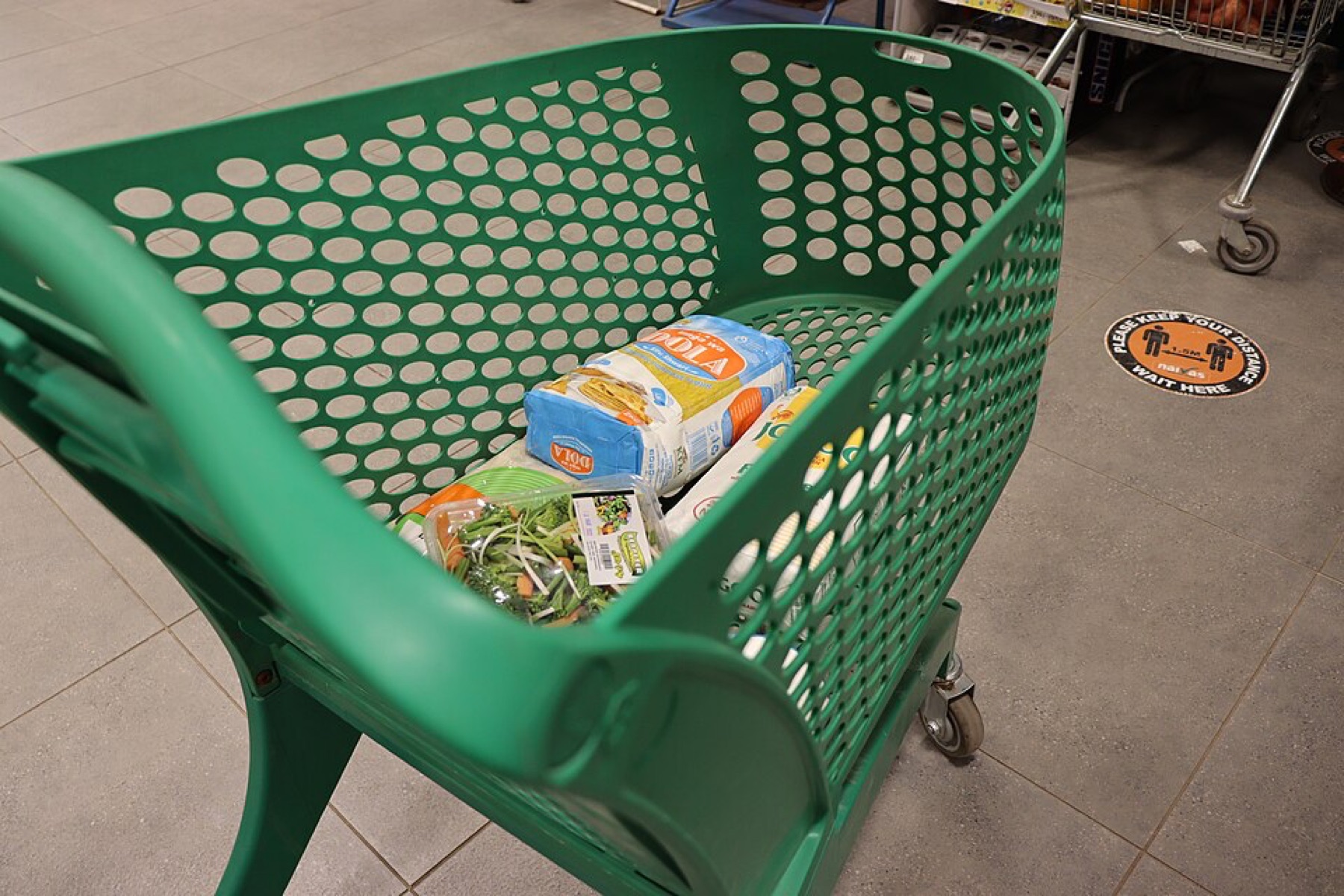
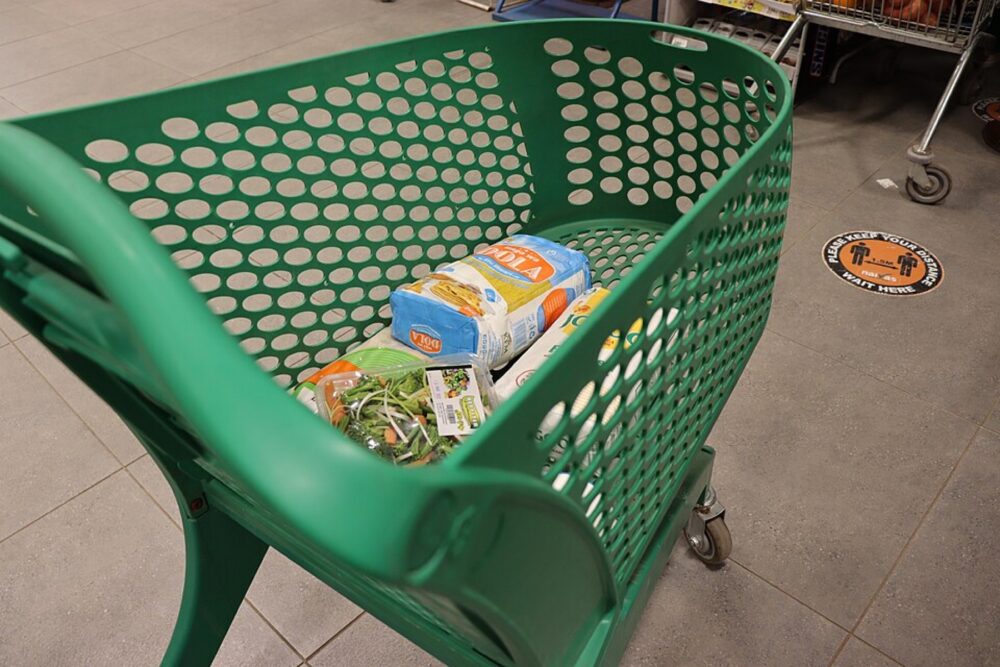
Photo: Safari Travel Plus, “A shopping cart at Naivas supermarket in Kenya,” dedicated to the public domain under CC0; Wikimedia Commons source page.
If your risks sit on both sides—shrink in a small store and static in a back-room repair bench—you’ll probably end up buying both: basic secure retail carts for customers, and a small, clearly marked ESD trolley that never leaves your controlled electronics area.