
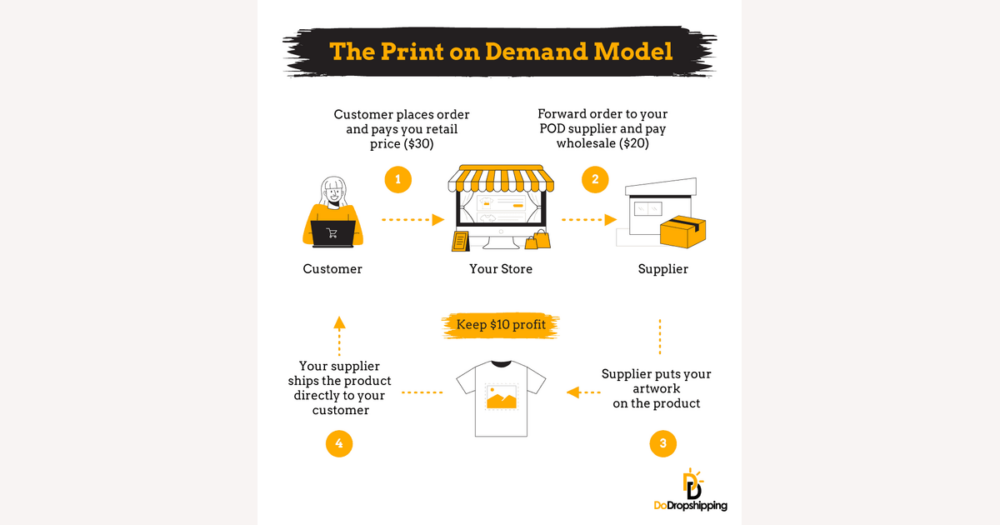
Print‑on‑demand can be profitable, but the real margins are usually more modest than the hype. Many sellers see product‑level gross margins in the 30–60% range, business‑wide gross margins closer to 20–30%, and net margins in the low‑ to mid‑teens once marketing and overhead are counted. This guide explains how those numbers are calculated and how DHgate pricing, shipping, and seller reliability influence whether your POD margins hold up in practice.
Typical profit margins in print‑on‑demand
On DHgate and across the print‑on‑demand (POD) world, profit margins are highly variable. They depend on your niche, product type, pricing power, and how tightly you control costs like shipping and platform fees, so any number you see is a range, not a guarantee.
At the product level, many POD guides talk about targeting around 40–45% gross margin on each item, but once you factor in realistic production, shipping, and platform costs, a lot of sellers end up closer to roughly 30–40% gross margin per product. After discounts, marketplace commissions, and occasional refunds, overall business‑wide gross margins often sit nearer 20–30%.
A few definitions make the calculation clear. Revenue is the total money you collect from customers for sales (for example, $30 for a printed T‑shirt). Cost of goods sold (COGS) in POD means all direct costs to deliver that item: blank product cost, printing/fulfillment, packaging, per‑order shipping, and platform and payment fees. Gross profit is simply revenue minus COGS. Gross margin percentage is gross profit divided by revenue, shown as a percentage.
Operating expenses are the ongoing costs that aren’t tied to a single item but still matter for POD: design work, advertising, apps and software, samples, and your own time or team costs. Net profit is what’s left after subtracting these operating expenses from your gross profit, and net profit margin is net profit divided by revenue.
In practice, many POD operators treat roughly 10–20% net margin as solid, with around 15%+ being a reasonable long‑term goal when pricing and operations are disciplined. Chasing headline‑high percentages is less important than building clear, predictable margins that still look acceptable after you include shipping, fees, promotion, and the risks of using cross‑border suppliers such as those on DHgate.
How to calculate POD profit margin step by step
| Line item | Amount (USD) | Role in margin calculation |
|---|---|---|
| Selling price (printed T‑shirt) | $30.00 | Total revenue collected for one order. |
| Blank T‑shirt from supplier | $8.00 | Direct product cost; part of COGS. |
| Printing/fulfillment service | $5.00 | Cost to print and pack the shirt; part of COGS. |
| Packaging materials | $1.00 | Mailers, labels, inserts; direct per‑order cost. |
| Shipping paid to carrier | $4.00 | Per‑order shipping you pay; often underestimated in POD. |
| Marketplace/platform commission | $3.00 | Percentage fee taken by the sales platform (e.g., 10% of $30). |
| Payment processing fees | $1.00 | Card or payment‑gateway fees (roughly 3–4% of revenue). |
| Estimated taxes per order | $1.00 | Representative per‑order share of sales or income tax obligations. |
| Refund/chargeback allowance | $1.00 | Average cost per order for occasional refunds, reships, or chargebacks. |
| Total direct costs (COGS + fees) | $24.00 | Sum of all direct product, fulfillment, shipping, platform, payment, tax, and refund costs. |
| Gross profit per shirt | $6.00 | Revenue minus total direct costs: $30.00 – $24.00. |
| Gross margin percentage | 20% | Gross profit divided by revenue: $6.00 ÷ $30.00. |
You can generalize the example with simple formulas. Gross profit = revenue – all direct costs (blank + printing + packaging + shipping + platform commission + payment fees + per‑order taxes + refund allowance). Gross margin % = gross profit ÷ revenue.
To move from gross to net margin, add a per‑order share of your overhead. For example, if you allocate $4.00 per sale to design work, marketing, apps, and other monthly tools, net profit becomes $6.00 – $4.00 = $2.00. Net margin % is then $2.00 ÷ $30.00 ≈ 6.7%, which shows how quickly overhead can shrink apparently healthy gross margins.
When you involve DHgate, the inputs that change most are the blank product and printing cost, international shipping, and any currency‑conversion or cross‑border payment fees. If those numbers are lower and stable, your gross and net margins improve; if they rise unexpectedly, your margins compress. Missing categories like platform commissions, cross‑border fees, taxes, or a realistic refund allowance can make your estimates look far better on paper than they will in your actual POD business.
How product type changes your POD margins
- Wall art and home decor often combine relatively low production costs (paper, canvas, simple frames) with customers who accept higher price points, so they can support higher percentage margins as long as shipping and packaging are priced in.
- Small accessories like stickers, phone cases, and simple jewelry can be marked up several times over their base cost, but each order may only yield a few dollars of profit, so you need volume for them to feel meaningful.
- Standard apparel such as T‑shirts and hoodies is highly competitive, with clear price expectations; once you subtract printing, platform fees, and advertising, gross margins that look good on paper can compress quickly.
- Heavier or bulkier products—large framed prints, blankets, metal signs—usually incur higher weight‑based shipping charges and potential surcharges, so margins fall unless you raise prices or negotiate very efficient freight.
- Using lower‑cost overseas blanks from platforms like DHgate can widen potential margins in categories such as apparel and accessories, but variable international shipping, customs, and quality risks must be run through the same margin formula before you rely on those savings.
- Treat these category patterns as starting points, not guarantees: for every new POD idea, plug real prices, costs, and shipping (including DHgate sourcing where relevant) into the calculation from the previous section to see the true margin.
Hidden costs that quietly destroy POD profit
- Underestimated shipping—destination surcharges, weight‑based pricing, and fuel or peak‑season fees—can turn a seemingly profitable product into a low‑margin one if you don’t include realistic per‑order shipping in your calculations.
- International shipping, customs and duties, plus currency conversion or cross‑border payment fees, all increase landed cost when you source overseas, so margins shrink if you only look at the supplier’s base price.
- Platform commissions and payment processor fees take a percentage of every sale, directly reducing your gross margin on each order.
- Advertising and promotion costs—paid social ads, marketplace ads, influencer fees—can consume most or all of your profit if customer acquisition cost per sale approaches or exceeds your gross profit per item.
- High refund, return, and chargeback rates from quality issues, misprints, sizing problems, or long delivery times force you to replace or refund orders, eroding margins and sometimes pushing net profit negative.
- Unexpected supplier surcharges such as setup fees, rush charges, and small‑order premiums raise your true cost per unit compared with the headline price, especially for low‑volume or test runs.
- With overseas suppliers found on platforms like DHgate, inconsistent shipping estimates, changing freight rates, and quality variability can trigger extra costs, reshipments, or refunds that eat into margins if you haven’t planned for them.
- To protect your POD profit, build conservative assumptions for all of these risks into your margin planning instead of relying on best‑case scenarios from supplier quotes or past orders.
A simple process to estimate POD margins before you launch
- Define your product idea and target market, then note the typical price range customers already pay for similar items so you don’t plan a selling price that the niche won’t accept.
- Gather all supplier costs: blank product, printing or fulfillment, packaging, and realistic shipping quotes to your main destinations—including any DHgate or other overseas options—using conservative assumptions for weight and surcharges.
- Add platform, marketplace, and payment processing fees as a percentage of the selling price so you know how much each order contributes to commissions and transaction charges.
- Estimate a per-order share of marketing and overhead by taking your planned monthly spend on ads, apps, and design tools and dividing it by the number of orders you realistically expect to receive.
- Set target margin percentages that match the earlier ranges, such as aiming for roughly 40%+ gross margin on each product and around 15%+ net margin after overhead and marketing.
- Work backwards from either your desired retail price or the market’s typical price band to see whether those gross and net margin targets are still achievable once every cost line is included.
- If the margins fall short, adjust the product idea, switch or renegotiate suppliers, or refine pricing, then rerun the numbers using slightly higher shipping and slightly weaker ad performance so you’re prepared for less-than-perfect outcomes.
- Favor products, suppliers, and price points that give you stable, predictable margins on realistic assumptions rather than chasing the highest percentage on paper with fragile, best-case estimates.
DHgate checks that protect your POD margins
- Check each DHgate seller’s reputation by reviewing ratings, written feedback, and the volume of completed orders so you avoid untested suppliers whose mistakes could trigger costly refunds or reshipments.
- Request clear written quotes that separate base product cost, any printing or processing charges, and all available shipping options (standard vs. express), including minimum order quantities and setup fees, so you can plug accurate landed costs into your margin calculation.
- Confirm production and shipping lead times, and ask how peak-season congestion or unexpected delays are handled, because long or uncertain timelines increase the risk of refunds and wasted ad spend that eat into profit.
- Understand DHgate’s dispute and refund mechanisms and each seller’s own policies for fixing quality issues, misprints, or damaged goods, since poor resolution processes can turn small defects into large margin losses.
- Ask explicitly about extra charges such as custom packaging, logo printing, or small-order surcharges that may not appear in the headline price but raise your true per-unit cost.
- Review how currency conversion and cross-border payment handling will be priced, and consider exchange-rate movement when you estimate margins, so fluctuations don’t quietly reduce your effective profit.
- Document all of these details in your cost spreadsheet and choose DHgate suppliers whose prices, policies, and reliability keep real-world landed costs close to your estimates, supporting the more predictable margins this guide prioritizes.
Conservative vs. aggressive POD margin strategies
- Conservative POD margin strategy: work with reliable, well‑vetted suppliers (including DHgate sellers you’ve thoroughly checked), use realistic shipping times, and set moderate markups that comfortably cover conservative cost estimates for production, shipping, platform fees, taxes, and an allowance for refunds.
- Results of the conservative approach: margins are usually steadier, cash flow is more predictable, and you deal with fewer customer service crises because orders arrive roughly when promised and quality problems are rarer—even if your headline profit percentages are modest rather than spectacular.
- Aggressive POD margin strategy: chase the lowest possible base cost, sometimes with less‑tested overseas suppliers, push higher markups, and experiment quickly with more products and trends, accepting more uncertainty in quality, shipping performance, and ad results.
- Risks of the aggressive approach: while some products can deliver very high margins, you face more exposure to misprints, delayed shipments, refund spikes, chargebacks, and reputation damage that can erase those gains or leave overall profit far below your projected margins.
- Editorial preference and guidance: I prefer the conservative, predictable approach because it protects net margin and day‑to‑day sanity; if you have a higher risk tolerance and want to pursue the aggressive path, pair it with strict DHgate seller checks, cautious test orders, and tight tracking of refunds and support issues so you can quickly drop products or suppliers that threaten your margins.
Margin questions about shipping, discounts, and what’s “good” profit
Does offering free shipping always kill my margins?
Free shipping never makes shipping free—it just means you pay the shipping cost instead of the customer. If you keep your product price the same and start offering free shipping, your revenue per order stays flat while your shipping expense moves into your own cost line, so your margin shrinks. You can protect margin by either raising prices enough to cover typical shipping or accepting a lower margin in exchange for higher conversion and order volume. In every case, treat shipping as part of your cost of goods sold and include it in the margin formula; only then can you see whether a free‑shipping offer still leaves you with acceptable gross and net margins.
How do discounts and coupons affect POD profit?
Discounts and coupons reduce the revenue you collect per sale, while most direct costs—blank product, printing, packaging, shipping, platform and payment fees—stay roughly the same. That means your gross profit per order and your margin percentage both shrink at the discounted price. Before running a promotion, plug the lower selling price into your existing margin calculation and check whether the resulting gross and net margins are still acceptable. If they fall below your target, limit the discount size or duration, or reserve deep coupons for products that have more room in their margins.
What counts as a “good” profit margin for print‑on‑demand?
In practice, many POD operators treat solid product‑level gross margins and mid‑teen net margins as healthy. A common goal is to price products so that, after realistic production, shipping, platform, and payment costs, there is enough gross profit left for overhead and marketing to produce a net margin somewhere in the mid‑teens or better over time. The right target for you depends on how much risk you’re willing to take, how volatile your costs are (including overseas sourcing on platforms like DHgate), and how efficiently you acquire customers. Safer, more predictable operations can justify slightly lower headline percentages; aggressive, high‑margin strategies demand stricter cost tracking to ensure those margins don’t disappear in real orders.