
At a Glance
If you want to sell or source products online, your biggest risk isn’t usually the supplier or the platform—it’s picking a market that’s too small or too crowded.
This guide shows you:
- What “big online markets” actually are (and how to define them)
- A practical workflow to discover and validate them
- How to use marketplaces like Amazon, Etsy, DHgate, and others as discovery tools, not just places to list or buy
- How to compare different marketplace routes and decide where DHgate fits in your strategy
You’ll walk away with a repeatable process you can use whenever you’re exploring a new niche or product category.

What the Product Category Covers
When we talk about “finding big online markets,” we’re really talking about product discovery at the market level, not just picking individual items.
What is a “big online market”?
A big online market is a combination of:
- A broad problem or desire
(e.g., “home fitness,” “pet care,” “phone accessories”) - A large, active audience online
People searching, browsing, and buying regularly - Commercial depth
Multiple product types, price points, and brands, not just one viral item
Think of “home office equipment” as a market. Within it you have:
- Sub-markets: ergonomic chairs, standing desks, monitor arms
- Price tiers: budget, mid-range, premium
- Buyer segments: remote workers, gamers, corporate buyers
Your job is to identify markets like this that are:
- Big enough to support multiple sellers and products
- Accessible enough that you can realistically enter
- Profitable enough after fees, shipping, and marketing
What counts as “big”?
There’s no single threshold, but for practical purposes:
- Search demand: thousands to hundreds of thousands of monthly searches for core keywords
- Sales volume: visible sales activity across multiple platforms (Amazon, Etsy, DHgate, niche sites)
- Category breadth: dozens of subcategories and product variations
- Global reach: buyers in multiple regions, not just one city or country
“Big” doesn’t always mean “best.” You’re looking for big and reachable, not just massive and dominated by global brands.
How to Compare Options
Before you dive into tools, it helps to understand the main routes you can use to discover big markets and how they differ.
Main discovery routes
-
Search data tools
- Examples: Google Keyword Planner, Ahrefs, SEMrush, free keyword tools
- What they show: search volume, keyword trends, related topics
- Best for: spotting broad demand and trend direction
-
Marketplace data
- Examples: Amazon, Etsy, eBay, DHgate, regional marketplaces
- What they show: listings, sales rank, reviews, pricing, assortment
- Best for: seeing real products, price points, and competition
-
Social and content platforms
- Examples: TikTok, Instagram, YouTube, Pinterest, Reddit
- What they show: emerging trends, communities, influencer-driven demand
- Best for: early-stage trends and niche communities
-
Industry and trade sources
- Examples: trade shows, B2B platforms, industry reports, government data
- What they show: macro trends, import/export volumes, category growth
- Best for: validating long-term potential and cross-border opportunities
How to compare these routes
When you’re choosing how to research a market, compare each route on:
- Depth of demand insight
Does it show just interest (searches, views) or actual purchases? - Granularity
Can you see subcategories, price tiers, and buyer segments? - Speed and cost
How quickly can you get useful data, and what does it cost? - Relevance to your business model
Are you dropshipping, private labeling, wholesaling, or manufacturing?
You’ll usually combine several routes:
- Use search tools to find big topics
- Use marketplaces (including DHgate) to see real product and pricing patterns
- Use social platforms to spot angles and positioning
- Use industry data to confirm that the market isn’t a short-lived fad
Step-by-Step Workflow to Discover Big Markets
Here’s a practical workflow you can reuse whenever you’re exploring new opportunities.
Step 1: Start with broad problems, not products
List 5–10 broad problems or desires people have, such as:
- “Stay fit at home”
- “Protect expensive phones”
- “Keep pets entertained”
- “Make small apartments feel bigger”
Each of these can map to multiple product categories. You’re looking for problem spaces, not single items.
Step 2: Use search data to size the opportunity
For each problem space:
- Turn it into 3–5 core keywords
- “home workout equipment,” “phone case,” “cat toys,” “small apartment furniture”
- Check search volume and trends
- Use keyword tools to see monthly searches and whether they’re rising or stable
- Identify related keywords
- Look for “best,” “cheap,” “DIY,” “near me,” “online” modifiers
You’re looking for:
- Consistent or growing search volume
- Multiple related keywords with meaningful demand
- Signs of commercial intent (e.g., “buy,” “price,” “review”)
Step 3: Map the market on major marketplaces
Take your strongest candidates and:
- Search them on Amazon, eBay, Etsy
- Note: top categories, bestsellers, price ranges, review counts
- Search them on global sourcing marketplaces like DHgate
- Note: product variety, MOQ (minimum order quantity), price spread, supplier locations
- Search them on regional marketplaces (e.g., Mercado Libre, Shopee, local platforms) if you target specific regions
Questions to ask:
- How many listings exist? (Too few may mean low demand; too many may mean heavy competition.)
- Are there clear subcategories? (e.g., “magnetic phone cases,” “shockproof,” “wallet-style”)
- Is there a wide price range? (Indicates room for different positioning.)
- Are there many sellers or a few dominant brands?
Step 4: Identify sub-markets and angles
Within each big market, look for:
- Subcategories
Example: “home fitness” → resistance bands, adjustable dumbbells, compact treadmills - Buyer segments
Example: beginners vs. advanced users, budget vs. premium buyers - Use cases
Example: travel-friendly, space-saving, eco-friendly, kid-safe
You’re trying to find reachable corners of big markets—places where you can differentiate without leaving the big demand pool.
Step 5: Check social and content signals
Search your market on:
- TikTok / Instagram: hashtags, short videos, product demos
- YouTube: reviews, “best of” lists, tutorials
- Reddit / forums: complaints, wishlists, “what should I buy?” threads
Look for:
- Repeated complaints (opportunities to improve products)
- Frequently recommended products (benchmarks)
- Emerging trends (new materials, designs, or use cases)
Step 6: Validate commercial depth
Before you commit, validate that the market is commercially meaningful:
- Multiple price tiers (budget, mid-range, premium)
- Multiple product types (not just one hero product)
- Multiple platforms where products are sold (not just one marketplace)
- Evidence of repeat purchases or accessories (e.g., refills, add-ons, upgrades)
If a market only has one viral product and no supporting ecosystem, it may be too fragile.
Step 7: Decide your entry route
Based on what you’ve found, decide:
- Are you entering via existing marketplaces (Amazon, Etsy, DHgate, etc.)?
- Are you building a direct-to-consumer store and using marketplaces mainly for research and sourcing?
- Are you focusing on B2B or wholesale, using marketplaces to understand demand and supply?
Your discovery work should make this decision clearer by showing where buyers already are and how they prefer to purchase.
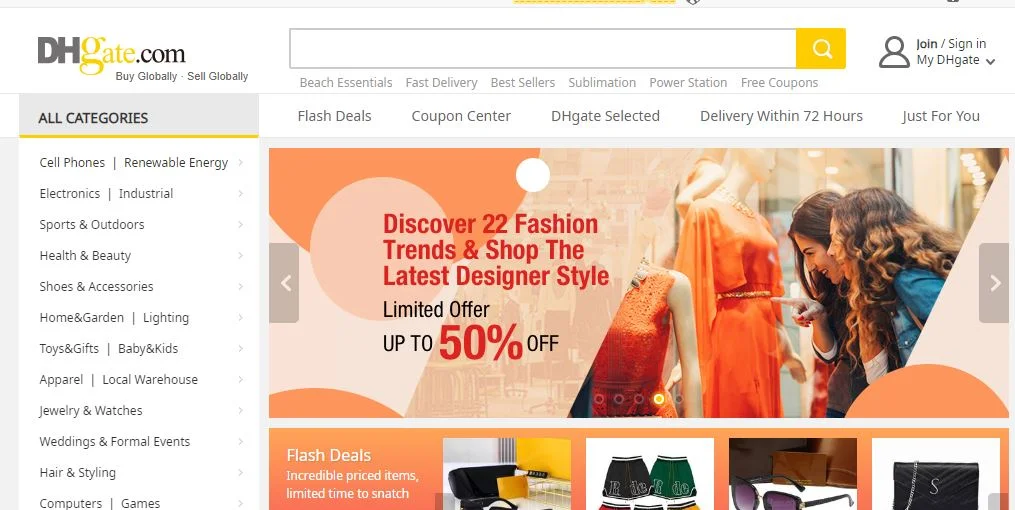
Using Online Marketplaces to Spot Demand (Amazon, Etsy, DHgate, and More)
Marketplaces are powerful because they show real buyer behavior: what people actually buy, at what price, and how they review it.
What to look for on major retail marketplaces (Amazon, eBay, Etsy)
When you search your candidate market:
- Bestseller lists and rankings
Show which products dominate and how stable demand is. - Review counts and ratings
High review counts indicate sustained sales; detailed reviews reveal pain points. - Price distribution
Helps you see budget vs. premium segments and where most volume sits. - Listing quality
Professional photos and copy often indicate serious competition.
Use these platforms to answer:
- Is this market already saturated with strong brands?
- Are there obvious gaps (e.g., underserved styles, sizes, materials)?
- Are buyers price-sensitive or willing to pay for premium features?
What to look for on sourcing and cross-border marketplaces (including DHgate)
Platforms like DHgate, Alibaba, and other B2B marketplaces show the supply side:
- Assortment breadth
How many variations exist (colors, materials, features)? - Supplier concentration
Many small suppliers vs. a few large manufacturers. - MOQ and pricing
Indicates how easy it is to test small batches and what your cost base might be. - Regional focus
Where suppliers are located and which markets they typically serve.
Use these platforms to answer:
- Can you source differentiated products in this market?
- Are there unique designs or bundles you could bring to retail marketplaces?
- Is cross-border sourcing realistic for your target region (shipping times, regulations)?
DHgate fits naturally here as one of several platforms you can browse to:
- Compare price ranges for similar products
- See how many suppliers offer a given item
- Explore variations that aren’t yet common on your target retail marketplace
Comparison Matrix
This table compares common platform types you’ll use when researching big markets and deciding where to sell or source.
| Platform Type | Typical Use in Discovery | Demand Insight Depth | Supply Insight Depth | Who It Suits Best |
|---|---|---|---|---|
| Search Tools (Google, etc.) | Find big topics and keyword demand | High (search volume, trends) | None | Anyone starting from scratch |
| Retail Marketplaces (Amazon, eBay, Etsy) | See real products, prices, and reviews | Very high (sales signals, reviews) | Low–medium (some seller info) | Sellers validating product ideas and competition |
| Sourcing Marketplaces (DHgate, Alibaba, etc.) | Explore product variations and supplier options | Low (indirect demand signals) | Very high (assortment, pricing) | Sellers planning cross-border sourcing or private label |
| Social Platforms (TikTok, YouTube, Instagram) | Spot trends, angles, and communities | Medium (engagement, virality) | None | Trend-focused sellers and brand builders |
| Industry Reports / Trade Data | Validate long-term market size and growth | High (macro demand) | Medium (import/export patterns) | Businesses planning larger or long-term investments |
Use this matrix to decide which platforms to prioritize at each stage:
- Early exploration: search tools + social platforms
- Mid-stage validation: retail marketplaces + sourcing marketplaces
- Long-term planning: industry reports + trade data
Who This Route Fits Best
The workflow in this guide is most useful if you:
- Want to discover markets systematically, not chase random product ideas
- Plan to sell online via marketplaces, your own store, or both
- Need to source products globally or compare local vs. cross-border options
- Prefer data-backed decisions over gut feeling alone
It’s especially relevant for:
- New e-commerce entrepreneurs
Who need a repeatable way to find and validate niches. - Existing sellers
Looking to expand into new categories or regions. - Small brands and private label sellers
Who want to identify big markets where they can carve out a differentiated position.
If your business relies heavily on strict local regulations, official warranties, or brand-authorized channels (e.g., medical devices, certain electronics), you’ll still use this workflow—but you’ll lean more on official retail and industry data than on cross-border marketplaces for sourcing.
Where DHgate Fits Naturally
DHgate is one of several global marketplaces that can play a useful role in your market discovery and sourcing process, especially when you’re exploring cross-border opportunities.
When DHgate is a good fit in your discovery workflow
Use DHgate (alongside other platforms) when:
- You’ve identified a big market and want to see how deep the product assortment goes
Example: You see strong demand for “LED home decor” on retail marketplaces; you browse DHgate to explore different shapes, colors, and features. - You’re comparing price ranges and variations before deciding on a product angle
Example: You check DHgate to understand the cost difference between basic and premium versions of a product. - You’re testing small batches or variations to see what resonates in your target retail marketplace
Example: You source a few variations of a trending accessory to test on Amazon or your own store.
When DHgate is not your primary route
DHgate is less central when:
- Your priority is local warranties, regulated after-sales support, or brand-authorized buying
In those cases, official distributors, local wholesalers, or brand-owned channels are usually more appropriate. - You’re selling in categories with strict compliance requirements in your region
You’ll need to rely more on local regulatory guidance and specialized suppliers.
Think of DHgate as:
A cross-border product and supplier discovery tool that complements your research on retail marketplaces and search platforms, rather than replacing them.
Verification Checklist
Before you commit to a market or a product within it, run through this checklist.
Market-level verification
- [ ] Core keywords show meaningful and stable search volume
- [ ] Multiple related keywords indicate broad interest, not just one phrase
- [ ] Retail marketplaces show active listings and reviews across several subcategories
- [ ] Social platforms show ongoing content and engagement, not just a short-lived spike
- [ ] Industry or trade data (where available) supports medium- to long-term demand
Competition and positioning
- [ ] There are multiple sellers, but not only global brands dominating every listing
- [ ] You can identify at least one clear angle (design, bundle, audience, price tier) to differentiate
- [ ] Reviews reveal pain points you can address (quality, usability, packaging, etc.)
Sourcing and feasibility (including DHgate and other marketplaces)
- [ ] You can find reliable-looking suppliers offering the product type you want
- [ ] Assortment breadth suggests you can test variations without redesigning from scratch
- [ ] Price ranges allow for healthy margins after fees, shipping, and marketing
- [ ] Cross-border shipping times and costs are compatible with your target buyers’ expectations
Risk and resilience
FAQ
How do I know if a market is “big enough” to pursue?
Look for strong, consistent demand across multiple signals: meaningful search volume, active listings and reviews on major marketplaces, and ongoing social media content. If several related keywords and subcategories show activity, you’re likely looking at a sizable market.
Should I start with products or with markets?
Start with markets. Identify broad demand first (e.g., “home fitness,” “pet accessories”), then drill down into specific products and angles. This reduces the risk of chasing one-off fads and helps you build a coherent product line.
How can DHgate help with product discovery?
Once you’ve validated demand on retail marketplaces and search platforms, use DHgate to explore product variations, price ranges, and supplier options. It’s especially useful for testing small batches and discovering new twists on proven product types.
How do I avoid oversaturated niches?
Use a simple comparison table:
| Signal | Healthy Market | Oversaturated Niche |
|---|---|---|
| Number of sellers | Many, but varied | Many, mostly similar offers |
| Review patterns | Mixed; clear pain points | Mostly perfect; few complaints to improve |
| Price spread | Multiple tiers (budget–premium) | Tight clustering around similar prices |
| Differentiation room | Clear gaps in features or positioning | Hard to find a unique angle |
If most signals fall in the right column, reconsider or narrow your focus.
How many products should I test in a new market?
Aim to test a small, focused range—often 3–10 variations or related products. That’s enough to learn what resonates without overcommitting inventory or marketing budget.
What’s the fastest way to validate a product idea?
Combine quick data checks with small tests: confirm search and marketplace demand, skim reviews for pain points, source a limited batch (via platforms like DHgate or local suppliers), then run short campaigns or listings to measure clicks, saves, and early sales.
What to Do Next
- Pick one broad market you’re interested in (e.g., home office, pet care, outdoor gear).
- Run the verification checklist on that market using search tools, retail marketplaces, and social platforms.
- Identify 3–5 product angles with clear differentiation potential.
- Use DHgate and other sourcing channels to explore variations, pricing, and suppliers for those angles.
- Launch small tests, track performance, and double down only on products that show promising early traction.
Repeat this cycle regularly, and you’ll build a portfolio of products anchored in real, validated demand rather than guesswork.