
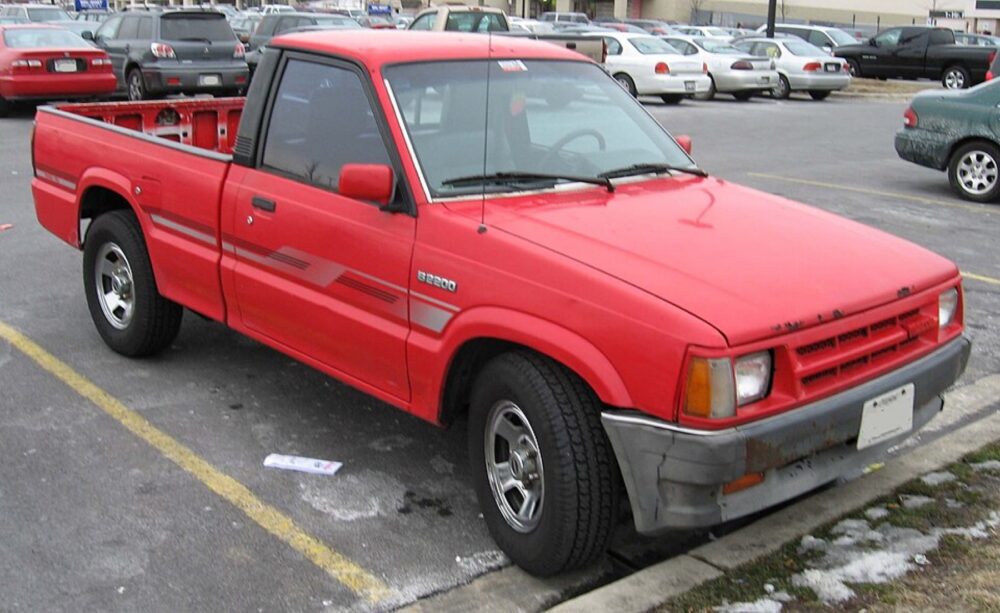
Mazda B2000 and B2200 carburetors are still available, but they now live in a niche market split between three real options: factory-style feedback carbs, rebuilt OEM-style units, and Weber 32/36 conversion kits. Factory carbs keep the truck close to stock and plug into the original emissions and vacuum setup. Rebuilt units from carb specialists reuse OEM castings with fresh internals. Weber kits replace the complex feedback carb with a simpler two-barrel plus an adapter, often at the cost of emissions equipment and some wiring. The right choice depends on whether you want plug‑and‑play originality, simpler tuning, or a part you can stock and support as a small seller.
What the Mazda B2000 and B2200 Carburetors Actually Are
Mid‑1980s to early‑1990s Mazda B2000 (2.0L) and B2200 (2.2L) pickups used carbureted inline‑four engines. You can still see complete carburetor assemblies and subcomponents listed in Mazda’s own catalog views, for example for a 1986 B2000 or a 1987 B2200 under the fuel system/carburetor section on Mazda OEM Parts Online and its B2200 counterpart. Those diagrams are your reference for what “correct” looks like.
Service documentation describes these as feedback‑type carburetors with multiple vacuum ports, solenoids, and linkage to emissions hardware.Source In plain English: the carb isn’t just mixing air and fuel; it’s talking to sensors and valves so the truck can meet period emissions targets. That complexity is one reason owners complain about vacuum spaghetti and why many listings emphasize that their replacement units are “OEM style” or “Nikki replacement” rather than universal carbs.
Replacement is hard now because:
- Many true Mazda-branded carbs are long out of regular dealer stock; what you see now is often new‑old‑stock or superseded parts.
- Some sites list complete assemblies, but availability is sporadic and often remanufactured rather than brand‑new.
- Small variations by year, engine, and emissions package mean “fits B2200” on a generic listing isn’t enough—you have to match it to your VIN or original part number.
If you treat the Mazda catalog drawing and part number as your anchor, every other option—rebuilt or Weber—becomes easier to evaluate.
Quick note: feedback vs non‑feedback behavior
- Feedback carb (stock): Uses sensors and solenoids to trim mixture based on conditions. Lots of vacuum lines and an ECU controlling some functions.
- Non‑feedback carb (typical Weber 32/36 swap): A largely mechanical carb. You set jets and mixture physically; there’s little or no computer interaction and fewer vacuum connections. Tuning is simpler, but you’re taking responsibility for how the truck runs under all conditions.
Understanding which side you want to live on—computer‑assisted or mostly mechanical—frames the entire buying decision.
OEM-Style vs Rebuilt vs Weber 32/36: Which Path Fits Your Truck?
From a buyer’s standpoint, the main choices are:
- Genuine or OEM‑style feedback carb
- Rebuilt carb from a specialist
- Weber 32/36 conversion kit (DGV/DGEV family)
Here’s how they differ in practice.
OEM or OEM-style feedback carb
Mazda’s original carb for these trucks was built in a specific form factor with all the vacuum, electrical, and throttle hookups in defined places. Some OEM catalog mirrors still show complete assemblies and subcomponents for the B2000 and B2200, but many are listed as limited, reman, or special order.Source
Independent carburetor shops have stepped into that gap. For example, at least one specialist advertises a rebuilt or replacement carburetor targeted specifically at Mazda B2200 trucks with an OEM-like layout.Source Their pitch is that the carb bolts up like stock and is calibrated for the original engine. Expect these to:
- Use an OEM or OEM‑style casting
- Retain emissions and feedback functions
- Be close to plug‑and‑play if your vacuum harness is intact
This is the natural choice for restorations, period-correct builds, or fleets in regions that visually inspect emissions equipment.
Rebuilt OEM core vs generic rebuild
Rebuilt units fall into two buckets:
- VIN‑specific remans that start from your original core (typical of carb specialists).
- Generic “fits 1987-1993 B2200” replacements sold via big marketplaces.
The first kind normally tracks your truck’s calibration more closely because the shop references the Mazda parts data and your existing carb. The second kind may be built to a generic spec. For older work trucks, that may be acceptable; for picky drivability, it can be annoying.
For small ecommerce sellers, rebuilt OEM‑style units are attractive because you can advertise “stock replacement” without needing to support custom tuning or adapter plates. The trade‑off is depending on core availability and a rebuilder’s lead times.
Weber 32/36 conversion kits
A large slice of the enthusiast world has gone to Weber conversions instead of wrestling with aging feedback carbs. Aftermarket 32/36 DGV/DGEV kits are explicitly advertised for 1986-1993 Mazda B2000/B2200 pickups and usually mention an adapter plate to mate the Weber to the Mazda intake manifold.Source
Video guides and forum posts show these swaps as a common alternative to rebuilding the stock carb.Source The pitch is straightforward:
- Fewer vacuum lines and a simpler linkage
- Easier manual tuning
- Readily available jets and rebuild parts
But you pay for that simplicity with:
- The need for an adapter plate and sometimes a modified or replaced throttle cable
- Manual rerouting or capping of emissions/vacuum hookups
- Potential emissions‑compliance issues, especially where inspections are strict (you should check local rules; this article doesn’t make legal or road‑worthiness claims)
How the options stack up for real use cases
Here’s a compact comparison by use case:
| Use case | OEM/OEM-style feedback carb | Rebuilt OEM core | Weber 32/36 conversion |
|---|---|---|---|
| Stock daily driver | Best for plug‑in compatibility, least rewiring | Good if spec’ed to your VIN | Works, but requires more setup |
| Emissions/visual inspection | Keeps factory hardware present | Same as OEM if vacuum/emissions retained | Risky; depends on local rules |
| Simple, DIY tuning | Harder due to feedback complexity | Same complexity as OEM | Easiest; jets and mixture screws are accessible |
| Small shop / reseller inventory | Harder to stock, more variants by year/emissions | Manageable if using a trusted specialist | One or two SKUs plus adapters per engine family |
| Budget work truck | Can be costlier, especially true NOS | Often moderate-cost, depends on core policy | Costs include carb + adapter + tuning time |
Scenario: DIY owner vs small reseller
- DIY owner with one truck: If your B2200 is mostly stock and you want minimal wiring changes, a rebuilt OEM‑style carb from a specialist or a reman that matches your exact part number is usually safer. You can always defer a Weber swap until you’ve exhausted “bolt‑in” options.
- Small reseller or shop: Stocking a Weber 32/36 kit plus the correct Mazda adapter can make sense. You’re selling a repeatable solution across multiple B‑series years, and you can build in your own tuning support as a service. Keeping one or two OEM‑style units from a rebuilder on hand is a hedge for restoration‑minded customers.
Where to Source B2000/B2200 Carburetors and How to Limit Cross-Border Risk
Because these trucks are old, there’s no single best channel. You’ll usually mix OEM catalog sites, carb specialists, and broad marketplaces—sometimes domestically, sometimes cross‑border.
OEM catalog and dealer-linked sites
Mazda parts mirrors such as Mazda OEM Parts Online’s B2000 carburetor section and their B2200 equivalent are your best references for part numbers and exploded views. Some still show:
- Complete carb assemblies (often with notations that imply remanufactured/limited)
- Gaskets, diaphragms, and sub‑assemblies
For buyers and small shops:
- Use these sites to pull the exact part number tied to your VIN.
- Treat any listing on another platform as suspect until its description matches that Mazda number or clearly states which OEM numbers it supersedes.
Carburetor specialists
Independent carb shops (like the B2200‑focused example on GuaranteedCarburetors.com) fill two roles:
- Selling ready‑to‑install rebuilt carbs with OEM‑style fitment
- Rebuilding your existing unit if you ship it as a core
These businesses usually describe their product as “replacement for Mazda B2200” rather than claiming to be genuine Mazda parts. For cross‑border buyers or resellers, they reduce some risk by standardizing calibration and backing it with their own reputation rather than a random marketplace seller.
Large marketplaces and global listings
Big marketplaces (including auction and general ecommerce platforms) host a mix of:
- OEM‑style replacements labeled for B2000/B2200
- Weber 32/36 DGV/DGEV carbs and Mazda‑specific adapter kits
- Universal replacement carbs that happen to bolt on but aren’t tuned for these engines
For example, marketplace category pages for Mazda B2200 air and fuel delivery have shown both “Mazda B2000/B2200 carburetor 1986-1991” offerings and 32/36 kits advertised as free‑ship bolt‑ons in past search results. Because listings change, treat any example as a pattern, not a guarantee.
When you cross borders via these platforms (for instance, importing a carb from a seller outside the US), the practical checks are:
- Part number match: Does the description quote Mazda numbers you can verify against the OEM catalog?
- Carb type disclosure: Does it clearly say OEM‑style/feedback or Weber 32/36? If it’s silent, assume you’ll be doing more adaptation.
- Adapter and hardware: For Weber‑style kits, does the listing mention a Mazda B2000/B2200 adapter plate similar to those described on sites selling dedicated adapter kits?
- Core and returns: If it’s a reman, do they want your old carb as a core? For cross‑border buyers, core returns can wipe out any apparent price advantage.
Cross-border sourcing risks specific to B-series carbs
Unlike a modern sensor, a 30‑plus‑year‑old carburetor is often remanufactured, modified, or stored for decades. When you extend the supply chain internationally:
- Condition uncertainty goes up: photos might not reveal worn throttle shafts or marginal castings.
- Spec drift is common: a “B2200 carb” may have been tuned for a different market’s emissions package.
- Return friction is real: shipping a carb back across borders is rarely worth it for a DIY owner or small shop.
That doesn’t mean you should avoid cross‑border sellers entirely, but it does favor:
- Using OEM catalog numbers and specialist descriptions as your spec baseline.
- Treating Weber 32/36 kits as a controlled, repeatable solution when you’re willing to handle tuning and emissions decisions yourself.
If you stay honest about which path you’re on—stock‑style feedback carb, rebuilt OEM‑style, or Weber conversion—you can pick channels and listings that actually line up with your truck and your tolerance for risk.