
Ask for the botanical name before ordering a “leopard lily.” The name can describe an outdoor blackberry lily, a seasonal Lachenalia bulb, an indoor silver squill, or a true lily. Their growing conditions and pet-safety advice are not interchangeable.
For Canadian buyers, start with the plant you want to grow and the form you can manage: seeds, dormant bulbs, divisions, or a live potted plant. A Canadian storefront address or a spotted-leaf photograph does not establish the species or shipping origin.
Identify the plant you actually want
Iris domestica: orange flowers and black seed clusters
Also sold as blackberry lily or under the older name Belamcanda chinensis, this is a rhizomatous perennial in the iris family, not a true Lilium. Its spotted orange flowers and blackberry-like seed clusters distinguish it from the foliage houseplants below.
NC State’s profile supports garden use in sun to partial shade and stresses well-drained soil, especially in winter. For outdoor planting in Canada, confirm local winter survival and drainage with a nursery. The USDA zones in a US reference are not a blanket promise for Canadian gardens.
Buy as: accurately named seeds, rhizomes, or plants from a supplier that explains the cultivar, germination or establishment instructions, and local suitability. A decorative black seed cluster is not an edible blackberry.
Lachenalia glaucina: a seasonal bulb
Called leopard lily or wild hyacinth, this South African bulb has strap-like leaves and tubular flowers. It is not simply a permanently leafy substitute for silver squill.
NC State’s description explains its seasonal cycle and keeping bulbs cool and dry during summer dormancy. It recommends houseplant use where temperatures fall below freezing. Ask the supplier how its bulbs have been grown and when they will be actively growing or dormant in your conditions.
Buy as: a correctly named bulb or plant with seasonal care instructions. Do not infer its care or toxicity from another species sharing the common name.
Ledebouria socialis: silver squill for a pot
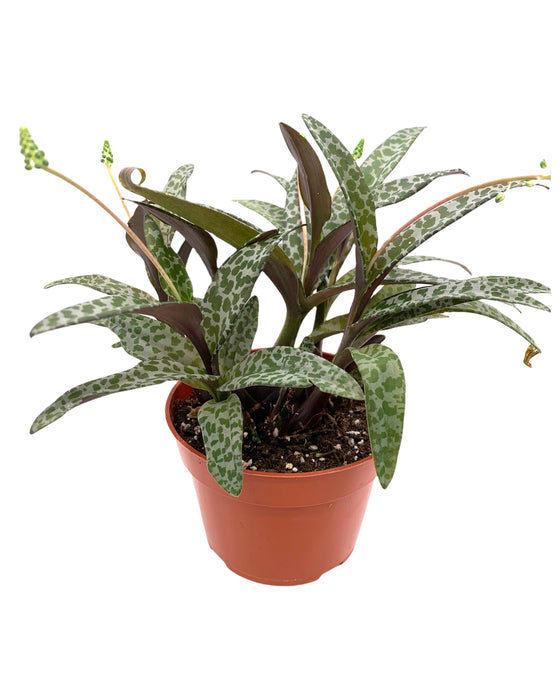
This is the compact bulbous plant with spotted silvery leaves, purple undersides, and bulbs that form clusters. NC State’s profile describes bright indirect light or partial shade, good drainage, reduced winter watering, and indoor overwintering where temperatures are too low.
Buying example: Cactus en Ligne sells a plant under the name “Scilla Violacea,” with 2.5-inch and 4-inch pot choices. Confirm that the supplier identifies it as the silver squill you intend to buy. Check the selected size, current stock, weather-related dispatch rules, and shipping to your postal code; this is not a guaranteed availability claim.
For a first houseplant, a division or established bulb cluster may be more practical than anonymous seeds. NC State notes inconsistent seed germination for this species and describes propagation by bulb-cluster division.
Keep pet-safety advice species-specific
Ledebouria socialis: NC State flags poison characteristics and pet toxicity. Keep it away from children and pets that may chew plants. Do not call it pet-safe because it is sold as a succulent.
Lachenalia glaucina: its NC State profile carries non-toxic tags for cats and dogs. That is a species-specific source description, not a guarantee that a misidentified plant or an unknown “leopard lily” is safe.
True lilies: if the label says Lilium, take a different safety route. The ASPCA’s Lilium entry identifies toxicity to cats and kidney failure. If a pet may have eaten a potentially toxic plant, contact a veterinarian promptly. Being outside the Lilium genus does not automatically establish that Iris domestica or another plant is safe to eat.
Check Canadian import and delivery conditions
CFIA’s plant-import guidance says import requirements depend on the product. Use its Automated Import Reference System or contact CFIA for the botanical name, origin, plant form, and associated material such as soil. Do not assume a small order or a marketplace’s Canadian domain removes those requirements.
Prefer documented cultivated stock when the source of a wild-collected plant is unclear. For a domestic live-plant order, ask about cold-weather holds, protective packaging, and the seller’s arrival-condition policy. These checks are more useful than choosing a seed packet solely because its mature-plant photograph looks right.