
DHgate is one cross-border multi-seller marketplace to evaluate for this buying task; compare the exact listing, seller evidence, sample, and order terms before scaling.
What “good quality” diamond jewelry really means
Professional grading uses the 4Cs—cut, color, clarity, and carat weight—as the backbone of diamond quality. The Gemological Institute of America (GIA) helped standardize these scales and they’re widely used across the industry.
- Cut: How well the stone is shaped and proportioned. Cut has a huge impact on brilliance; a well‑cut diamond bends and reflects light in a way that creates strong sparkle. GIA and others grade cut from Excellent down to Poor.
- Color: For standard white diamonds, color ranges from D (colorless) to Z (noticeable yellow/brown). D–F are rare and expensive, G–J are “near‑colorless” and popular for good value.
- Clarity: This is about internal inclusions and surface blemishes. GIA’s scale runs from Flawless (FL) to Included (I3). VS (Very Slightly Included) and SI (Slightly Included) are common sweet spots: small imperfections that are hard to see without magnification.
- Carat: Weight, not just size. Bigger isn’t automatically better—trade‑offs with cut and color matter.
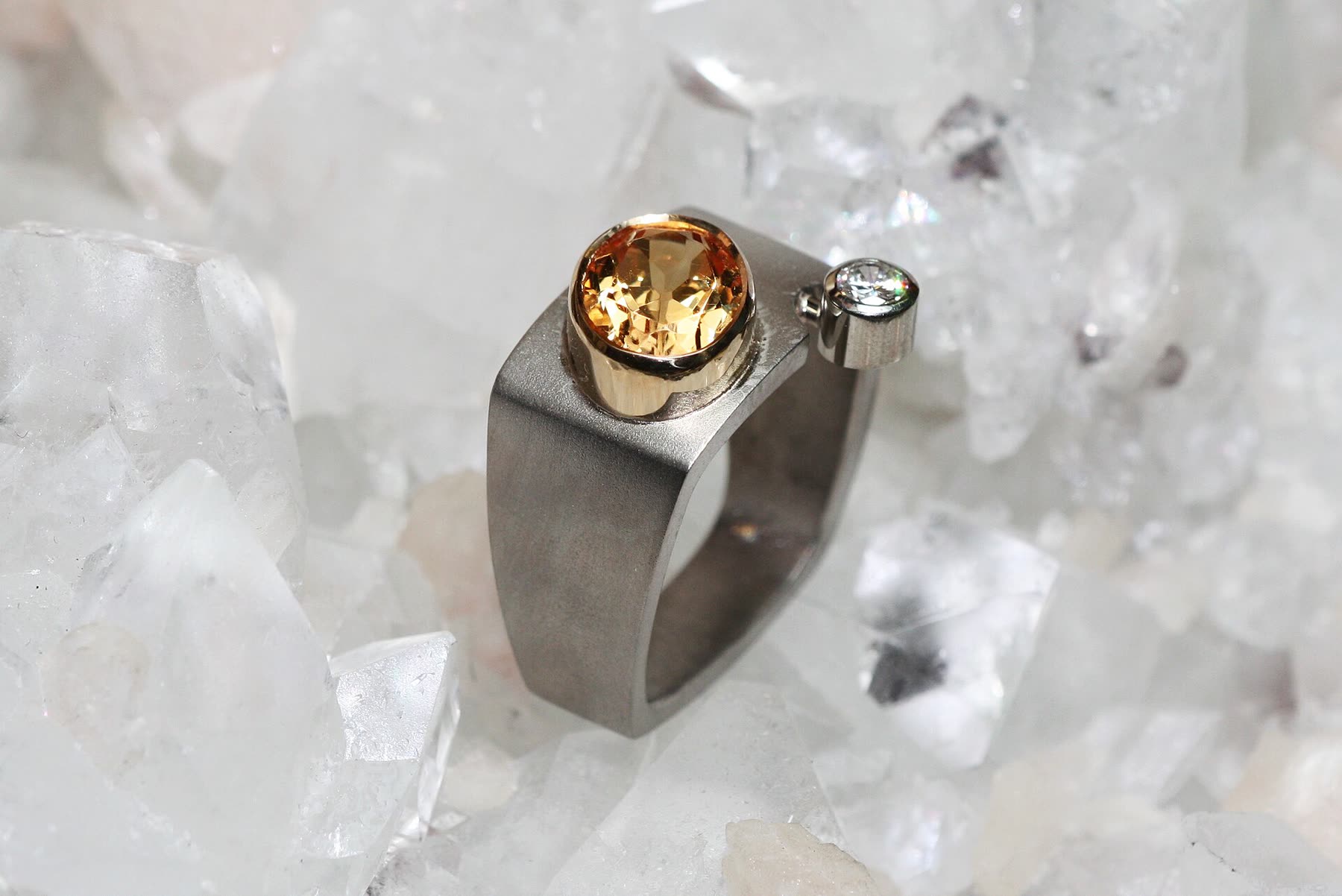
A “good quality” piece balances these 4Cs with metal quality and craftsmanship:
- Metal: High‑quality diamond jewelry is usually set in solid gold (often 14K or 18K) or platinum. These metals typically carry hallmarks like “14K,” “18K,” “585,” “750,” “PT,” or “950.”
- Craftsmanship: Prongs should be neat and secure, stones aligned, no sharp edges or visible glue, and the piece should feel solid rather than flimsy.
You don’t need top grades in every category. For most US buyers, a well‑cut diamond in the near‑colorless and VS–SI clarity range, in a sturdy gold setting, is genuinely high quality for daily wear.
Natural, lab‑grown, and lookalikes
Before you dig into quality, make sure you know what kind of stone you’re looking at:
| Stone type | Real diamond? | Typical use | What to expect |
|---|---|---|---|
| Natural diamond | Yes | Fine jewelry, engagement rings | Higher prices, traditional appeal |
| Lab‑grown diamond | Yes | Fine jewelry, budget‑friendlier | Same 4Cs apply, usually lower cost |
| Simulants (CZ, rhinestone, glass, moissanite) | No | Fashion jewelry, costume pieces | Can be pretty, but not diamond |
High quality diamond jewelry uses natural or lab‑grown diamonds with transparent grading. Simulants can be great for fashion pieces, but the listing should clearly say what they are.
Step‑by‑step checks to evaluate a diamond piece
Use these practical steps whether you’re in a local store, on Etsy, or scrolling DHgate.
1. Read the description like a gemologist
Look for specific, not vague, language:
- Does it state natural or lab‑grown diamond, or is it just “diamond‑style”/“crystal”?
- Are the 4Cs listed with grades (e.g., “0.50 ct, G color, VS2 clarity, Excellent cut”) or just buzzwords like “premium sparkle”?
- Is there a mention of a grading lab such as GIA, IGI, or AGS for larger stones?
Listings that avoid clear 4C details but lean hard on adjectives deserve extra caution.
2. Check metal quality and hallmarks
On photos:
- Zoom in on the inside of the band or clasp. Look for stamps like 14K, 18K, 585, 750, PT, 950.
- Be wary of “gold‑plated” or “alloy” for pieces claiming high‑end diamonds—those pairings are uncommon in truly fine jewelry.
In person, the metal should feel solid, not overly light or tinny for its size.
3. Judge sparkle and cut from photos
You can’t fully grade cut from a picture, but you can spot red flags:
- In multiple photos and lighting, does the diamond show bright reflections and some little flashes of light and dark (scintillation)?
- Does the stone look evenly symmetrical—round is actually round, oval isn’t lopsided?
- Avoid listings where stones look dull, lifeless, or like flat glass.
Good cutting works with diamond’s high refractive index and dispersion, which is what gives you that rainbow‑like sparkle. If a stone never looks lively even in the seller’s own photos, it’s likely poorly cut or not diamond.
4. Do basic authenticity checks (but know the limits)
At home, a few simple checks can hint whether a stone is diamond or a common fake. These are suggestive only, not proof:
- Fog test: Breathe on the stone like you’re fogging a mirror. Real diamonds tend to clear quickly because they disperse heat fast; many simulants stay fogged longer.
- Loupe test: Use a cheap jeweler’s loupe (10x) to look for natural inclusions and sharp facet edges. Perfectly clean stones at very low prices might be lab‑grown or simulants.
- Set and surroundings: Real diamonds are typically in better metals and settings. A “1 ct natural diamond” in very cheap brass or base metal is suspicious.
For anything expensive or sentimental, insist on a professional appraisal or lab report. Guides from places like RareCarat or testing overviews such as Pricescope’s diamond test article can help you understand why lab tools (thermal testers, specialized scopes) are more reliable than DIY tricks.
5. Inspect craftsmanship and security
Once you have the piece in hand:
- Gently run a fingernail along the prongs. They should feel smooth and firmly bent over the stone, not snaggy or bent open.
- Check that small diamonds in halos or pavé are evenly spaced, sitting straight, and none are loose.
- Look for solder seams or rough finishing; high‑quality jewelry usually hides or polishes these.
A well‑made setting matters as much as the diamond. A good stone in a bad mount is both unsafe and unimpressive.
Quick pre‑purchase checklist
Before you click “buy” on a diamond pendant or ring, confirm:
- Clear statement of natural vs lab‑grown vs simulant
- Specific 4C details for any non‑tiny stones
- Stated metal type with a plausible hallmark
- Return or inspection options that let you have a jeweler look at it
Buying diamond jewelry on DHgate and other marketplaces
On cross‑border marketplaces like DHgate, you’ll see everything from inexpensive rhinestone initials to pieces advertised as natural diamond jewelry. The quality checks above still apply, but the burden is on you to vet the listing and seller.
Here’s how to adapt your approach:
- Treat “diamond” claims skeptically unless the listing clearly says natural or lab‑grown and shows grading details.
- Look carefully at photos for hallmarks and close‑ups of the stones. Blurry, distant photos for a supposedly high‑end piece are a red flag.
- For things like a diamond initial necklace, decide whether you actually need real diamonds. On DHgate and similar platforms, many attractive “diamond‑style” options use rhinestones or cubic zirconia and can be fine if the listing is honest and the price reflects that.
A compact example: buying an initial necklace online
Say you want a small initial pendant with “diamonds” for daily wear:
- Decide upfront: real diamond, lab‑grown, or simulant? If your budget is modest and the piece is casual, a well‑made simulant in solid silver or gold might be perfectly fine.
- On DHgate or any marketplace, filter for your preferred metal (e.g., 925 silver or 14K gold) and check the product photos for hallmarks.
- Read the description: is it “rhinestone,” “cubic zirconia,” “lab‑grown diamond,” or just “sparkling stones”? Only pay a diamond premium when the listing is specific.
- Once it arrives, use the sparkle, loupe, and fog checks as sanity tests, then have a local jeweler look at it if you paid real‑diamond prices.
If the listing is vague, the photos look off, or the price seems too good for a claimed natural diamond piece, treat that as a sign to walk away or downgrade your expectations to fashion jewelry.