
On DHgate, the best deal on 1kg milk powder is never a single fixed page—it’s the specific listing where clear specifications, fair total cost, and a trustworthy seller line up for your needs. This guide shows you how to read weight and packaging details, compare real per‑kilogram pricing, and use visible quality signals and DHgate’s protections so you can decide which offer is genuinely good value, not just apparently cheap.
Why there’s no single place for the “best” 1kg milk powder deals on DHgate
On DHgate there is no single page, seller, or shortcut where the “best” 1kg milk powder deal always lives. DHgate is a marketplace of many independent sellers, and listings, prices, and promotions change over time, so any good deal you find is tied to a specific offer at that moment rather than to a fixed section of the site.
For 1kg milk powder, each listing can differ in real value because of details like the true net weight, how that weight is split across packs, the type of packaging, shipping costs and delivery time, seller rating and history, and whatever quality signals are visible in the description and reviews. A headline price that looks low can end up more expensive once you add high shipping or discover that the total weight is less than you expected, while a slightly higher sticker price may include more product, better packaging, or clearer terms.
Imagine two DHgate listings for 1kg milk powder. One shows “1kg net weight” with clear photos of the package, explains whether it is a single bag or multiple smaller packs, states the country of origin, and comes from a seller with a solid rating and consistent positive reviews. The other looks cheaper but only says “milk powder” with a vague weight range, no clear pack count, and mixed feedback about late delivery or items not matching the description. I would choose the first listing, even if it costs a bit more, because transparent specs and a reliable seller usually matter more than saving the last small amount on price.
Instead of looking for one permanent “best deals” corner of DHgate, treat the marketplace as a set of individual offers you need to compare. The next step is learning how to read the specifications on a 1kg milk powder listing—especially net weight and packaging—so you can see what you are really getting before you start comparing prices.
How to read 1kg milk powder specifications on DHgate
To confirm that a DHgate listing really matches the 1kg of milk powder you want, start by finding the net weight and how it is divided across packs. A listing that says “1kg” for a single bag is different from one that lists “10×100g” sachets; both total 1kg, but the net weight per unit and the way you will open and store the product are not the same. Always check both the total listed weight and the number of units so you know whether 1kg refers to one large pack, a bundle of smaller packs, or even a multi-pack where the combined weight is only close to 1kg rather than exact.
Misreading grams and kilograms or overlooking pack count can easily lead to surprises—for example, ordering what you think is 1kg and receiving only 800g across several small sachets, or the reverse, ending up with more than you can reasonably store once opened. A listing that clearly states something like “Net weight: 1000g (10 packs × 100g)” leaves far less room for misunderstanding than one that just mentions “milk powder 1kg” without explaining the breakdown.
Packaging form is another clue you will see in DHgate-style specs and photos. Bulk bags are usually one large pouch or sack, which may suit you if you plan to use the powder quickly and do not mind measuring each portion yourself. Individual sachets or stick packs can be easier for portion control or travel but may cost more per kilogram. Tins or cans can help with storage and resealing, which some buyers find more convenient once the product is opened. These differences are practical rather than nutritional: they affect how you handle the product day to day and how long it stays usable after opening.
Specification fields may also mention basic composition—such as whole or skim milk powder, added sugar or flavors—and the stated country or region of origin. While this page does not verify any health or nutrition claims, those details still help you decide whether the product fits your expectations and habits. I would always prefer a listing where net weight, pack count, packaging type, and simple composition or origin information are laid out clearly over any offer where the weight breakdown is vague, units are not stated, or the packaging description leaves you guessing. If the specs feel confusing or incomplete, it is safer to keep browsing for a clearer listing before you move on to price comparison.
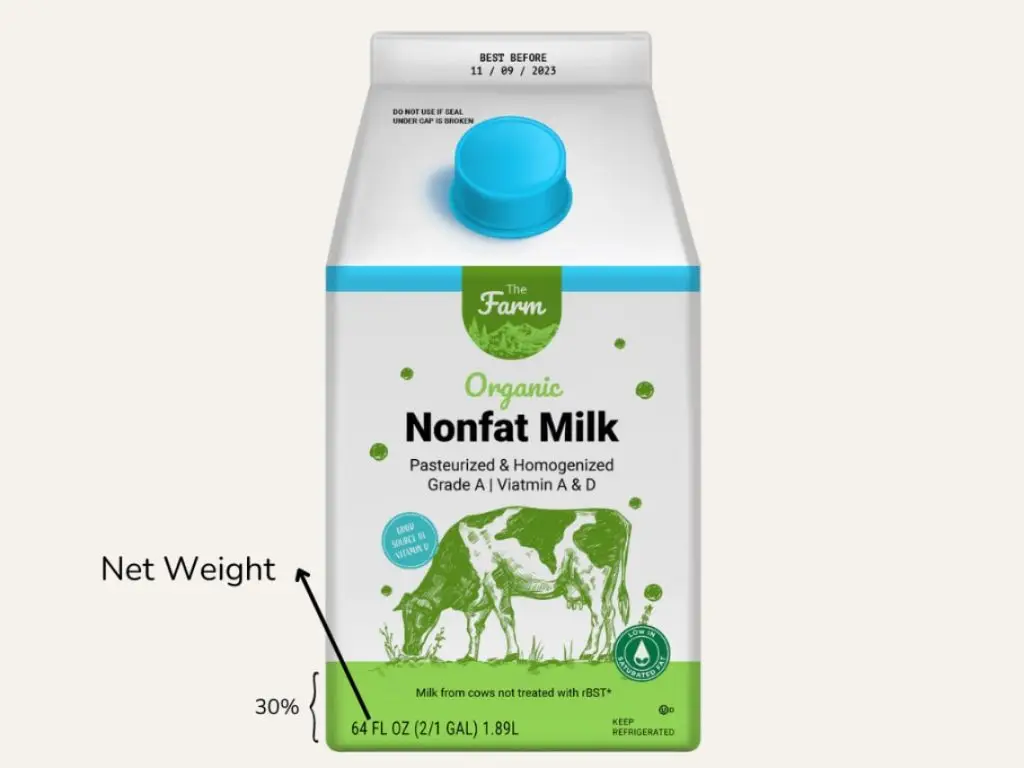
This illustration shows how net weight appears on food packaging; when you review DHgate listings, look for similarly clear net weight lines and pack details in the specification area so you know exactly how much milk powder you are buying.
Calculating real price: unit cost and total landed cost
Once you know a listing’s true net weight, you can turn its price into a unit price you can compare across DHgate. Take the total item price and divide it by the total net weight in kilograms. If a bag costs $12 and clearly states 1.0kg net weight, the unit price is $12 per kg. If another offer costs $7 for 500g (0.5kg), its unit price is $14 per kg, even though the sticker price looks lower.
Headline prices can be misleading because shipping is often a separate charge. Imagine two 1kg listings: Listing A is $12 with $3 shipping, for a total of $15 delivered. Listing B is $10 with $6 shipping, for a total of $16. Even though B has the cheaper sticker price, A is actually the better deal once you include shipping. I would treat any “too good to be true” base price with expensive shipping as a sign to slow down and check the total cost carefully.
Minimum order quantity and tiered pricing also change what you really pay. A listing might advertise a low per‑kg price but require you to buy two or three units to unlock it. If each 500g pack costs $8 and the seller requires a minimum of two packs, your total item spend is $16 for 1kg before shipping. When you compare offers, look at how many units you must buy, how much total weight you will receive, and whether that quantity actually fits your needs and storage space.
Cross‑border orders can sometimes trigger taxes or customs charges that depend on your country, order value, and local rules. Those costs are not fully predictable from the listing alone. Treat them as a possible extra when judging overall value, and check DHgate’s help pages and your local customs information if you are unsure about import rules for milk powder. If you are close to a threshold where duties might apply, it can be safer to assume there could be an additional charge rather than counting on everything being tax‑free.
Because of these factors, I would rather choose a DHgate listing where item price, shipping fee, and order conditions are laid out clearly than the absolute cheapest-looking offer with confusing quantity rules or vague shipping. A transparent price that makes it easy to estimate your per‑kg and landed cost is a stronger candidate for a real “best deal” than a rock‑bottom headline number that hides its true cost in the fine print.
| Listing label | Item price | Net weight (kg) | Shipping fee | Minimum order quantity | Unit price per kg | Estimated landed cost for minimum order |
|---|---|---|---|---|---|---|
| Listing A | $12 | 1.0 | $3 | 1 unit | $12 per kg | $15 (1 × item price + shipping) |
| Listing B | $10 | 1.0 | $6 | 1 unit | $10 per kg | $16 (1 × item price + shipping) |
| Listing C | $8 per 0.5kg pack | 0.5 per pack (1.0 total at MOQ) | $4 | 2 packs | $16 per kg (2 × $8 ÷ 1.0kg) | $20 (2 × item price + shipping) |
Reading quality and authenticity signals in listings
Once you have a sense of real cost, the next question is whether a listing looks like it offers genuine, acceptable‑quality milk powder. On DHgate, some of the strongest soft signals appear on the listing itself: clearly named brands or producer information, mentions of relevant food‑safety certifications or standards, and practical details about packaging and storage, such as whether the powder comes in sealed tins, sachets, or bulk bags and how it should be stored after opening. Photos that match the written specs—for example, showing a tin when the text says tin, or sachets when the text says 10×100g sachets—also suggest that the seller has taken care to describe the product coherently.
Ratings and reviews provide extra context rather than proof. It helps to look for patterns over time: do buyers repeatedly say that the packaging arrived intact, the quantity matched the description, and the delivery time was reasonable, or are there recurring complaints about damaged packs, strange labelling, or the product not matching the listing? Be cautious with listings that have very few transactions, only a handful of generic reviews, or a mix of very positive and very negative comments without clear explanation. In those cases, you are working with weaker evidence, so it may be worth comparing more established listings as well.
Marketing language on the page—claims about exceptional quality, special origin, or superior nutrition—is written by the seller and is not independently verified here. Treat those statements as claims to weigh alongside more concrete signals like clear specs, consistent photos, and review patterns, not as guarantees. If quality and authenticity matter a lot to you, I would rather pay slightly more for a listing with coherent brand information, plausible certification mentions, and steady positive feedback than choose the absolute cheapest option that is vague about who made the product or shows worrying review patterns.
Step-by-step checklist for comparing 1kg milk powder listings
- Shortlist two or three DHgate listings that appear to offer around 1kg of milk powder and match your basic needs, avoiding offers with unclear descriptions or obviously different products.
- For each shortlisted listing, read the specifications carefully to confirm net weight, pack count, and packaging type so you know the total quantity and exact form you would receive.
- Estimate a unit price per kilogram and a rough landed cost for each listing by combining the item price with visible shipping fees and any minimum order quantity requirements.
- Compare seller information such as overall rating, number of completed transactions, and review patterns, paying attention to comments about accurate descriptions, intact packaging, and reliable delivery.
- Review the available shipping methods, estimated delivery times, and any surcharges or special conditions that could affect how convenient or predictable the order will be for you.
- Check the listing and DHgate help resources for clear information on refunds, returns, and dispute handling so you understand what happens if the product does not arrive or is not as described.
- Make your final choice based on overall value—transparent specs, fair unit price, reasonable landed cost, solid seller reputation, and clear protections—rather than simply picking the lowest headline item price. When those factors conflict, prioritize transparency and reliability even if it costs a little more.
How DHgate’s buyer protections affect what counts as a good deal
On DHgate, buyer protections are part of what makes a 1kg milk powder offer a genuinely good deal. The platform typically provides mechanisms for handling problems such as non‑delivery or items that do not match their description, but the exact rules, time limits, and steps can change over time. Before relying on any protection, check DHgate’s current help or policy pages directly to see how disputes, refunds, and returns are meant to work in your situation.
At the listing level, clear seller policies are just as important as the headline price. It is safer to choose offers where return, refund, and dispute terms are easy to find and written in straightforward language, and to be cautious with sellers whose conditions are vague, contradictory, or missing. When a seller explains how they handle problems and appears to cooperate within DHgate’s protection framework, you have stronger recourse if anything goes wrong with your milk powder order.
Seen this way, a good deal is a combination of fair pricing, clear product specifications, and solid backup if the transaction fails—not simply the cheapest number on the page. I would rather pay slightly more for a listing from a trustworthy seller that sits visibly within DHgate’s protections and has transparent policies than risk a rock‑bottom offer with uncertain support. Treat buyer protections and seller behaviour as part of the value you compare alongside unit price and landed cost when choosing between 1kg milk powder listings on DHgate.
Common pitfalls when chasing the lowest price
- Treat the lowest item price as a warning to investigate, not proof of a bargain. Check the shipping fee, handling charges, and whether the price only applies above a certain quantity. A listing that looks cheap but adds high shipping or requires multiple units can end up more expensive per kilogram than a slightly higher‑priced offer with reasonable delivery costs.
- Avoid guessing from headline weights. Read carefully to see whether the stated weight refers to a single unit or the total of a multi‑pack, and make sure you are not confusing grams with kilograms. Only compare unit prices after you have confirmed the true net weight of the milk powder bundle, using the earlier method of dividing total cost by total kilograms.
- Do not ignore weak seller signals because a price looks tempting. Low ratings, very few completed transactions, or reviews mentioning unresolved complaints all increase the risk that an order will arrive late, differ from the description, or be difficult to fix. Use the seller’s rating history and feedback as part of your comparison, favouring sellers with consistent, credible patterns over one‑off cheap offers from unknown accounts.
- Treat bold claims about premium quality or special origin as marketing unless they are backed up by clear specs and plausible certification mentions. Look for details such as named standards, batch or production information, and reviews that discuss the product in a concrete way. When a listing leans heavily on slogans but is vague about composition or origin, assume the claims are unverified and weight that against the price.
- Do not skip refund, return, and dispute terms. Before you decide a low price is worth the risk, check how the seller says they will handle problems and how their policies sit within DHgate’s buyer protections. If conditions are hard to find, contradictory, or unusually restrictive, that is a sign to be cautious, because you may have limited options if the milk powder does not arrive or does not match the description.
- Use a cautious routine by default: always check shipping, net weight and units, seller feedback, and protection terms together before you treat any listing as a good deal. I would personally walk away from any 1kg milk powder offer that triggers several of these warning signs—vague specs, poor ratings, heavy marketing language without evidence, and unclear policies—even if the headline price looks very attractive, unless I had unusually strong reasons to trust the seller. Let your judgment about reliability carry at least as much weight as the number on the page.
FAQ: Is DHgate always the cheapest place for 1kg milk powder?
Is DHgate always the cheapest place to buy 1kg milk powder?
No. DHgate is one online marketplace among many, and prices for 1kg milk powder can vary widely between platforms, individual sellers, countries, and times. This guide does not track live inventory or compare DHgate against other stores, so it cannot claim that DHgate is always cheapest overall.
Treat DHgate as one option in your shopping research. On DHgate, focus on whether a specific listing is a good deal by checking the true quantity, calculating unit price and total landed cost (including shipping and any order conditions), reviewing seller ratings and feedback, and reading refund and dispute terms. If you look at other stores as well, apply the same habits there, but avoid assuming that any single channel is automatically the cheapest; base your choice on transparent specs, reliable sellers, and clear protections.