
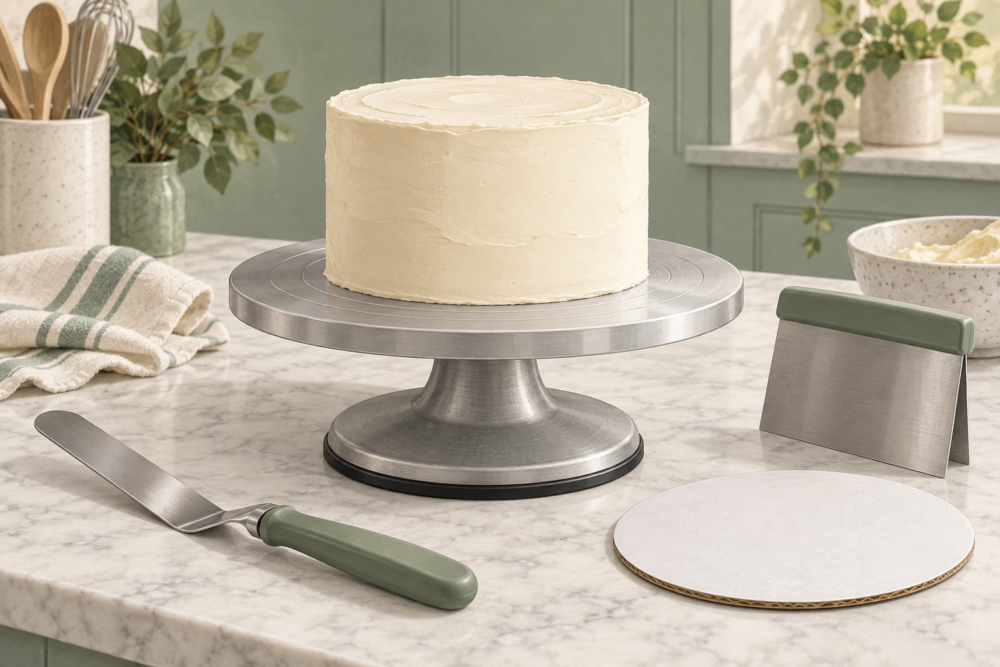
When comparing cake turntables on DHgate, check the top diameter against your cake board, the working height on your counter, and how the stand rotates and stays stable. A simple manual stand may suit occasional icing; adjustable height or tilt is useful only if it serves your decorating task. Confirm the selected option’s dimensions and included tools before ordering, rather than relying on a “professional” label.
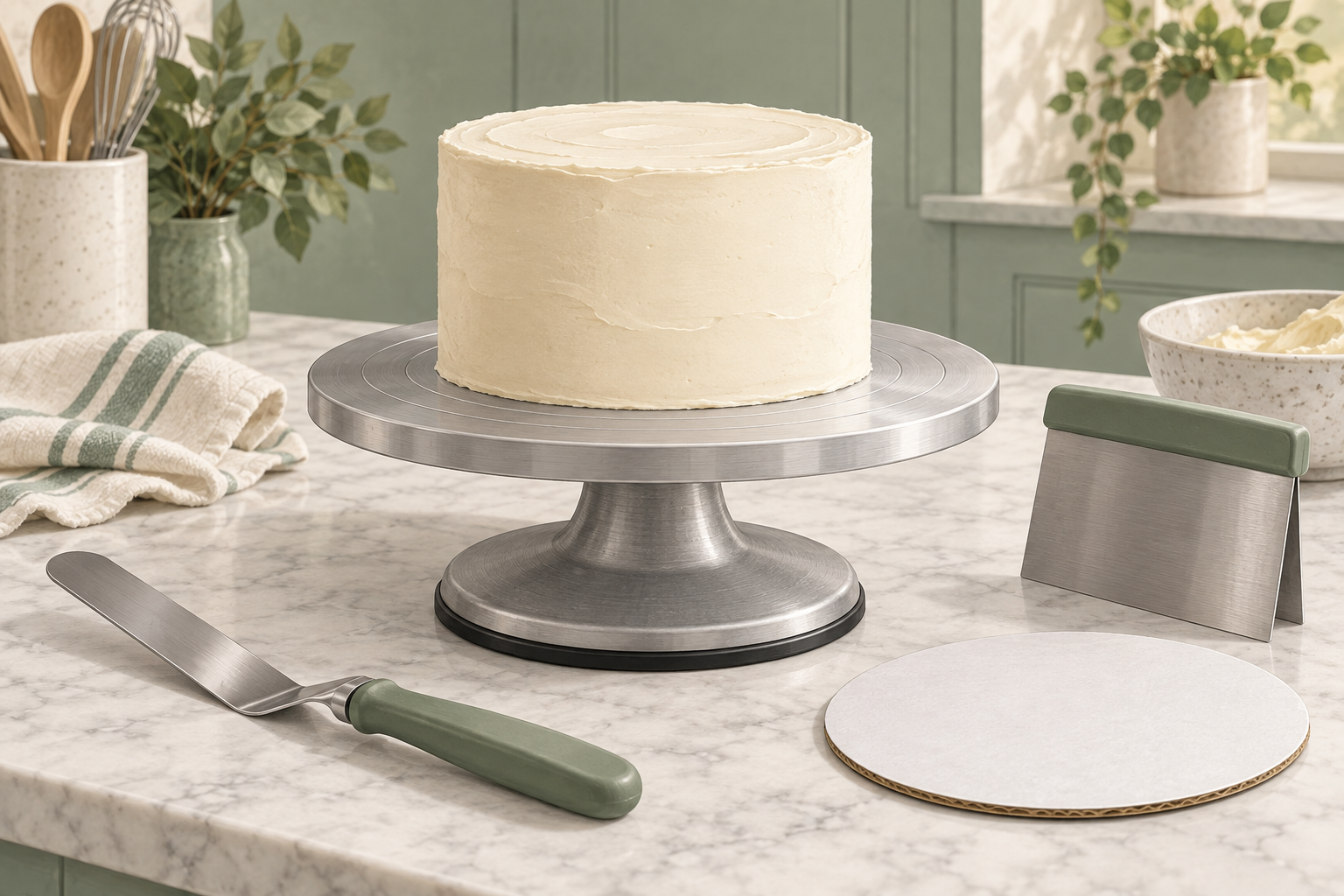
AI-generated illustration; not a seller product photograph or a scale drawing.
What a cake turntable does – and when a simple stand is enough
If you bake occasionally and mostly ice single‑ or double‑layer round cakes, a basic manual stand that spins in both directions, has a top at least as wide as your usual cake boards, and sits low enough to feel natural on your counter is typically enough. For many DHgate shoppers, that means a fixed‑height stand without tilt or power.
Fixed Height, Adjustable Height or Tilt?
A fixed-height manual stand is a straightforward choice when its height works on your counter and the platform suits your usual cake boards. Adjustable height changes where the cake sits relative to your hands. Tilt changes the angle of the platform, which is a different feature: check the intended use, board-retention method and locking instructions rather than assuming any angled stand will hold your cake securely.
Two manufacturer examples show what useful specifications look like. Wilton’s round plastic turntable is described as a 12-inch model. Its high-and-low model specifies a 12.75-inch diameter, two heights of 3.45 and 5 inches, and legs that lock in position. These are named product examples, not specifications or availability claims for DHgate listings.
If you are considering a motorized model, first establish whether you need continuous rotation for your technique. Request its instructions, power requirements and speed-control details. An electric drive is not a substitute for the correct platform size and a stable setup.
Check the Board, Working Height and Rotation Separately
Match the platform to the cake board
Measure the board you intend to use, including any border around the cake. Compare that with the stand’s usable top diameter, not the overall width of the base. Ask whether a raised rim reduces the usable area. Do not infer load capacity from diameter or from a photograph of a tall cake.
For a heavy or tiered project, obtain the maker’s stated use limits and instructions. If the selected DHgate option provides no usable specification for your project, choose a stand with better documentation. There is no universal cake-size-to-turntable-size chart established by this guide.
Set a practical working height
Consider the counter, stand, cake board and finished cake together. The highest setting is not automatically the best: you need to reach the top as well as hold a scraper at the side. Compare the listed height with your workspace and confirm whether the measurement includes an optional riser.
Distinguish three kinds of locking
A lock may secure the legs, hold a tilt angle, or stop the rotating top. These are different functions. Wilton’s high-and-low example describes locking legs; that alone does not establish a rotation lock. If you need the top to remain still for a detail, ask which part the selected mechanism actually locks.
Request a short demonstration of the stand turning with a board in place if smoothness is unclear. Look for visible wobble, rubbing or a base that moves across the counter. A demonstration helps assess the shown unit; it is not a guarantee about every item supplied.
| Detail in a DHgate offer | What to compare | Question if unclear |
|---|---|---|
| Platform diameter | Usable top versus your cake board | Does the rim reduce usable space? |
| Working height | Stand plus cake at your counter | What are the assembled height settings? |
| Lock | Rotation, legs or tilt angle | Which movement does it stop? |
| Base | Contact area and stated non-slip parts | Are feet or a mat included? |
| Bundle | Stand, board and decorating tools | What arrives with this exact option? |
Care and Bundle Contents Affect the Choice
A scene may show a cake, board, scraper and spatula even when the selected option is only the stand. Read the contents list and ask for an itemized answer. For smooth-side icing, consider whether you already own the spatula and scraper before paying for a larger set. More pieces do not establish that the stand itself is suitable.
Ask how the top and rotation mechanism should be cleaned. Do not assume that a metal appearance means stainless steel, that a removable top is dishwasher-safe, or that the entire stand can be immersed. For its high-and-low plastic model, Wilton specifies wiping with a clean damp soft cloth and drying thoroughly. That instruction belongs to that model; follow the instructions for the item you buy.
Check storage dimensions in the assembled and folded states if space is limited. Confirm which parts detach and whether reassembly requires tools. Keep cleaning and reassembly instructions with the stand so you can use the same setup consistently.
Smooth sides with a manual turntable: a short technique
Before you pay extra for tilting or electric stands on DHgate, try this simple manual approach. Use your recipe’s temperature and handling instructions, with the cake supported on an appropriate board.
- Level and crumb‑coat
Place your cooled, leveled cake on a board. Set the board on the turntable. Apply a thin layer of buttercream over sides and top to trap crumbs.
- Chill briefly
Refrigerate until the crumb coat firms up slightly. Follow your recipe’s chilling instructions before adding the final coat.
- Apply the final coat
Return the cake to the turntable. Add more buttercream than you think you need on the sides and top.
- Smooth the sides
Hold a straight icing scraper upright against the buttercream and turn the stand slowly with your other hand. Keep the scraper steady, remove excess icing from it between passes, and fill visible gaps before another pass.
- Clean the top edge
Pull the buttercream rim from the outside edge toward the center using an offset spatula, turning the cake as you go.
Where size and rotation matter here:
- A top that’s just slightly larger than your board gives room for your fingers and scraper, without feeling like the cake is drifting on a too‑wide platform.
- Smooth, consistent rotation lets you focus on hand position instead of repeatedly jerking the stand.
If you can get results you’re happy with using this method on a basic stand, you may not need tilting or powered models for everyday cakes.
When to Ask More Questions or Choose Another Stand
Before ordering on DHgate, resolve the measurements and mechanism details that matter to your own cakes. If the listing and seller’s answer disagree, keep the purchase undecided. A brand-identified stand from a baking retailer may be easier to assess when you need a particular dimension or documented use limit.
Upgrade because a specific task needs it: a different working height, a platform suited to your board, or controlled rotation. A heavier-looking finish or a bundle labeled “professional” does not establish those capabilities.
Use listing and seller risk checks alongside guidance on reading seller ratings. For a concise inquiry, see questions to send before ordering; include the selected option, your board diameter and the mechanism you need explained.
Reviewed September 12, 2026. This guide uses manufacturer documentation and practical selection checks; it does not report live listing reviews or hands-on product tests.