
Choose a windshield-washer tester that is specified for the fluid formulation you use. A coolant scale, DEF scale, or generic “4-in-1” label is not enough. Ask for the washer-fluid scale, supported chemistry, measurement range, and instructions before relying on a reading.
A portable tester can support routine checks of dilution or the stated property it measures. It does not by itself certify cleaning performance, nozzle operation, or every winter-protection claim. This is a purchasing guide, not a laboratory validation procedure.
Match the scale to the liquid
Washer fluids can use different alcohol formulations and additives. A scale calibrated for one mixture should not be assumed valid for another. Read the fluid’s label and safety data sheet, then ask the instrument supplier to identify which formulations the washer scale supports.
A hydrometer uses density and buoyancy; an optical refractometer uses a refractive-index reading. Any conversion to concentration or estimated freeze protection depends on the applicable scale and method. Do not infer a universal accuracy advantage from the instrument type.
Specific listings to investigate
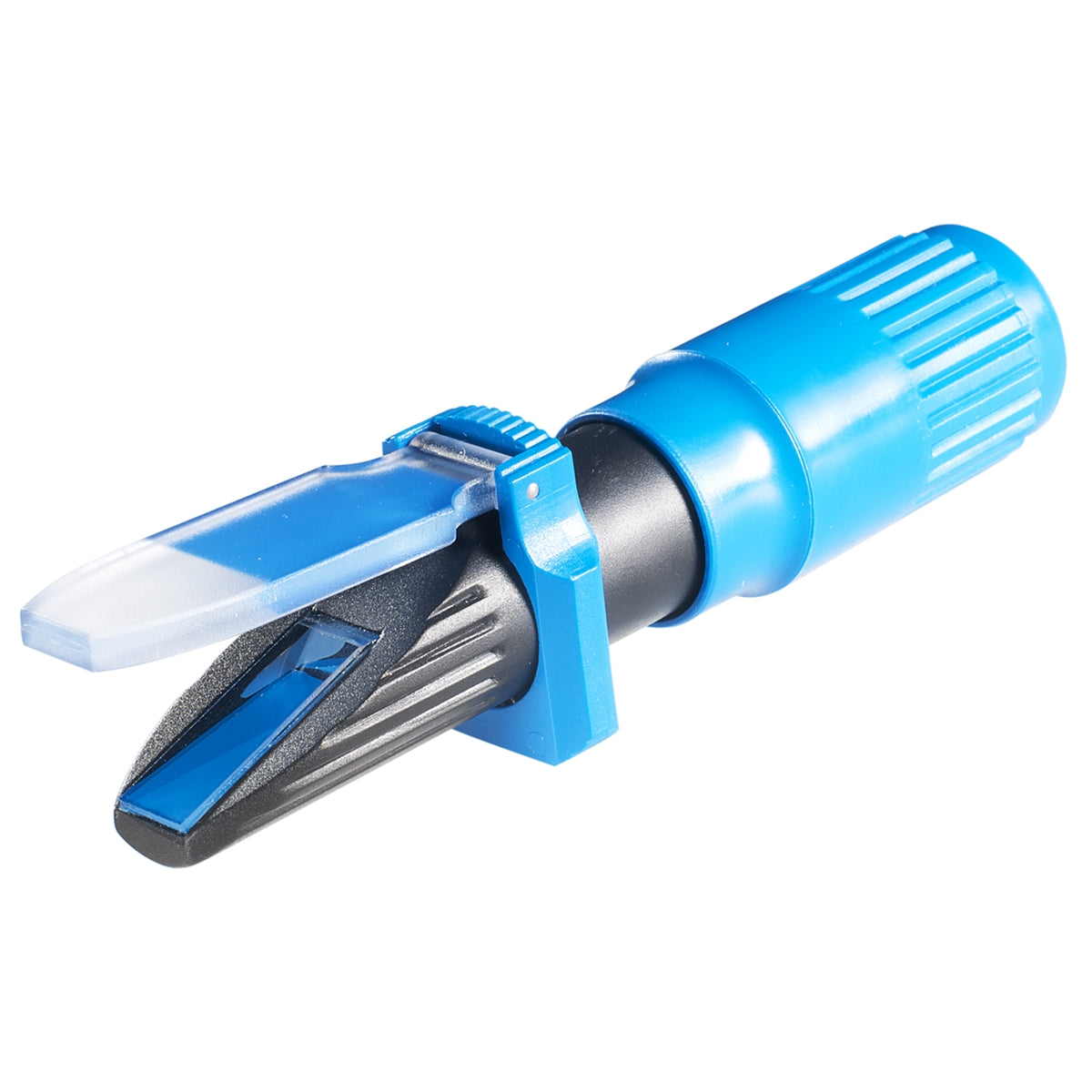
Mueller Kueps MLK727090 at OEM Tech Tools
The specific product page explicitly lists DEF/AdBlue, radiator coolant, windshield washer fluid, and battery acid applications. It lists a sampling dropper, cleaning cloth, and calibration-adjustment screwdriver. That supports the stated range of applications, not a claim that it works on every chemical blend.
Ask before buying: the exact washer-fluid chemistry, scale units and range, resolution versus stated accuracy, test-temperature limits, and a model-specific manual. The page does not provide enough information to quote a verified accuracy value or certify a fluid’s label claim.
IBSPOT’s multi-fluid ATC refractometer
The IBSPOT listing says it includes washer-fluid, coolant, DEF, and battery-electrolyte measurements, ATC, and a user manual. Its description does not establish a model-specific accuracy specification or the alcohol formulation behind the washer scale.
Best reason to investigate it: you need several automotive scales in one instrument and can obtain the missing specifications. Do not treat the seller’s feature list as a calibration certificate or evidence that all multi-fluid tools are interchangeable.
Check the operating limits
Calibration and temperature
Follow the exact manual’s calibration procedure and use its specified reference. ATC is automatic temperature compensation within an instrument’s supported conditions; it does not remove the need to calibrate or validate readings. Allow the sample and instrument to reach the conditions required by the manufacturer.
Sampling and cleaning
Use the manufacturer’s sampling and cleaning instructions. Keep equipment used for different fluids from contaminating the next sample. Handle washer fluid and battery electrolyte according to their safety data sheets; do not use food containers or food-use instruments for automotive chemicals.
Recording a result
Record the fluid identity, sample source, tool model, selected scale, calibration check, test conditions, and result. A number without the scale or formulation may not support the conclusion you want to draw.
Choose for the job, not the tool count
For occasional washer-fluid checks, consider a purpose-built tester only when its documentation matches your fluid and expected temperatures. For a workshop handling several fluids, a multi-scale instrument may save storage and equipment duplication, but each scale still needs its own applicable method.
For production quality control or substantiating advertised freeze-protection limits, ask the fluid manufacturer or an appropriate testing laboratory for the required test method and validation. Do not use a retail refractometer description alone to promise professional-grade precision.
Before checkout, obtain the manual, support and return terms, and the final delivered cost. Our shopping-site trust guide covers seller and payment checks; it cannot determine whether a measuring instrument is technically suitable.