
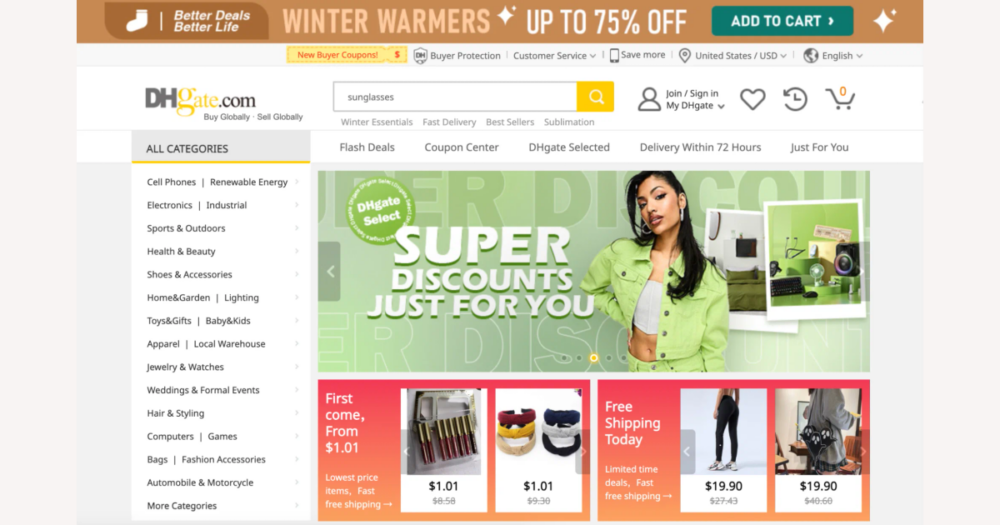
If you’re in the US looking for custom shirts made in China, DHgate is one relevant marketplace rather than a single best answer. Its value comes from aggregating many suppliers while handling payments, ratings, and buyer protection, but you still need to judge each listing on fabric details, sizing, customization options, and how well the seller and platform safeguard your order. This guide explains how to use DHgate in that role so you can reduce risk before you commit money.
How DHgate fits among platforms for China-made custom shirts
For China-made custom shirts, there isn’t a single objectively best platform. What you need—small test runs versus bulk orders, simple logo prints versus more complex designs, and how much sourcing work you’re willing to do—changes which type of platform makes sense.
Broadly, buyers use three categories of platforms. China-focused marketplaces like DHgate and Alibaba give you direct access to many suppliers, with wide variation in shirt quality and service. You do more evaluation yourself, but the platform usually provides ratings, reviews, and structured payment and dispute tools. Global print-on-demand services wrap design tools, on-demand printing, and fulfillment into one interface; they tend to be more expensive per unit but require less sourcing effort. Manufacturer directories and sourcing lists mainly connect you to factories and are often geared toward larger minimum order quantities and brand-level production runs, not one-off custom tees.
DHgate’s role in this landscape is as a marketplace that aggregates many China-based sellers and runs the transaction layer. You search listings for custom shirts, review seller profiles and specs, then pay through DHgate rather than wiring money directly to a factory. DHgate’s own ratings, payment handling, and buyer-protection framework can make it a practical option when you want access to multiple suppliers but still want some structure around orders, shipping updates, and disputes.
From my perspective, DHgate is useful when a seller can show transparent shirt specifications—fabric composition, sizing charts, customization options—and you can see clear signs of reliable transaction handling. If a listing or seller can’t provide that level of detail, I would rather walk away, even if the price looks attractive. The rest of this guide focuses on how to read DHgate listings and seller signals through that lens, instead of chasing a single “best” site for every custom-shirt project.
How ordering custom shirts on DHgate typically works
- Start by searching or browsing DHgate for custom shirts, narrowing results by shirt type and style (for example, T-shirts, polos, work shirts) and using keywords related to customization such as “logo print,” “embroidery,” or “custom design.”
- Open promising listings to review the shirt options and customization parameters. Pay close attention to size charts, available colors, printing or embroidery methods, and how you’re expected to provide artwork or text—whether via file upload, text fields, or seller messages.
- Check the seller information attached to each listing, including ratings and reviews, then use DHgate’s internal messaging to clarify specs. Confirm that your design files are suitable, that the seller can handle your requested quantities and timelines, and that they understand any specific sizing or color requirements.
- Once you’re satisfied with the listing and seller responses, place the order through DHgate’s checkout. Select quantities, confirm any customization notes that are recorded in the order, and choose from the shipping options the seller offers within the platform flow.
- After payment, monitor order status and shipping updates through DHgate’s tracking tools. Keep all important communication—approving proofs, asking questions, reporting issues—inside DHgate’s messaging and order system so you have a clear record if you ever need to reference it for adjustments or a dispute.
Key listing specifications to verify for custom shirts on DHgate
- Fabric: Look for clear fiber composition such as “100% cotton” or specific blends (for example, 60% cotton / 40% polyester), and note any listed weight or gsm if available. Treat vague phrases like “high quality fabric” or “premium material” as marketing, not a substitute for precise fabric information when you care about feel, breathability, and how the shirt will wash and wear.
- Sizing: Check that the listing includes a measurement-based size chart—chest width, body length, shoulder width, sleeve length—rather than relying only on S/M/L labels. Pay attention to fit descriptors like slim, regular, or oversized, and be cautious when you see regional sizing (Asian, EU, US) without clear measurements; use the chart to compare against a shirt that already fits you.
- Colors and finishes: Confirm the available colors and any finish options (matte vs glossy prints, heather vs solid fabrics). See how colors are named or coded—swatches, color codes, or detailed descriptions—and understand that exact brand or Pantone-like shade matching may be limited unless the seller explicitly offers color code matching and is willing to confirm it in messages.
- Customization methods: Identify which decoration technique the seller will use, such as screen printing, DTG (direct-to-garment), heat transfer, or embroidery. This affects how crisp the design looks, how long it lasts, and what kind of artwork files are suitable. If the method isn’t stated, ask; avoid listings that promise custom logos but never clarify how they’re applied.
- MOQ and variants: Verify the minimum order quantity (MOQ) for custom work and whether mixed sizes or colors are allowed within one order. Check if prices change at different quantity tiers and how that affects your budget for test runs versus bulk orders. A clear MOQ and pricing structure makes it easier to plan samples without committing to more units than you need.
- Customization input and proofs: Check how you’re expected to submit designs—file uploads, text fields, or detailed notes about logo placement and size—and whether the seller offers digital proofs or mockups. For custom shirts, insist on a proof that shows placement and approximate scale before production, and make sure your approvals and any changes are recorded in DHgate messages or the order notes.
Reading material-quality signals beyond marketing claims
For material quality, precise data is more useful than broad labels. Listings that specify fabric composition in percentages—such as 95% cotton and 5% spandex—tell you far more about how a shirt will feel and behave than generic descriptions like “cotton blend.” Composition lets you anticipate stretch, breathability, and how well the fabric will hold prints or embroidery, especially if you’re ordering for workwear or branded merch where comfort and consistency matter.
Weight and thickness indicators, when provided, are another key signal. Some DHgate sellers list gsm (grams per square meter) or describe shirts as lightweight, midweight, or heavy. Link those clues to your intended use: a low gsm is typically better for summer promotional tees, while a thicker fabric suits uniforms or pieces meant to last longer. If weight isn’t specified, treat claims like “not see-through” or “thick quality” cautiously and ask the seller for more detail if weight is important to you.
Visual evidence can help bridge gaps in the written description. Close-up photos of the fabric surface, seams, neck ribbing, and inside stitching give you a sense of construction quality. Visible loose threads, uneven seams, puckering around prints, or stretched-out collars in product photos may indicate weaker workmanship; by contrast, clean stitching and stable necklines are more consistent with shirts that will survive repeated wear and washing.
Reviews are often uneven, but patterns are informative. When scanning DHgate buyer feedback, look for repeated comments about softness, breathability, shrinkage after washing, how well prints or embroidery hold up, and whether colors fade quickly. Consistent notes—positive or negative—carry more weight than a single outlier review. A listing with many orders and multiple comments saying “fabric shrinks a lot” or “logo cracked after a few washes” should be treated as higher risk than one with steady praise for comfort and durability.
Overall, treat seller adjectives like “premium,” “luxury,” or “high quality” as marketing unless they’re backed by concrete evidence—composition percentages, weight information, detailed photos, and review patterns. When a listing leans heavily on hype but offers little specific data, it’s safer to downgrade your confidence or walk away, especially if you’re ordering for a brand or team where material feel and longevity really matter.
Assessing seller reliability for custom work on DHgate
Once you’re reasonably happy with the fabric and construction, the next question is whether the seller can actually deliver custom work without drama. On DHgate, that starts with the combination of rating and transaction volume. A seller sitting at around 4.7–4.9 stars with dozens or hundreds of completed orders usually gives you a clearer picture than someone with a perfect score and only a handful of sales, because there’s more history for problems to show up in.
Don’t stop at the star score. Open the reviews and look specifically for comments about custom logos, print or embroidery quality, sizing accuracy, and how issues were handled. Feedback that mentions things like “logo matched the file,” “sizes ran small,” or “seller fixed a misprint quickly” is far more useful than a long list of one-line notes saying only “fast shipping.” Patterns matter: repeated complaints about wrong colors or poor communication are a warning sign, while steady praise for accurate customization and good after-sales support is a positive signal.
Communication behavior before you pay is another reliability filter. Send a clear pre-order message that covers your design, quantities, size breakdown, deadlines, and any special requirements, and watch how the seller responds. Prompt replies, specific answers to each point, and a willingness to share extra photos or clarify specs suggest they’re paying attention; vague, delayed, or copy-paste responses are a sign you may struggle to resolve problems later. If a seller can’t explain their own process or timelines in messaging, I would rather choose someone who can, even if it costs a bit more.
DHgate sometimes highlights sellers with badges or verification marks that indicate a certain level of platform recognition. These can be one part of your trust picture, especially when they align with strong ratings and solid review detail, but they’re not guarantees. Treat badges as supporting evidence, not a reason to ignore weak communication or worrying feedback patterns.
For custom shirts, I would prioritize transparent information and solid reliability signals over the absolute lowest price. A seller who clearly documents specs, has a substantial track record, answers messages thoroughly, and shows consistent review patterns is usually a safer choice than a much cheaper option with thin history and generic promises. If you’re running a very tight budget test, you might decide to experiment with a riskier, lower-priced seller—but do it with eyes open, keep the order small, and be prepared for more follow-up work if something goes wrong.
A practical pre-order checklist for DHgate custom shirts
- Re-check key listing specs. Confirm fabric composition, size chart measurements (including how they compare to shirts you already own), available colors, and the stated customization method (screen print, DTG, embroidery, heat transfer, and so on). Make sure the listing explains how you will submit designs—file upload, text input, or image messages—and whether there are format requirements.
- Message the seller before you order. Send a concise but detailed note summarizing your design, quantities, size breakdown, and deadline. Ask them to confirm production time, any limits on colors or print areas, and whether they will provide digital proofs or sample photos before full production. Their speed and clarity in responding is itself a reliability signal.
- Verify shipping methods and timelines. Check which shipping options are available, the estimated delivery windows, and how production time interacts with transit time. For events or launches, build in buffer for cross-border shipping and potential delays, and avoid assuming the fastest listed option will always arrive on the earliest date.
- Review payment handling and protection at a high level. Understand that DHgate keeps payment within its system and offers defined buyer protection mechanisms, and plan to keep all key agreements inside the order and messaging thread. Avoid any suggestion to pay off-platform (for example, via direct transfer or another app), as that usually weakens your ability to rely on DHgate’s safeguards.
- Start small when you can. If the design is new, complex, or the seller is unfamiliar to you, place a sample or small test run first. Use that batch to check fit, print quality, color accuracy, and how the seller communicates when adjustments are needed before committing to a large bulk order.
- Keep the tradeoff in mind. This checklist deliberately emphasizes clarity and safeguards over speed and rock-bottom unit prices. I’d rather spend a little more time and money up front to avoid a large batch of unusable shirts; if your budget is extremely tight, you might compress some steps or accept higher risk, but make that choice consciously rather than by default.
How DHgate’s payment, shipping, and dispute protections apply to custom shirts
For custom shirt orders, DHgate generally sits between you and the seller in an escrow‑like role: you pay through DHgate, and the money is released to the seller only when certain conditions in the order flow are met, such as shipment or confirmation of receipt. Keeping all payments inside DHgate—not via bank transfer, external apps, or direct invoices—helps ensure that your transaction is covered by the platform’s buyer protection rules.
Once an order is placed, DHgate typically shows status updates in your account (payment received, in production, shipped, delivered) and surfaces tracking details provided by the seller or carrier. Because custom shirts add production time on top of shipping, it’s important to agree on realistic timelines before you pay: ask the seller to confirm how many days they need for printing or embroidery, how long shipping usually takes to your location, and what date range you can reasonably expect for delivery, then compare that with any event or launch deadlines you have.
If something goes wrong, DHgate offers structured processes for opening a dispute and requesting a refund or adjustment. Those processes usually rely on evidence: order details showing what was promised, message history documenting any agreements or changes, and photos or videos that show defects, wrong designs, sizing problems, or non‑delivery. The platform’s rules determine which issues qualify for which types of resolution, so you should treat any summary here as a starting point and read the current policy wording on DHgate itself before you rely on it.
To make those protections work in your favor, keep all key agreements inside DHgate’s system. Send design files, spec confirmations, quantity and size breakdowns, and timeline promises through DHgate messaging rather than off‑platform chat. When the seller shares digital proofs or sample photos, save them in the thread or attach them to the order. If you later need to escalate a dispute about misprinted logos, incorrect sizes, or late delivery, that on‑platform documentation becomes your main evidence, and without it DHgate has less basis to intervene. Protections are useful, but they are not automatic; they work best when you deliberately structure your communication and payment around them.
Common risks and misunderstandings with DHgate custom shirts
- Sizing confusion. Custom shirts often trip buyers up when listings rely on vague labels like S/M/L or mix regional systems without clear measurements. Poor or inconsistent charts can lead to entire batches that don’t fit. For DHgate orders, treat the size chart as non‑negotiable: compare the listed chest, length, and shoulder measurements to shirts you already own, ask the seller to clarify any missing data, and avoid guessing between “Asian” and “US” sizing without concrete numbers.
- Color and print mismatches. What you see on your screen and what comes out of a printer or embroidery machine are not always identical. Differences in color profiles, fabric type, and print method can shift hues or mute gradients, and low‑resolution files can look jagged on the final shirt. Reduce this risk by agreeing on color references where possible (such as Pantone codes or simple descriptive comparisons), checking the seller’s guidance on acceptable file formats and minimum resolution, and asking how they handle adjustments if the first sample is off.
- Design execution errors. Even when the file is correct, prints can end up misaligned, logos can sit higher or lower than expected, or text can be misspelled. For custom work on DHgate, push for a proof step: ask the seller to send a digital mock‑up or photos of a sample shirt showing placement and scale before they produce the full run. Reviewing that proof carefully and confirming changes in writing is much cheaper than trying to fix an entire bulk order after the fact.
- Timeline surprises. Buyers often underestimate how long custom production plus cross‑border shipping will actually take. Factory queues, material availability, holidays, and carrier delays can all push delivery beyond the optimistic estimate shown in a listing. Treat DHgate’s timeframes as best‑case scenarios, build in buffer time for events or launches, and confirm with the seller how they handle delays or partial shipments so you’re not relying on a single narrow delivery window.
- Overreliance on protection. DHgate’s safeguards can help when something goes genuinely wrong, but they are bound by specific conditions and evidence requirements. Being disappointed by fabric feel or minor color variation may not qualify for a full refund, whereas clear proof of non‑delivery or major misprints usually carries more weight. Prepare by reading the current buyer protection and dispute policies on DHgate, keeping all key communication and proofs in the platform, and, where possible, starting with smaller test orders so that any problems are limited in scope rather than affecting your entire budget.
FAQ: Is DHgate suitable for small runs or single custom shirts?
Is DHgate suitable for small runs or single custom shirts, or is it mainly for bulk orders?
DHgate itself doesn’t set one minimum order quantity (MOQ) for all custom-shirt sellers; it’s a marketplace, so each seller chooses their own rules. Some sellers offer low-MOQ or sample-friendly options and may accept very small runs or even single customized pieces, especially for promotional or print-on-demand-style listings. Many others focus on bulk production and require higher MOQs, which can be a barrier for first-time buyers.
To see whether a listing works for small quantities, read its MOQ and quantity fields carefully and check if it explicitly allows mixed sizes or colors within one order. If this isn’t clear, message the seller through DHgate to ask about minimums, size and color breakdowns, and whether they’ll provide a sample or small test run before a larger order. When a seller’s MOQ permits it, using DHgate for a limited test batch is often a sensible way to validate fit, print quality, and communication before you commit to full-scale bulk production—but you shouldn’t assume every custom-shirt seller on DHgate will agree to very low quantities.