
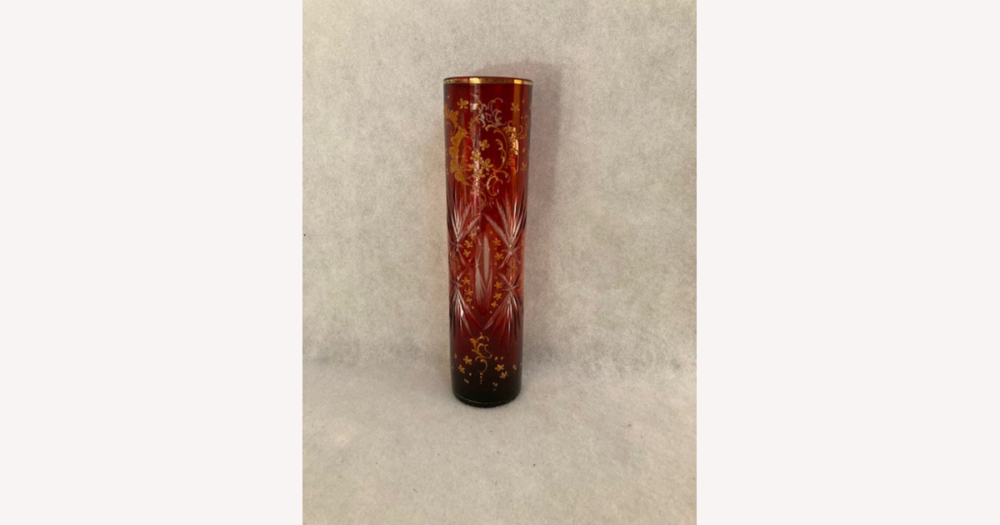
If you’re searching for rare Moser cranberry or Bohemian glass vases, DHgateWiki can’t show you live inventory or point to specific sellers—but it can make your next decision much safer. This guide explains how these vases are typically described, which physical details you can verify from photos and measurements, and what to ask a seller about authenticity, credibility, and shipping before you commit to any listing on any marketplace.
How this guide helps you research rare Moser and Bohemian cranberry vases
On DHgateWiki, you won’t find live listings or recommendations for specific Moser or Bohemian cranberry vases. Instead, this page helps you use DHgate as a research hub: it explains what sellers usually mean by rare Moser cranberry and Bohemian glass, how those vases are described in listings, and which details you can objectively check in photos and descriptions.
You can use that knowledge to prepare questions and authenticity checks, and to decide whether a listing on any marketplace is documented well enough for the price and risk you’re considering. The goal is to avoid weakly described or misrepresented pieces; you still make your own purchase decision after applying the seller, authenticity, and logistics checks outlined in the rest of the guide.
What typical features do Moser cranberry and Bohemian glass vases have?
Listings for Moser cranberry and Bohemian glass vases usually start with concrete material and color details. You’ll often see cranberry or ruby red glass, sometimes paired with clear or differently colored crystal. Descriptions should make it possible to confirm the basic points in photos: is the color even and rich, does the glass look clear rather than cloudy, and does the surface show the expected gloss of quality crystal or glass rather than a dull finish.
Form and size are another objective layer. These vases range from slim bud vases to larger statement pieces with wider bodies or flared rims. Bohemian work often features cut or overlay patterns—panels, facets, or layered colors—that you can see clearly from multiple angles. Accurate dimensions, shown in both text and scale photos, help you judge whether the vase fits your display plans and whether the proportions match what the seller claims.
Decoration frequently includes gold gilding and hand‑painted enamel motifs such as florals, scrollwork, or other ornamental designs. Close‑up images should let you inspect how crisp the enamel lines are, whether the gold shows even application, and how much wear is visible on raised or rim areas. Those are factual, checkable details. By contrast, phrases like “rare,” “fine,” “museum‑quality,” or “exceptional” are promotional language; they don’t by themselves prove age, maker, or scarcity unless backed by marks, provenance, or other evidence discussed later in the guide.
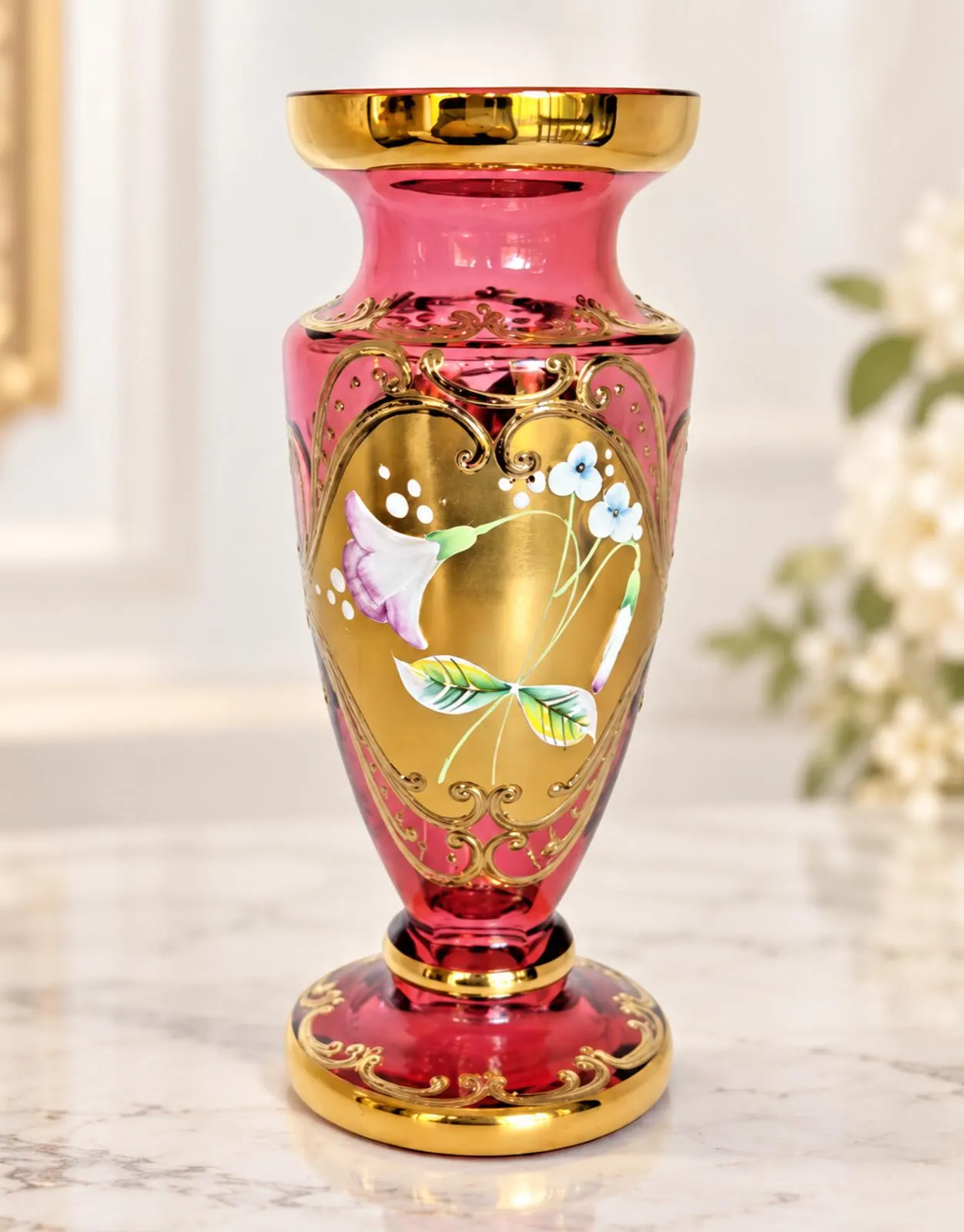
A cranberry‑red glass vase with decorative detailing illustrates how color, form, and surface decoration appear in real pieces, helping you connect listing descriptions to an actual object.
How is Moser glass distinguished from generic Bohemian cranberry glass?
Sellers and collectors usually start Moser attribution with concrete cues rather than headline adjectives. Strongly attributed pieces often carry a signature or maker’s mark on the base or lower side of the vase, sometimes etched, engraved, or painted. These marks are then considered alongside characteristic decorative features: dense, well-controlled enamel work, rich but finely applied gilding, and motifs that match documented Moser patterns and production periods in general references or auction records.
By contrast, listings that say “likely Moser,” “Moser-style,” or simply “Bohemian cranberry glass” are signaling weaker certainty. They may show cranberry-red glass and ornate gilding, but without a readable mark, clear documentation of origin, or decoration that closely matches known Moser designs, the attribution is essentially an informed guess. In practice, many attractive Bohemian vases are described in aspirational language that outstrips the available evidence.
Because attribution often depends on marks, style comparison, and provenance considered together, it may remain unresolved. A listing title alone cannot guarantee that a vase is genuine Moser; at best it tells you how the seller wants the piece to be perceived. I would personally treat high-priced vases without convincing marks or documentation as decorative Bohemian cranberry glass rather than verified Moser, and I would walk away if a seller expects collectible-level pricing while offering only vague attribution. If you are comfortable treating the piece purely as a decorative object, looser attribution may be acceptable, but that is a different decision from serious collecting.
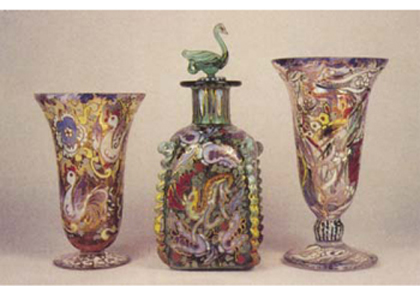
Use the close-up to see how marks, enamel, and gilding may appear together on a vase, and to practice asking yourself whether those cues genuinely support a Moser attribution or could belong to similar Bohemian-style glass.
Checklist: how to vet authenticity claims for rare Moser and Bohemian vases
- Read the full listing description carefully and separate specific claims from sales language. Note what the seller states about maker (for example, Moser or “Moser-style”), production period (19th century, circa 1880s, vintage), materials (cranberry glass, lead-free crystal), rarity, and condition, rather than focusing only on words like “rare” or “fine.”
- Inspect every photo at the highest resolution available. Look for clear, legible signatures or maker’s marks on the base or lower body, and check that enamel and gilding are evenly applied with crisp lines, not smudged or roughly painted. Confirm that the glass color, clarity, and cut or overlay details in the images genuinely match what the description promises.
- Evaluate wear patterns for consistency with age. Antique or older vintage vases often show gentle wear to gilding on rims or high points, light scratching or dulling on the base, and minor surface marks that feel appropriate to decades of careful use. A piece that looks uniformly new, or one with harsh, inconsistent damage, may not match claims of 19th-century origin.
- Compare motifs, forms, and decorative techniques to examples in general glass references or auction archives. Look for strong, specific similarity in shape, panel layout, enamel style, and color combinations rather than a vague resemblance. This comparison won’t prove authenticity on its own, but it helps you decide whether the listing’s attribution is plausible or stretched.
- Contact the seller with targeted questions whenever the price is high or the listing leans on bold phrases like “rare Moser,” “museum-quality,” or “circa 1880s.” Ask for close-up photos of any marks, the decoration, the rim, and the base, and request any available documentation or provenance, such as prior auction listings or expert appraisals that link the vase to Moser or a specific Bohemian workshop.
- Decide how far you are willing to go without solid evidence. For serious collecting at higher prices, I would only proceed when marks, style comparison, and documentation all point convincingly to Moser or a well-defined origin. If those elements are missing or weak, I would either treat the vase strictly as a decorative piece—priced and judged as such—or walk away. Even with careful checks, online attribution is never completely foolproof, so it is better to accept uncertainty openly than to pay collectible-level prices for a hypothesis.
How to judge seller credibility for collectible glass purchases
For rare or high-value glass vases, treat the seller’s track record as part of the authenticity evidence. Start with overall ratings, how many transactions they’ve completed, and what recent reviews actually say. Comments that mention accurate descriptions, careful packing of fragile items, and good communication are more useful than generic praise. A seller who routinely handles glass, antiques, or collectibles and writes detailed listings—with clear measurements, material descriptions, and honest condition notes—generally inspires more confidence than one who offers sparse information and stock phrases.
Pay close attention to how the seller responds before you commit. Prompt, specific answers to questions about marks, provenance, and packing are a positive sign, and written policies on returns, damage claims, and resolution timelines help you know what will happen if something goes wrong. Strong credibility makes it more reasonable, though never guaranteed, to rely on nuanced claims about origin or age. When a seller is new or has very little feedback, they are not automatically untrustworthy, but I would only pay collectible-level prices with extra caution—or treat the vase as a decorative purchase where exact attribution matters less.
Key logistics to settle before buying a fragile glass vase online
- Confirm all item details before purchase. Make sure dimensions, weight, materials, and condition notes match what you expect, and calculate the full cost with shipping and any taxes or duties so there are no surprises.
- Ask the seller to describe or show their packing method for fragile glass. Look for practical safeguards such as double boxing, generous padding around the vase, and space between the glass and the box edges so impacts are absorbed by packing, not the item.
- Clarify how the vase will be shipped. Confirm the carrier, service level, estimated delivery time, and tracking, and ask whether the parcel will be insured for its declared value, especially if the piece is expensive or traveling internationally.
- Factor in customs or import implications for cross-border orders. Duties, inspection delays, or extra documentation can affect your total cost and timing, so it’s better to understand these possibilities before you pay.
- Plan your documentation in case something goes wrong. Keep all pre-sale correspondence, and when the vase arrives, photograph the outer box, inner packing, and the vase itself from multiple angles as soon as you open it, especially if you see damage or discrepancies.
- Remember that even excellent logistics can’t remove all risk. Clear agreements about packing, shipping, insurance, and documentation simply make it much easier to use marketplace dispute or refund processes if the vase arrives broken or not as described.
Major risks to watch for with “rare” Moser and Bohemian vase listings
Collector vs decorator: which buying approach fits your vase search?
As a collector, you look for signed or clearly marked cranberry and Bohemian vases, strong evidence that a piece is genuinely Moser, and decoration that matches documented patterns and production periods in reference books or auction records. You expect detailed condition notes and clear provenance, and you are willing to pay more—or to walk away entirely—when a listing’s attribution or documentation doesn’t meet that standard.
As a decorator, you focus on how the vase looks in your space: color, form, motifs, and overall condition. You may be comfortable with “Moser‑style” or generic Bohemian cranberry glass, accepting that the piece is not a verified collectible as long as it is attractive, sound enough for display, and fairly priced for its decorative value.
Each approach has trade‑offs. Collectors typically face higher prices, narrower selection, and more research effort in exchange for stronger provenance and clearer authenticity. Decorator‑style buying opens up more options and often lower costs, but with more uncertainty about maker and age. For any listing framed as rare, antique, or high‑value, I would personally treat it with collector‑level standards and skip it if marks, documentation, or condition are poorly supported; I’d only relax those demands for clearly lower‑priced, style‑first pieces where you’re consciously choosing design over verified attribution.
Before you buy: cross-check bold claims and decide what matters most
Treat bold listing claims—such as “Moser,” precise 1880s dates, or “rare investment piece”—as hypotheses, not settled facts. When a seller leans on those statements, compare the vase’s form, motifs, enamel and gilding style, and color combinations with examples in neutral glass references or published auction records for similar pieces. Those sources often show wide variation in how Moser and Bohemian glass are described and valued, which is a reminder to question any single, confident claim.
As you compare, pay attention to gaps and contradictions. If marks are unclear, dates don’t match typical production periods, or the style looks unlike documented Moser work, treat the attribution as unresolved rather than quietly assuming the listing is correct. For higher-priced or supposedly antique vases, it’s safer to assume uncertainty when evidence is thin than to pay collectible-level prices on the strength of a title or sales language alone.
When choosing a cranberry or Bohemian vase, should I prioritize confirmed Moser branding or overall design and condition?
It depends on whether you are buying as a collector or as a decorator. As a collector, confirmed branding and provenance—readable marks, style that matches documented Moser patterns, and credible references or past auction records—should carry the most weight, and I would walk away from any listing priced as rare or antique that cannot support those claims. As a decorator, you can reasonably focus on color, form, motifs, and sound condition, accepting that a “Moser-style” or generic Bohemian vase is an unverified design piece rather than a certified collectible. I would only relax collector-level standards for clearly lower-priced, style-first purchases where you are explicitly comfortable with that uncertainty.