

On DHgate, the most useful beginner’s slide rule for a student isn’t a rare brand; it’s a simple, clearly printed rule that’s easy to read and sturdy enough for everyday class use. This guide explains the key features to look for and shows how to combine those criteria with DHgate’s seller, order, payment, and dispute tools, so you can assess any listing yourself rather than rely on product recommendations.
What makes a slide rule beginner-friendly for a student?
For a student’s first slide rule, “beginner-friendly” means straightforward and easy to read, not impressive or collectible. Instead of hunting for one perfect brand or model, focus on a simple rule that helps a new learner see how the scales work without struggling with tiny, crowded markings or unusual layouts.
Most student-friendly slide rules are roughly 25–30 cm (about 10–12 inches) long, with clear contrasting printing so the numbers and tick marks stand out against the background. A good beginner tool usually carries just a small set of core scales for multiplication and division (often labelled C and D), and sometimes extra scales for squares, roots, or basic trigonometry, rather than a dense forest of specialised markings.
I would personally choose a clean plastic or plain metal slide rule with a solid feel and uncluttered scales over a feature-packed, ornate, or heavily vintage piece for a first-time learner, because it’s easier to see what’s going on and survive everyday use in a school bag. If a school specifies a certain type, or if someone is collecting, it’s reasonable to pick a more complex or older rule to match that requirement, as long as you recognise that it may be harder for a beginner to read and use.
Basic slide rule parts and scales you’ll see in listings
Once you know you’re aiming for a simple, readable slide rule, it helps to recognise the basic parts you’ll see in listing photos. A typical straight slide rule has a fixed body with printed scales along its length, a sliding inner strip that moves left and right, and a transparent cursor (also called a hairline) that glides over the front. The body and slide carry the numbered scales; the cursor’s fine line lets you line numbers up accurately between them.
In photos, the body often looks like a solid rectangular frame, the slide is the central strip you can see shifted slightly off-centre in different images, and the cursor appears as a clear plastic window with a thin vertical line. Listings may mention scales like C and D (commonly used for multiplication and division), A and B (for squares and square roots), and simple trigonometry scales. You don’t need a full calculation lesson to shop: for a beginner, it’s usually better when these standard scales are clearly labelled and spaced out than when the rule is packed with many tightly crowded or unfamiliar markings. If listing images show a cursor, a few well-spaced scales with neat labels, and numbers you can easily read at a glance, that’s a good sign for a student tool.
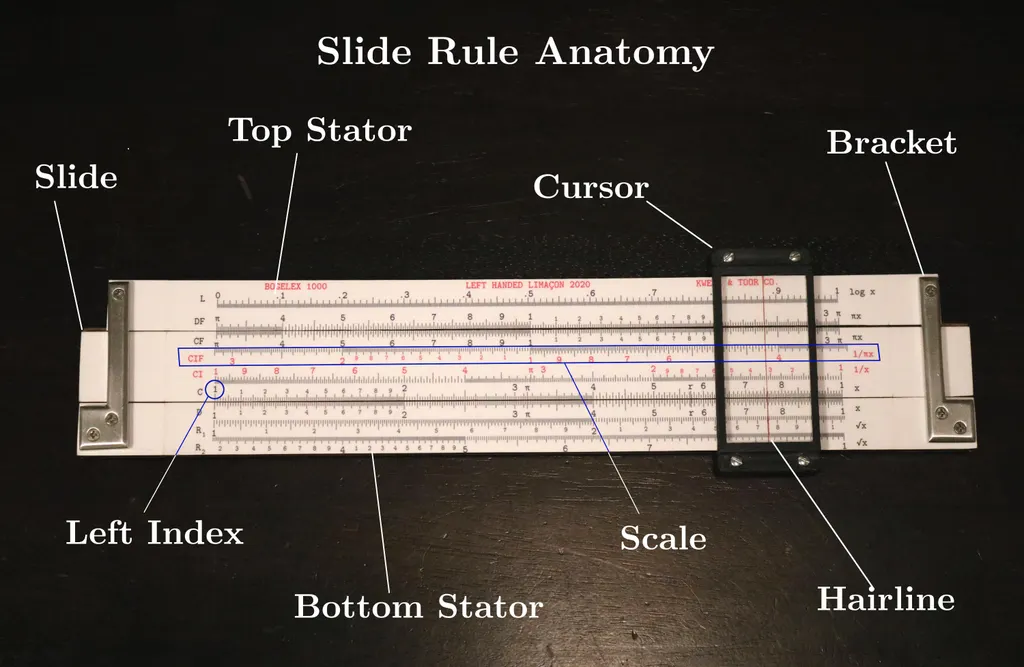
A straightforward slide rule with a fixed body, central sliding strip, and clear cursor helps you match the parts described in the guide to what you see in listing photos.
Student tools vs advanced and collectible slide rules
| Type of slide rule | Typical features | Condition and readability | Best suited for | Listing signals it targets collectors or advanced users |
|---|---|---|---|---|
| Simple student slide rule | Straight rule around 25–30 cm with a fixed body, central slide, cursor, and a few standard scales (C, D, A, B, maybe basic trig). | Modern printing with high contrast; scales are clearly labelled and spaced so numbers are easy to read in class. | Students learning how slide rules work; teachers and parents who want a practical classroom tool. | Plain titles mentioning “student,” “learning,” “school,” “math tool,” standard-length measurements, clear photos of a cursor, and uncluttered scales rather than dense diagrams. |
| Advanced technical slide rule | May be longer, pocket-sized, or circular; often includes many extra scales for specialised calculations, multiple notations, and very dense markings. | Crowded scales and fine print that can be hard to read quickly; still usable but visually overwhelming for a beginner. | Enthusiasts who already understand slide rules or professionals recreating historical calculation methods. | Descriptions that emphasise “scientific,” “engineering,” “multi-function,” long lists of specialised scales, close-up photos packed with markings, and little mention of classroom use or beginner suitability. |
| Vintage or collectible slide rule | Classic brands, unusual formats, or decorative designs; may have original cases or paperwork and historically interesting layouts. | Backgrounds can be yellowed; markings may be faded, blurred, or worn; cursors or parts can be missing, making accurate reading difficult. | Collectors, hobbyists, or buyers following a specific school or course requirement who accept the trade-off in readability and condition. | Keywords such as “vintage,” “collector,” “antique,” “decorative,” “display,” mention of age or era, focus on brand and rarity, staged photos on shelves, and limited information about scale clarity or student use. |
Using DHgate search and seller info to find a beginner-friendly slide rule
- Begin with DHgate search using simple product terms plus descriptors, such as “slide rule student” or “slide rule 30cm,” and scan titles and thumbnails for standard length, a visible cursor, and a modest number of clearly separated scales.
- Open only the listings that look straightforward and check the description for material (plastic or metal), approximate dimensions, mentioned scale types, and whether a case or instructions are included, comparing these details with the beginner-friendly criteria you already have.
- Scroll to the seller ratings and feedback and read comments for signals about overall product quality, how closely items matched their descriptions, and whether shipping was timely and reliable, instead of relying only on the star score.
- Use DHgate’s Q&A or messaging tools to ask specific questions when something is unclear—for example, the exact length, whether the markings are sharp and easy to read, or if the scales are printed or engraved—before you commit to an order.
- When choosing between options, prioritise listings that clearly match beginner traits—standard size, a simple set of well-spaced scales, and sturdy material—over ornate or very complex slide rules, especially if the rule is for a student’s everyday learning rather than collecting.
How DHgate’s order, payment, and shipping flow works for a small tool
On DHgate, buying a small tool like a slide rule usually starts with choosing a listing, checking any options, and confirming the order through the platform checkout. After you decide which slide rule fits your student’s needs, you select the quantity and any available variations (for example, colour or material), then submit the order and pay using DHgate-supported payment methods rather than sending money directly to the seller.
In many cases DHgate holds the payment for a period rather than handing it to the seller immediately. The money is typically released after you confirm that the order has been received or after a platform-defined time window passes. During this time you should keep an eye on the estimated delivery date shown in the order details and use any tracking number the seller or DHgate provides to monitor progress, especially if the slide rule is needed for a specific class or exam.
To keep whatever buyer protections DHgate offers, keep all communication and payments inside DHgate: use the built-in messaging tools to ask questions, and pay only through the official checkout flow. If a seller suggests moving to an external chat app or taking payment by bank transfer, that is a sign to be cautious, because problems with off-platform deals are much harder to resolve.
Policies, holding periods, and dispute rules can change, and they may vary by country or payment method. Treat any description of the process as general guidance only, and check DHgate’s current help or policy pages before you order so you understand the latest rules and timeframes. Even though a slide rule is a relatively inexpensive educational tool, it still makes sense to read the order details carefully, save your receipts, and follow the on-platform steps so you have the best chance of support if something goes wrong.
Common slide rule buying risks and what to do if things go wrong
Quick checklist: choosing a student’s first slide rule
- Standard student-friendly length: around 25–30 cm (10–12 in), with a body that looks straight and not warped in photos.
- Clear, high-contrast markings: numbers and tick marks should be sharp and easy to read, not tiny, blurred, or crowded together.
- Limited set of essential scales: at least C and D, with maybe A/B and simple trig scales, rather than a front packed with many unfamiliar extra scales.
- Properly fitted transparent cursor: a clear slide or window with a fine, distinct hairline that lines up accurately across the scales and appears to move smoothly.
- Durable but affordable material: simple plastic or plain metal that looks solid enough to survive daily use in a bag or classroom without being overly delicate.
- Useful extras: a protective case or sleeve and any basic instructions or reference card that help the student learn how to use the rule.
- Course or school requirements: if a teacher specifies a particular type or layout, match that first, but still favour a version with clean, legible scales the student can actually read.
Do I have to buy a slide rule on DHgate for this advice to help?
You do not have to buy a slide rule on DHgate for this guide to be useful. The core criteria for a beginner-friendly slide rule—standard length, clear and high-contrast markings, a limited set of basic scales, a good cursor, and sturdy construction—apply on any online marketplace or in a physical shop. The DHgate-focused sections about search tools, seller ratings, ordering, shipping, and disputes simply illustrate how to apply those criteria within one platform’s systems. If you prefer another site or already have a local store, you can still rely on the checklist and recognition skills from this guide when comparing slide rules. If you do choose to use DHgate, the earlier sections show how to work within its buyer checks and protections when ordering a small educational tool like a slide rule.