
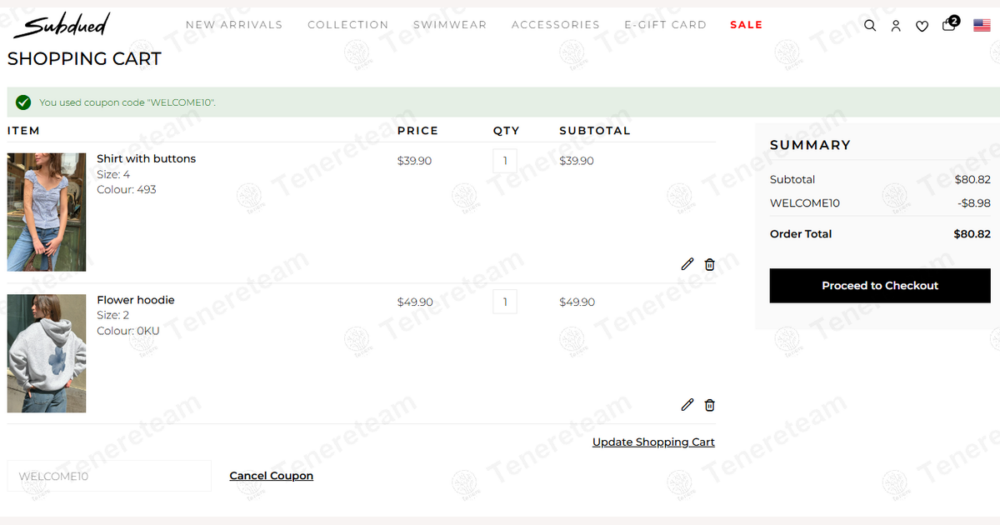
Subdued’s discount codes almost always work on a one-code-per-order basis, which means you should not plan on stacking multiple coupons or special offers for extra savings. For DHgate buyers, that one-code assumption is the safest way to estimate landed cost, fees, and profit: start from what Subdued’s terms actually allow, then layer in DHgate shipping, payment charges, and taxes so your budget reflects the price you are likely to pay, not an idealized stack of discounts.
How many Subdued discount codes can you usually use on a single order?
Subdued generally treats discounts as a one-code-per-order benefit. Promotion pages and coupon sites consistently use language such as “one promo code per order” and “cannot be combined with other offers or coupons.” Plan on applying a single Subdued discount code at checkout, not stacking several for extra savings.
Those terms are not a permanent legal guarantee for every future promotion, but the pattern is clear enough that a cautious DHgate buyer should budget on the basis of one Subdued discount at most. That means treating separate newsletter, first-order, student, referral or similar codes as alternatives, not as something you can pile together on the same order unless the official promotion text explicitly says multiple codes are allowed.
For DHgate-related budgeting and profit calculations, plan your landed cost and margin using a single anticipated Subdued discount at most, and treat anything more generous as an unexpected bonus. Only written promo terms or clear, current messaging on Subdued’s own site are a reasonable basis for expecting more than one code to apply to the same transaction.
Using one Subdued code on sale items vs trying to stack multiple offers
When Subdued says a discount “cannot be combined with other offers,” it is usually addressing the stacking of multiple coupon codes or structured promotions at checkout, not the prices already shown for products in your cart. In practice, applying one eligible code to items with a lower, sale, or promo price is different from entering several codes or overlapping coupon-style deals on the same order.
Some promotions and examples show that a single Subdued code may still apply to sale-priced items if the fine print allows it, but you cannot count on that by default. Unless the official terms clearly state that a particular code works on discounted products, it is safer to assume it applies only to full-price items or a defined subset of categories.
For DHgate-related planning, treat “cannot be combined” as meaning you get one meaningful discount mechanism at checkout—either a single code or an automatic promotion—and budget accordingly. If a valid code happens to reduce already discounted items as well, consider that extra compatibility a bonus rather than something your profit calculations depend on.
What Subdued’s one-code rule means for your DHgate landed cost
For DHgate buyers, landed cost is the total you actually spend to get Subdued products to your door for use or resale. Here, that means the item price after any single Subdued discount that successfully applies, plus DHgate shipping, payment or handling fees, currency-conversion costs, and applicable import taxes or duties.
To keep your budget realistic, plan around one modest Subdued discount at most—something like 10–20% off—rather than assuming you can stack two or more codes to create much deeper savings. If you model your margin on a fantasy scenario where multiple codes combine, you risk setting prices or profit expectations that won’t survive the real checkout total.
Treat a Subdued code as a helpful reduction on top of DHgate’s usual charges, not as the foundation of aggressive underpricing or very tight reselling margins. Build your business case assuming only one valid code will apply to each order; if you happen to get a better-than-expected discount, that’s upside, not the baseline.
If an order is later refunded or partially refunded, the amount you receive will typically be calculated from what you actually paid after that single applied discount, not from any imagined stacked savings. Refunds and dispute outcomes usually follow the real transaction total, so planning with a one-code assumption helps align your expectations with what DHgate and the seller are likely to return.
How to check whether a Subdued promotion will really apply to your order
- Find the official Subdued promotion terms for the exact code or offer you want to use. Read the fine print carefully for phrases like “cannot be combined with other offers,” eligibility limits such as new customers only, excluded items or categories, and start/end dates.
- On DHgate or your chosen purchasing route, review the checkout or payment interface to see how many promo or coupon fields exist and whether there are notes about automatic discounts or limits such as “one code per order.” A single code field and non-combinable language are strong signals that stacking won’t work.
- Build a small test cart with representative items and apply the Subdued code. Check whether the discount appears, whether it applies to any sale-priced products, and whether other visible offers or automatic promotions disappear once the code is used. Let this observed behavior, not assumptions, tell you what really applies.
- Read Subdued and DHgate return and refund language so you understand that refunds usually reflect the actual discounted amount you paid and that promotions often cannot be applied retroactively to completed orders. Do not expect to add a missed code after the fact in a dispute or return.
- Finalize your budget based on what you see in this test—actual prices, visible discounts, and checkout behavior—rather than optimistic interpretations from coupon aggregators or the hope that multiple codes will stack. Use verification to confirm a single, reliable saving, not to hunt for tricks that bypass the one-code rule.
Risks of misreading Subdued’s non-combinable discount terms
Do some brands allow discount stacking when Subdued does not?
In the wider coupon world, some brands and e-commerce platforms deliberately allow several types of discounts to stack. Automatic markdowns, cart-wide promotions, and single-use codes can be configured to work together so shoppers see multiple layers of savings on the same order, and if you are used to those systems it is easy to assume every store works that way.
Subdued shows a different pattern. Its own promotion language and repeated summaries on coupon sites describe rules like “one promo code per order” and “cannot be combined with other offers,” which point to a more restrictive setup where only one code applies and additional coupons are blocked. That means you cannot safely import expectations from more permissive platforms and assume that Subdued will let sale prices, cart promotions, and extra codes stack just because you have seen that behavior elsewhere.
For DHgate buyers, the practical takeaway is simple: keep treating Subdued as a one-code-per-order environment unless current, official terms explicitly say a particular combination is allowed and checkout behavior confirms it. Plan your landed cost and profit using at most a single Subdued discount, and consider any theoretical stacking as noise rather than part of your real budget until you see clear written permission.
Subdued discount stacking FAQ for edge-case combinations
Can a Subdued newsletter sign-up code be combined with a student discount on the same order?
You cannot safely assume a newsletter code and a student discount will stack. Treat them as alternative offers unless current written terms for both explicitly say they can be used together and checkout visibly applies both. If the fine print is silent or says “cannot be combined with other offers,” plan your DHgate budget as if only one of these promotions will apply.
Can a Subdued first-order discount stack with a free-delivery promotion?
Public information does not guarantee that a first-order discount and free delivery will both apply on the same order. Often, first-order codes are treated like other structured offers and may exclude combinations with additional promotions. Unless the official promo terms clearly allow the pairing and you see both the price reduction and free delivery at checkout, assume that only one structured promotion will apply and budget accordingly.
Do Subdued seasonal or event-based codes work on top of ongoing sale prices?
Some Subdued promotions may apply to sale-priced items, while others explicitly limit discounts to full-price products or exclude certain categories. The only reliable way to know for a specific event code is to read its fine print and test it on a cart that includes sale items. If the terms are vague or restrictive and checkout does not show the code reducing already discounted prices, treat the code as non-combinable with those sale prices when planning your costs.
Can loyalty, referral, or similar Subdued benefits be combined with additional discount codes?
Loyalty, referral, and similar benefits usually behave like other structured offers and are often non-combinable with extra codes. Unless Subdued’s current program rules explicitly state that loyalty or referral rewards can stack with a discount code—and checkout confirms both are applied—treat these benefits as a single promotion and assume other codes will be blocked.
What is the safest way to approach all Subdued edge-case stacking scenarios when budgeting DHgate purchases?
Use non-stacking as your default assumption. For any hoped-for combination—newsletter plus student, first-order plus free delivery, event codes plus sale prices, or loyalty plus extra codes—start by assuming only one promotion will apply alongside the base item price. Then check the latest official Subdued terms and run a quick checkout test to see what actually happens. Do not build speculative stacked discounts into your DHgate landed-cost or profit calculations unless the fine print and visible checkout behavior clearly show that the combination is genuinely allowed.