
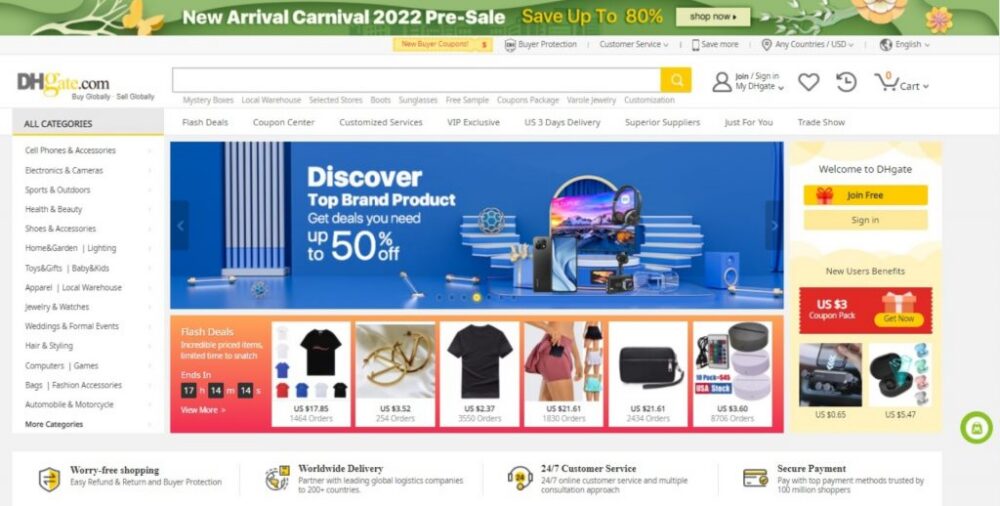
Quick answer: You can use DHgate to find listings that may ship from a U.S. warehouse, but a “US local” or “local warehouse” signal does not prove that the seller is a U.S.-based company. Treat it as a starting point: check the exact product page and checkout options, ask the seller where the selected item will ship from, and place a small test order before you rely on that listing for a larger purchase.
The distinction matters. A seller may operate from one country while holding some inventory in another, and the shipping origin can vary by product, variant, destination, stock level, and shipping method. If faster domestic delivery or lower fulfillment risk matters to your business, verify the specific order instead of relying on a label in a search result.
What does “U.S.-based” mean on a DHgate listing?
When buyers search for a U.S.-based supplier, they may mean different things. Before you compare listings, decide which of these conditions you actually need:
| What you need | What to verify | What does not prove it on its own |
|---|---|---|
| A product that ships from the United States | The shipping origin, delivery options, and selected product variant shown on the current listing and at checkout. | A “US local” label in search results without a matching product-page or checkout detail. |
| A seller that is a U.S. business | The seller’s own business information and a clear written response to your question. | A U.S. warehouse, a U.S. shipping option, or a short delivery estimate. |
| Faster delivery to a U.S. customer | The available shipping method, destination-specific estimate, total cost, and test-order result. | The warehouse wording alone; delivery can still vary by stock, carrier, and destination. |
| Inventory that is currently available in a U.S. warehouse | The selected variant, quantity, and current stock confirmation from the seller. | A similar product from the same seller or a previous order. |
For most buyers, the practical goal is to find a listing that can reliably ship the chosen item from a U.S. location to the intended customer address. Keep your product and delivery promises tied to what you have actually confirmed.
How do you search DHgate for listings that may ship from U.S. warehouses?
Start with a specific product search rather than a broad search for “U.S. suppliers.” Use product keywords, the item type, material, model, or other details that define what you need. Then use the filters and listing information currently available on DHgate to create a shortlist.
Look for location-related wording such as “US local,” “local warehouse,” “U.S. delivery,” or similar language. These signals can help you find candidates, but they are not a final verification step. Open the exact product page and check the selected variant before treating a listing as suitable.
DHgate’s guide to finding good sellers recommends comparing seller information rather than relying on one result. Use that approach here: shortlist several listings, then compare the seller record, shipping information, and written answers before ordering.
What should you check on each product listing?
Before contacting a seller, review the exact item you would order. Save the product page or take a screenshot so you can compare it with the seller’s reply and the checkout details later.
- Selected variant: Confirm the color, size, model, quantity, bundle, or other option that affects the item you will receive.
- Shipping origin: Look for the origin shown for the selected item and shipping option. Do not assume every variant uses the same warehouse.
- Delivery estimate: Check the estimate for the destination you intend to serve. Treat it as an estimate, not a guarantee.
- Total at checkout: Compare the item price, shipping cost, quantity, and any other charges shown before payment.
- Inventory status: Check whether the selected option is available now; availability can change after you start marketing a product.
- Returns and order terms: Read the current order terms before paying and keep your transaction records on the platform.
- Listing consistency: Make sure the title, photos, specifications, selected option, and shipping details describe the same product.
Pause if the shipping origin is unclear, the selected option changes important details, or the expected delivery would be difficult to explain honestly to your customer. A short phrase in a search result is not enough evidence for a customer-facing shipping promise.
How do you evaluate the seller behind the listing?
Seller information can help you decide whether a listing is worth further investigation, but it cannot independently prove where your product will ship from. Review the seller profile alongside the exact product page.
- Feedback pattern: Look for repeated and specific feedback about product accuracy, packaging, communication, and delivery experience.
- Seller history: If visible, use seller age and the amount of feedback as context rather than as a guarantee.
- Product range: Check whether the seller’s store and product range are consistent with the item you are considering.
- Message quality: A useful seller response answers your question directly and matches the product page.
- Consistency: Compare the seller profile, product listing, shipping information, and written reply. Conflicting details are a warning sign.
DHgate’s seller-selection guide also emphasizes reviewing seller information and contacting sellers before you rely on a listing. Use the platform message system so you retain a written record of the seller’s answer.
Supplier message template: confirm U.S. warehouse shipping
Send a concise message before you order. Ask about the exact item and option you selected, not a general product category.
Hello, I am considering a small test order of this item. Before I order, please confirm the following for the exact variant I selected:
- Where will this item ship from for delivery to the United States?
- Is the selected variant currently in stock at a U.S. warehouse, or will it ship from another location?
- Which shipping method should I select for the destination, and what delivery estimate should I expect?
- Does the item sent match the photos, material, specifications, and quantity shown in this listing?
- What packaging will be used, and will the parcel include an invoice, promotional insert, or supplier branding?
- If this product is unavailable in the stated warehouse, what will happen before the order is shipped?
Please reply through the DHgate message system so I can compare the details with the listing before I place the order. Thank you.
A vague confirmation is not enough for an important condition. If the seller says the item can ship from the United States, ask them to confirm that this applies to the selected variant, quantity, and destination. If the answer conflicts with the listing or remains unclear, compare another seller instead of assuming the order will be domestic.
How do you compare U.S.-warehouse listings?
Do not compare listings by item price alone. A lower product price may not be the better option after shipping, delivery reliability, packaging requirements, and the cost of handling a customer problem are considered.
Use this simple comparison:
Total fulfillment cost = item price + shipping + payment fees + packaging or service costs + expected refund or replacement allowance + taxes, duties, or other costs that apply to the order.
For each candidate listing, record the selected variant, shipping origin, delivery estimate, total fulfillment cost, seller response, and any unresolved question. This gives you a clearer basis for deciding which listing is suitable for a test order.
| Comparison point | Candidate A | Candidate B | Candidate C |
|---|---|---|---|
| Selected variant and quantity | __________ | __________ | __________ |
| Seller-confirmed shipping origin | __________ | __________ | __________ |
| Shipping method and delivery estimate | __________ | __________ | __________ |
| Total shown at checkout | __________ | __________ | __________ |
| Packaging or branding confirmation | __________ | __________ | __________ |
| Unresolved risks or questions | __________ | __________ | __________ |
Why should you place a test order first?
A test order is the best way to check whether the listing, seller response, and actual fulfillment experience match. It does not guarantee that future orders will be identical, but it provides evidence before you depend on the supplier for repeat orders or customer fulfillment.
For a useful test order, check:
- Whether the product matches the selected variant, photos, specifications, and quantity.
- Whether the parcel appears to have shipped from the origin the seller confirmed.
- Whether the tracking information and delivery timing match your customer-facing expectations.
- Whether the packaging, invoice, inserts, or branding create a customer-service issue.
- Whether the delivered quality and total cost still support your intended selling price.
- Whether the seller gives a clear response if something does not match the order record.
Save the listing, seller messages, checkout confirmation, tracking record, and photos of the delivered order. These records make it easier to evaluate a repeat purchase and document a problem if the item or shipping arrangement differs from what was promised.
When should you move forward or walk away?
Consider a repeat order when:
- The listing, seller response, checkout information, and test order are consistent.
- The selected item ships from the location the seller confirmed.
- The delivery experience supports the expectation you plan to set for customers.
- The product quality, packaging, and total fulfillment cost work for your business.
- You have clear records of the order and seller communication.
Keep comparing listings or reduce your order size when:
- The seller cannot clearly identify the shipping origin for the selected item.
- The listing and the seller’s written answer conflict.
- The estimated delivery window is unclear or does not support your customer promise.
- The test order differs from the product, packaging, quantity, or fulfillment details you documented.
- The expected margin disappears after shipping, replacement, refund, or support costs are considered.
FAQ: finding DHgate listings that ship from U.S. warehouses
Does a “US local” label mean the seller is based in the United States?
No. It may indicate a shipping or inventory-location signal, but it does not independently establish where the seller’s business is based. Ask the seller directly if their business location is important to your decision.
Can I assume every variation ships from the same warehouse?
No. Shipping origin, stock, and delivery options can change by selected variant, quantity, and destination. Check the exact option you plan to buy.
Is a fast delivery estimate enough to prove U.S. warehouse shipping?
No. Delivery estimates can vary for many reasons. Confirm the shipping origin in the current listing and in a written seller response, then test the order before making a firm customer promise.
What should I do if the seller gives a vague answer?
Ask a more specific follow-up question about the selected variant, quantity, and destination. If the answer remains unclear, treat the shipping origin as unconfirmed and compare another listing.
What is the safest first step?
Shortlist two or three listings, save their details, send each seller the verification message above, compare the answers and total checkout costs, then place a small test order with the strongest candidate.
Sources and further reading
- DHgate: How To Easily Find Good Sellers On DHgate
- DHgate: How To Find The Best Vendor Sellers List On DHgate