
If you’re curious about perfume vending machines and want to use DHgate to explore them without wasting money, start by treating it as a research tool rather than a shortcut to a single “best” machine. This guide shows you how different machine types, specs, materials, compatibility questions, and seller signals fit together so you can judge any listing you find and decide whether it deserves further attention.
How this guide helps you research perfume vending machines online
DHgate is a practical place to research perfume vending machines, along with other wholesale marketplaces, because you can see different machine concepts, specifications, and seller profiles in one place. Instead of pointing you to a single “best” machine or specific stores, this guide helps you understand how types of perfume vending machines differ and which specs, materials, and compatibility details matter for your business idea.
You won’t find shopping links, step-by-step ordering instructions, or brand recommendations here. The focus is on what information to look for in DHgate listings—capacity, footprint, fragrance and payment compatibility, seller reputation, shipping and warranty terms—so you can decide for yourself which machines are worth contacting suppliers about and which offers you should avoid.
Key types of perfume vending machines and how they operate
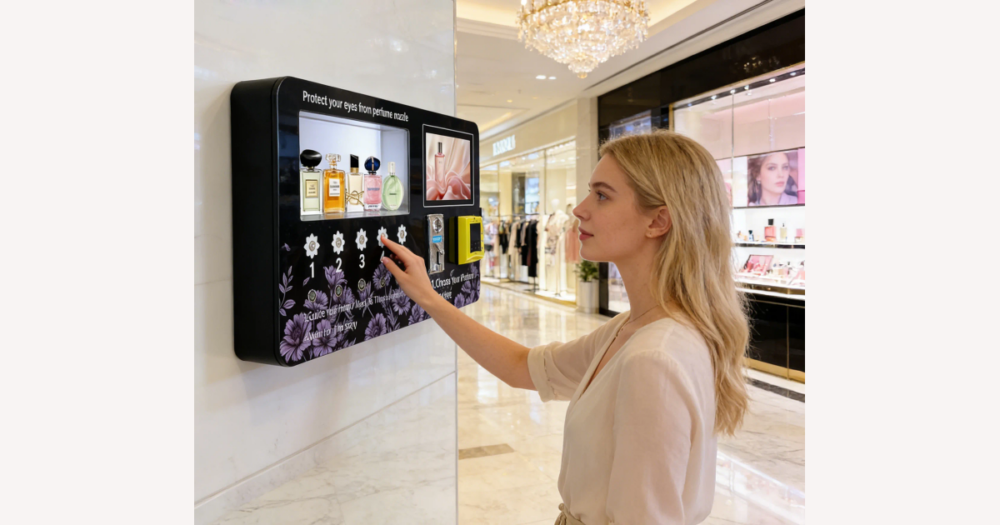
Most perfume vending machines fall into three broad types. Compact spray dispensers offer quick spritzes, often as wall-mounted or countertop units with small internal tanks and simple controls; they suit bathrooms, changing rooms, and other tight spaces where you want low-maintenance fragrance access. Refillable bottle or refill stations are larger units with multiple tanks or cartridges that let customers fill travel bottles or top up their own bottles, trading a bigger footprint and more frequent cleaning for higher perceived value and repeat use in places like malls, beauty shops, and hotel lobbies.
At the more complex end, digital kiosk-style machines combine multiple fragrance channels with touchscreens, guided selection flows, and modular payment systems. These typically occupy more floor space, hold more perfume, and may need regular supervision to manage software, payment modules, and spare parts, making them better suited to high-traffic retail areas or operators who already run vending equipment. For a first machine, simpler spray or basic refill units are usually easier to refill, clean, and troubleshoot; larger fleets with technical staff can more realistically take on kiosk-style systems with more advanced features and tighter maintenance demands.
Reading perfume vending machine specifications in listings
- Check external dimensions and weight against your planned location. Height, width, and depth determine whether the machine fits under ceilings, between fixtures, or on narrow walls, while heavier units may require reinforced floors or solid mounting points rather than lightweight partitions.
- Look at tank or cartridge capacity to estimate how often you’ll need to refill or service the machine. Larger tanks or higher cartridge volumes support more sprays or fills between visits, reducing staff workload, while very small capacities may be acceptable only in low-traffic spots or if you’re on-site every day.
- Note how many fragrance channels the machine offers and how they’re arranged. A single-channel spray unit suits a simple “signature scent” concept, while multi-channel refill stations or kiosks let you offer several perfumes at once but require more inventory management and cleaning for each channel.
- Confirm the stated power voltage and frequency against local standards before you consider any listing. A mismatch between, for example, 110–120 V and 220–240 V or different Hz ratings can damage equipment or require transformers and professional installation, which is usually more realistic for experienced operators than first-time buyers.
- Match payment system options—coin, bill, card, QR, NFC—to how customers in your location actually pay. Simple, standard modules such as coins plus widely used card or QR systems are usually easier to maintain and troubleshoot for a single machine; highly customized or multi-system setups make more sense for operators with technical support and existing vending infrastructure.
- Read each spec as a practical fit test for space, workload, fragrance variety, and local infrastructure rather than as a promise of revenue. On DHgate and similar marketplaces, clear, conservative specifications that you can map to your real-world environment are more useful than marketing claims about guaranteed sales or profits.
Materials and build quality: what to look for in a perfume vending machine
Perfume vending machines typically combine a metal cabinet—often steel or aluminum—with plastic panels or hoppers, glass or acrylic windows, and internal tubing and seals made from rubber or silicone. Steel tends to be strong and resistant to dents, while aluminum is lighter and less prone to rust; plastics can keep weight and cost down but may feel flimsy if they’re thin, and glass or good-quality acrylic usually gives a clearer, more premium-looking display.
For durability and perceived quality, pay attention to how substantial the body looks: thicker, corrosion-resistant metal, solid hinges and locks, and smooth, well-finished surfaces usually signal a machine that can handle bumps, occasional tampering, and regular use. In contrast, obviously thin sheet metal, loose doors, or panels that flex easily in photos suggest a build that may feel cheap and wear faster in busy environments.
Hygiene and ease of cleaning are especially important with fragrance. Listings that mention accessible internals, clearly described dispensing nozzles, and straightforward cleaning procedures make it easier for staff to keep tubing, nozzles, and exterior surfaces clean. Smooth, non-porous materials and seals that are compatible with perfumes or cleaning agents help reduce residue and odors over time.
When you review DHgate listings, inspect photos and material descriptions for signs of robust construction, anti-corrosion treatments, locking mechanisms, and clear cleaning instructions. If materials are described only in vague terms, photos hide key areas, or there’s no mention of how to clean and maintain the machine, treat that as a caution—especially if you’re buying a single unit and need something simple and easy to look after without specialist tools or staff.
Perfume and payment compatibility checks
- Refill style: Open refill tanks let you pour in bulk perfume from your own suppliers, giving flexibility on brands and pricing but demanding careful cleaning and scent changeover procedures. Proprietary cartridges or pods usually lock you into specific formats; they can simplify refills and reduce leaks, but you must confirm ongoing cartridge availability, cost, and whether you’re allowed to use non-branded fragrances.
- Fragrance limits: Some machines are designed only for thin, alcohol-based perfumes, while others can handle slightly thicker or oil-heavy fragrances. Listings may mention viscosity requirements, recommended alcohol content, or compatible product types; if they don’t, ask the seller directly which formats are acceptable and whether thicker or oil-based scents could clog tubing or nozzles.
- Channels and switching: Single-channel machines dispense one fragrance from one tank or cartridge, which keeps plumbing and cleaning straightforward but limits customer choice. Multi-channel machines route several scents through separate lines and switching mechanisms—buttons, touchscreens, or rotary selectors—so you can offer variety, but you need to understand how often fragrances can be changed, how cross-contamination is avoided, and what the cleaning process looks like between scent changes.
- Payment modules: Typical options include coin and bill acceptors, card readers, and QR/NFC mobile payment units. Some machines ship with only one or two modules built in, while others are designed to accept modular units that can be swapped or added. Always confirm which payment hardware is actually included, whether it can be configured for your currency and local payment norms, and whether additional modules require separate purchase or integration work.
- Choosing complexity level: First-time operators are usually better off with simpler compatibility setups—standard refill styles that match common bulk perfumes and mainstream payment modules already used in their region. Hybrid kiosks with many fragrance channels and multiple payment options offer more flexibility but also add plumbing, electronics, and software complexity that’s easier to manage if you already run vending machines or have technical support for installation, configuration, and maintenance.
Judging seller and product quality evidence on DHgate
On DHgate, stronger quality signals for perfume vending machines start with the seller profile. An established account with meaningful transaction volume, a solid rating, and a history of selling similar hardware is generally more reassuring than a brand-new profile. Pair that with clear product descriptions, spec sheets that list dimensions, capacity, power, and payment modules, and multiple sharp photos or demo videos that show the machine from different angles and in operation.
Review patterns can add another layer of evidence when they mention concrete pros and cons rather than just generic praise. Comments that describe how the machine was packaged, whether it matched the listing, how easy installation felt, or any issues with leaks or electronics are more informative than a handful of short, overly positive reviews that could be promotional or untested impressions.
Treat marketing claims and vague signals with caution. Promises of guaranteed earnings, unusually high revenue examples without context, or references to certifications that don’t name a standard or issuing body should not be taken as proof of quality or compliance. If a listing mentions certifications, ask which specific standards apply and request documentation; if you can’t get clear answers, assume those claims are more marketing than reliable evidence.
Even when the seller history looks good, specs are detailed, photos are clear, and reviews are reasonably specific, some important things remain unknown. Cross-border hardware deals always carry uncertainty about long-term reliability in your environment, how customers will respond to the fragrances you choose, and how the seller will handle problems months after the sale. Use DHgate’s quality signals to reduce risk, but keep them in perspective: they support a basic confidence that the machine is as described, not a guarantee that it will perform flawlessly or that every future issue will be resolved without friction.
DHgate-oriented buyer checklist for perfume vending machines
- Start with the seller profile. On DHgate, prioritize sellers with consistent ratings, meaningful transaction history, and a track record of supplying vending or similar hardware over brand-new accounts with no feedback.
- Check that the listing clearly documents key technical details: external dimensions and weight, tank or bottle capacity, number of fragrance channels, power requirements and voltage, refill style (open tanks vs. cartridges), and which payment modules are actually included or supported.
- Review payment, shipping, and lead-time information. Make sure accepted payment methods, shipping options and costs, estimated production and delivery times, and any customs considerations are spelled out and plausible for your location and business timeline.
- Look for explicit warranty and after-sales terms. Reliable listings state warranty duration, what faults are covered, who pays for return shipping, and how repairs or replacements are handled, along with basic information on spare parts availability and technical support channels.
- Prepare a short message for the seller covering fragrance types you plan to use, how refills and cleaning are handled, installation requirements (power, mounting, space), and what support they offer if the machine malfunctions. Treat clear, prompt, and specific replies as a positive sign and slow, vague answers as a warning.
- If documentation is thin, warranty or shipping terms are unclear, or the seller’s answers stay promotional rather than concrete, assume the risk is higher and move on to other listings that are better documented and more responsive before investing further effort.
Common risks and red flags when researching perfume vending machines online
- Be wary of marketing that guarantees profits, promises very short payback periods, or showcases impressive revenue examples without explaining assumptions such as location, foot traffic, perfume pricing, or maintenance costs. These claims are promotional, not reliable evidence for your own results.
- Treat vague or missing explanations of how refills work, how the machine is cleaned between different fragrances, and what routine maintenance involves as a practical red flag. Unclear refill and cleaning systems can lead to leaks, cross-contamination of scents, and higher downtime than you expect.
- Notice when a listing says little about spare parts, technical support, or who handles repairs if the machine fails. For cross-border hardware, limited access to replacement nozzles, pumps, electronics, or control boards can turn minor faults into expensive, time-consuming problems.
- Approach offers with weak, unclear, or absent warranty and return terms with caution, especially when international shipping is involved. Returning a large perfume vending machine can be difficult and costly, so lack of specific conditions increases your exposure if something goes wrong.
- Remember that none of these signs alone proves a scam, but the more they cluster together—aggressive earnings promises, thin technical detail, and opaque support or warranty—the more you should ask detailed follow-up questions or simply drop the listing from your shortlist and focus on better-documented alternatives.
From research to shortlisting: your next practical steps
- Clarify your concept first: decide where the machine will sit (washroom, corridor, spa, lobby), who will use it, and whether you want quick spritzes, refills, or more guided experiences.
- Match that concept to one or two machine types that fit your space and audience, focusing on capacity, footprint, and how customers interact with the interface.
- When you look at DHgate listings, filter hard on non‑negotiables: external dimensions and weight for your location, local power compatibility, refill style (open tanks vs. cartridges), and basic payment options you can realistically support.
- From the few listings that pass those filters, apply your detailed checklist and quality‑signal guidance: scrutinize seller history, documentation, warranty, and support, and prepare specific questions before deciding whether to contact any supplier.
- Unless you already run a vending fleet with technical support, consider starting with a single, simpler, well‑documented machine rather than committing to a complex multi‑unit setup or advanced features that are harder to maintain across sites.
FAQs about ordering perfume vending machines from overseas suppliers
Can I buy just one perfume vending machine from a DHgate supplier, or do they always require a minimum order quantity (MOQ)?
Many overseas suppliers on DHgate list a minimum order quantity, especially for custom or franchise-style machines, but that doesn’t automatically rule out single-unit orders. Some will quote for one machine at a higher per-unit price, or treat it as a sample order. Instead of assuming you must buy several units, treat MOQ as a starting point: check the listing for any stated minimum, then message the seller to ask explicitly whether they can supply a single machine, what price and terms would apply, and whether the warranty or support differs for a small order.
How do shipping costs, lead times, and customs affect the practicality of ordering a perfume vending machine from overseas?
Perfume vending machines are bulky and often heavy, so international shipping can be a significant part of the total cost and may take weeks rather than days. Carriers may charge extra for large or palletized freight, and your country’s customs rules can add duties, taxes, or inspection delays. Before you treat a listing as feasible, ask the seller for a detailed shipping quote to your exact location, the transport method they use, an estimated production and transit timeline, and who is responsible for customs clearance and any extra fees. Only when you have those specifics can you realistically judge whether the machine’s total landed cost and timing fit your business plan.
How should I think about spare parts and consumables like nozzles, cartridges, and cleaning agents over the life of the machine?
With cross-border hardware, ongoing access to parts matters as much as the initial purchase. Some perfume vending machines use standard components and open refill tanks, making it easier to source compatible cleaning agents or generic parts locally, while others rely on proprietary nozzles, cartridges, pumps, or control boards supplied only by the original manufacturer. When you research DHgate listings, ask each seller which parts are expected to wear out, how long they normally last, what replacements cost, and how you can order them later (through DHgate, directly, or via local partners). Treat vague answers or an absence of clear spare-parts and consumables policies as a warning sign and factor that into your decision before committing to any machine.