
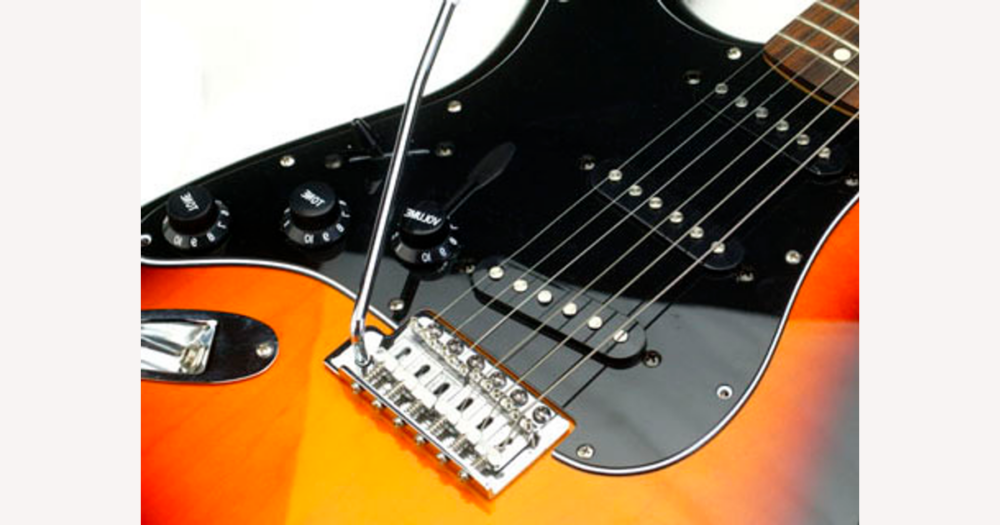
If you play a left-handed Strat and shop on DHgate, the best pickguard is the one that matches your guitar’s screw pattern, routing, and mirrored control layout—even if its design is simpler than the flashiest listings. This guide explains how left-handed Strat pickguards differ from right-handed ones, the main styles available, and the practical checks to make against DHgate descriptions, photos, seller details, and policies before ordering.
What makes a left-handed Stratocaster pickguard different, and what types can you choose from?
On DHgate, a true left-handed Stratocaster pickguard isn’t just any Strat-shaped plate flipped in the photos. It has a mirrored outline to match a left-handed Strat body, pickup cutouts in the correct lefty positions, a flipped control layout so the switch and knobs sit where your hand actually reaches, and an edge bevel that faces the right way once it’s mounted on a left-handed guitar.
Because some marketplace listings casually claim a guard “fits Strat” or simply show a right-handed control layout, you need either an explicit “left-handed” label or photos that clearly show the mirrored orientation. If the switch and knobs appear in the same position as a right-handed Strat, or the guard’s outline doesn’t mirror your guitar, treat that listing as suspect, no matter how good the design looks.
Most left-handed Strat guards on DHgate fall into three broad types. Plain routed guards are bare pickguards cut for standard layouts like SSS or HSS; they’re usually the simplest and lowest-cost option when the screw pattern and routing match your existing guitar, because you reuse your current pickups and controls. Decorative or custom-graphic guards use similar routing but swap in special colors, pearloid, printed artwork, or unusual materials. These often come from smaller workshops or short production runs, so fit documentation can be thinner and you may need to ask more questions before ordering. Loaded or prewired pickguards arrive with pickups, pots, switch, and wiring already installed, offering a combined visual change and electronics upgrade in one unit.
For a left-handed player on DHgate, I’d generally treat a clearly specified plain replacement guard as the safest starting point: it’s cheaper, easier to install, and you only have to match the physical spec. Decorative or custom guards make more sense when aesthetics are your top priority and you’re willing to verify measurements and hole patterns carefully with the seller. Loaded guards can be convenient if you’re ready for an electronics overhaul, but they add extra compatibility checks around body routing depth, control layout, and wiring style, and may still require soldering despite “drop-in” language in the description.
Given how rare left-handed parts can be, prioritizing guaranteed physical fit over flashy graphics or aggressive marketing is often the better tradeoff on DHgate. Later sections in this guide walk through the specific measurements, screw patterns, and layout checks you can use to confirm that any of these pickguard types actually match your left-handed Strat before you commit to an order.
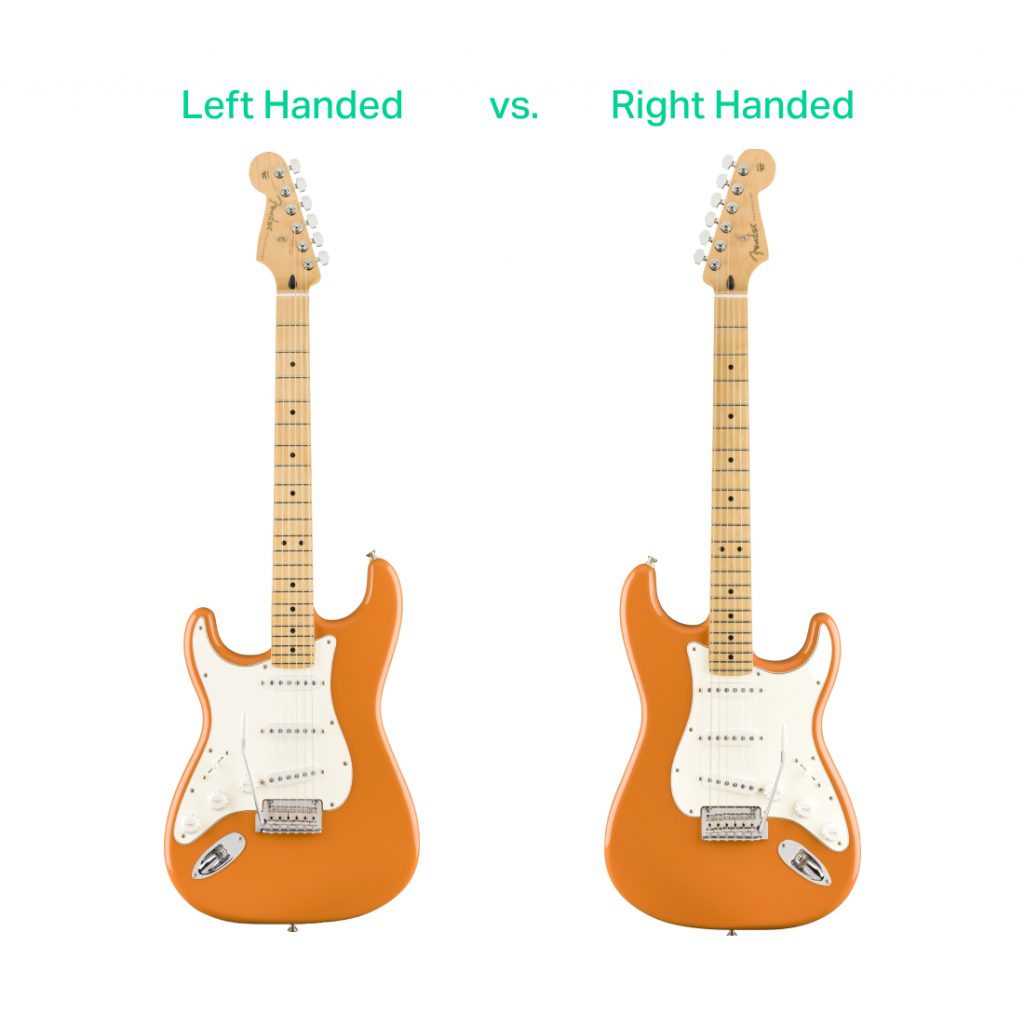
Side-by-side view of right-handed and left-handed guitars, showing how the pickguard outline and control layout mirror between orientations.
How to check if a left-handed Strat pickguard will actually fit your guitar
A left-handed Strat pickguard is only useful if it physically fits your guitar, so start by matching the screw-hole pattern. Strat-style guards commonly use 8 or 11 screws, and vintage-style bodies can place those screws slightly differently from modern ones. Count the screws on your current guitar and note their positions relative to the pickups and edges; any replacement guard should show the same count and roughly the same spacing, or you risk misaligned holes, gaps, or having to drill into the body to make it work.
Also check whether the guard is cut for USA or import-style Strat spacing. Many aftermarket and DHgate listings mention “fits USA Strat” or “fits import Strat” (which often includes Squier and other offshore Strat-style guitars). The bridge, neck pocket, and pickup locations aren’t identical between these categories, and a mismatch can leave the guard binding against the bridge, sitting too far from the neck, or putting pickups off-center under the strings. If a listing only says “fits Strat” without specifying origin, treat that claim cautiously.
Pickup routing and layout also have to match. Common layouts are SSS (three single coils), HSS (bridge humbucker plus two single coils), HSH (two humbuckers with a single coil in the middle), and single humbucker-only. The letters describe the pickup types in order from neck to bridge. Your guitar’s body routing and the guard’s cutouts must correspond, or you’ll expose cavities or cover pickups. Many left-handed guards are only offered in SSS, so if your Strat is HSS or more unusual, expect fewer truly compatible options and scrutinize those layouts in the photos.
Control layout is mirrored on a left-handed Strat: the switch, knobs, and any jack cutout on the guard appear on the opposite side compared with a right-handed model. When a DHgate listing claims a left-handed pickguard but the photos show right-handed control placement, that’s a strong sign the description is wrong or generic. Compare the control positions in the images to your actual guitar, not just the word “lefty” in the title.
Finally, look at the bevel orientation on multi-ply guards. The angled edge normally faces a particular direction; on a purpose-made left-handed pickguard it will look correct once installed on a left-handed body, rather than reversed. This detail is mostly cosmetic and about feel under your picking hand, but it can be a useful cue that the guard was genuinely cut for left-handed use rather than simply mirrored in a product photo.
When DHgate listings rely on generic language like “fits Strat” without backing it up with screw counts, origin (USA vs import), routing type, and clear photos of the layout, assume compatibility is unresolved instead of safe. Use the checklist that follows to turn these dimensions into measurements and photo comparisons before ordering, reject obviously incompatible guards, and focus on those with a realistic chance of fitting your left-handed Strat.
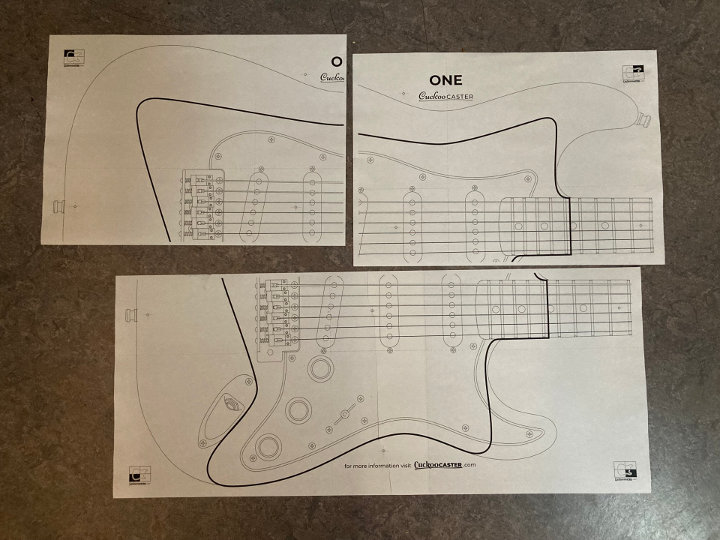
Diagram-style image with template sheets for a Strat-style guitar, useful as a visual reminder that screw positions, pickup cutouts, and body routing all need to line up with a new pickguard.
Pickguard materials and plies: what actually matters for look and durability
Once you’ve confirmed that a left-handed Strat pickguard will fit your guitar, consider what it’s made of and how it’s constructed. Most affordable left-handed guards use standard plastics such as PVC or similar thermoplastics in solid colors with simple gloss or matte finishes. They provide basic protection from picks and fingernails and are usually the baseline option for budget-conscious left-handed buyers.
Beyond plain plastic, many guards use multi-ply laminates—common examples are 3‑ply white/black/white or black/white/black. The layers are bonded together and then beveled, so you see a contrasting stripe running around the edge. Multi‑ply guards are typically a bit thicker and feel slightly stiffer under the hand than thin single‑ply plates, and that layered edge has a more “finished” or traditional Strat look that some players prefer.
Decorative surfaces add another layer on top of the plastic base. Pearloid and tortoiseshell‑style plastics, brushed or aged‑look finishes, and printed or graphic overlays all exist for left-handed guards, though the selection can be thinner than for right-handed ones. These options are mostly about visual impact: they change how the pickguard catches the light and how much pick wear you see, but they don’t reliably change how the guitar sounds.
There are also more unusual materials—such as metal pickguards or thicker acrylic sheets—but these are less typical in low-cost, DHgate-style listings. They can look striking and may feel more rigid, yet they also add weight and can introduce grounding or noise considerations if they’re conductive, so they’re best treated as niche choices rather than default upgrades.
Structurally, the key distinction is single‑ply versus multi‑ply construction. Single‑ply guards are one sheet of plastic: they’re usually thinner, more flexible, and show no contrasting stripe along the bevel. Multi‑ply guards stack two or three thin layers, which increases thickness and stiffness and creates the visible stripe around the edge. That stripe is purely visual, but the extra thickness can make the guard feel a bit more substantial and may resist warping better in some cases.
Color, pattern, gloss versus matte finish, the presence of a bevel stripe, and even a rough sense of thickness are things you can usually verify from clear DHgate photos and basic listing specs. By contrast, claims that a pickguard “improves tone,” “adds sustain,” or delivers “deluxe pro sound” aren’t backed by strong evidence for typical thin plastic guards and should be treated as marketing unless tied to detailed, objective information about mass, stiffness, and how the guitar is constructed overall. Similarly, vague labels like “premium” or “deluxe” without specific details on material type, measured thickness, or ply count don’t guarantee better durability.
For a left-handed buyer with fewer options to choose from, I would treat material and finish as a tiebreaker after fit, screw pattern, routing, and clearly stated specs. Different plastics and plies can change how quickly pick marks show and how the edge feels under your picking hand, but any expectations beyond surface wear—like long-term warp resistance or sound changes—should stay modest unless a listing offers unusually detailed specifications or you have independent reviews to compare.
Plain, decorative, or loaded: which left-handed pickguard style fits your goals?
| Pickguard style | Typical use case | Installation complexity | Fit risk | Cost range (relative) | When it’s a good choice |
|---|---|---|---|---|---|
| Plain replacement | Refresh appearance or replace a cracked or yellowed guard while keeping your existing pickups and wiring. | Low to moderate: you unscrew the old guard, transfer pickups and controls, and reinstall; basic tools and careful handling are usually enough. | Low if the new guard clearly matches your original spec (left-handed orientation, screw pattern, routing, USA vs import); problems mainly arise when specs are assumed instead of checked. | Generally the lowest or mid-range option among left-handed guards, especially for simple solid colors or common 3‑ply combinations. | Ideal if you’re cautious, new to guitar mods, or shopping on DHgate where detailed left-handed listings are rare. I’d treat a well-specified plain replacement as the default safest path for most left-handed players. |
| Decorative / custom-graphic | Prioritize a specific look—pearloid, tortoiseshell-style plastic, bold colors, or printed graphics—to make your left-handed Strat stand out. | Moderate: similar screw-and-transfer process to a plain guard, but you may need to take extra care to avoid scratching graphics or misaligning patterns. | Moderate to high, because custom or small-batch guards can follow slightly different outlines or hole placements; left-handed versions may have less standardized specs, so careful measurements and seller communication matter more. | Wide spread: some decorative plastics cost only slightly more than plain guards, while custom graphics or limited runs can be noticeably pricier and may involve longer lead times. | Makes sense if aesthetics are a major goal and you’re willing to measure your guitar carefully, compare every screw hole and cutout to the listing photos, and accept a bit more risk or waiting time to get the exact look you want. |
| Loaded / prewired | Change both the look and the electronics at once—new pickups, pots, and switch on a pre-assembled left-handed guard. | High: you’re swapping an entire wired assembly, which can involve desoldering and resoldering connections, checking grounds, and fitting everything into the control cavity. | High, because you must match not only screw pattern and pickguard outline but also body routing, pickup types, and control layout; left-handed orientation in the wiring (such as pot taper direction) also matters and is not always documented clearly. | Usually higher than bare guards, since you’re paying for pickups, controls, and assembly time, though prices vary with component quality. | Best if you’re ready for a more involved upgrade and comfortable doing or commissioning wiring work, and you’ve verified that the routing, pickup configuration, and left-handed layout all match your guitar. On DHgate, this path suits more experienced modders who can live with extra compatibility checks and potential troubleshooting. |
Measurement and info checklist before you order a left-handed pickguard on DHgate
- Count and map screw holes. If it’s safe, gently loosen or remove the current pickguard and count how many screws hold it in place. Note where each screw sits relative to the pickups and controls, or at least count the visible screws and compare their positions to a Strat pickguard diagram so you know whether you have an 8‑hole or 11‑hole pattern and how those holes are spaced.
- Identify your guitar’s type. Record the brand, model, and approximate year, and note whether it’s likely based on USA‑style or import‑style Strat specs. Many DHgate guitars and Strat‑style clones follow import spacing, but this is not guaranteed, so treat any “fits USA Strat” or “fits import Strat” claims as hypotheses to check against your own instrument rather than assumptions.
- Confirm your pickup layout. Check whether your guitar is SSS, HSS, HSH, or uses a single humbucker, and whether the output jack sits on the pickguard or on the body. Any replacement left-handed guard must have cutouts that match this layout and space for the jack in the same location, or you’ll be forced into extra routing or wiring changes.
- Verify left-handed orientation. Make sure your existing guard is genuinely left-handed: the outline should mirror a right-handed Strat, and the switch and knobs should sit under your picking hand in a way that feels normal when you play. Use this real instrument as your baseline when comparing DHgate listing photos—if the control layout or bevel direction looks wrong compared with your guitar, treat the guard as right-handed or uncertain.
- Measure a few key distances. With a ruler or basic calipers, roughly measure spans such as the distance between outer screw holes, from the neck pocket to the first pickup, and between pickups. You’re not doing precision engineering—just creating reference numbers you can hold up against any measurements given in a DHgate listing or seller reply to spot obvious mismatches.
- Photograph your existing guard. Take clear, straight‑on photos of the front of your guitar so the pickguard outline, screw locations, pickups, and jack placement are all visible. Avoid extreme angles that distort shapes; these images will be your visual template when you compare against DHgate listing photos.
- Compare your notes and photos to the listing. Check that the advertised screw count and visible screw positions match your pattern, that routing cutouts line up with your pickup configuration, and that the control layout in the photos is mirrored correctly for a left-handed Strat. If anything looks shifted, missing, or obviously different, assume the guard will not drop in cleanly.
- If crucial details are missing or unclear, stop. When the listing doesn’t clearly show the screw pattern, routing type, or left-handed orientation, contact the seller through DHgate to ask specific questions and request additional photos. If you still can’t confirm fit after that, it’s safer not to order from that listing—especially for a niche left-handed part where returns or disputes over misfit can be difficult.
Video walkthrough of removing a Stratocaster pickguard, counting and marking screw positions, measuring basic distances, and taking straight‑on reference photos to compare with online listings.
How to read DHgate listings and seller feedback for left-handed Strat pickguards
Once you’ve documented your guitar, judge each DHgate listing against those notes. Start with the title and description. For a left-handed Strat pickguard, look for explicit words such as “left-handed” or “lefty,” a stated screw-hole count, a routing type (SSS, HSS, HSH, single humbucker), and compatibility phrases like “fits USA Strat” or “fits import Strat.” Treat missing, vague, or contradictory details as unresolved: if the text only says “fits Strat” without explaining which models or origin, it has not actually confirmed that the guard will fit your specific instrument.
Then study the photos. Prefer listings that show real, clear images of the actual guard rather than only renderings or generic catalog pictures. Use the photos to confirm that the guard is truly left-handed, that the screw holes sit in the same places as on your guitar, and that the pickup and jack cutouts match your layout. If the images are low‑resolution, heavily angled, or cropped so you cannot see the full outline and all holes, assume there is still a fit risk rather than filling in the gaps yourself.
Where a DHgate listing includes a specification table or bullet list, read it carefully. Useful entries mention thickness, material type, number of plies, and named compatible models such as specific Strat variants. Check that these specs are consistent with what you expect from your guitar and with the photos. If the table says “3‑ply” or “1.5 mm” but nothing about orientation or screw pattern, you still need those missing fit details before trusting the guard.
Use DHgate’s Q&A and seller messaging to close gaps. Ask direct questions: confirm that the guard is left-handed, state your screw count and pickup layout, and request a photo of the guard laid flat so all holes and cutouts are visible. If your guitar is a particular brand or a Strat-style clone, ask whether the guard was designed around that brand or a generic template. A responsive seller who answers clearly and provides extra images is a safer bet than one who replies vaguely or not at all.
Seller feedback and ratings also matter, especially for niche guitar parts. Look for reviews that mention Strat compatibility, accurate descriptions, or left-handed fit; these can support your judgment, though their absence doesn’t prove anything. What does matter is a pattern of complaints about wrong items shipped, poor communication, or parts that “don’t fit”. For a left-handed pickguard, repeated issues like that are a strong warning sign, even if no one mentions your exact model.
Finally, read the return and dispute policies tied to the listing and seller. Check whether you can return or exchange the guard if it doesn’t fit, and whether the conditions are clear and realistic. Because left-handed pickguards are a niche item, I would favor DHgate sellers who spell out their policies and who seem willing to resolve misfit caused by ambiguous specs, rather than those with minimal or confusing terms.
When you weigh several DHgate options, prioritize listings and sellers with detailed specs, clear photos, specific compatibility statements, helpful Q&A, and transparent policies over slightly cheaper but poorly documented alternatives. Even with careful reading, some uncertainty will remain—especially for non‑branded or clone‑style guitars—but choosing better documented offers reduces the chance that your next left-handed Strat pickguard turns into a costly misfit.
Common pitfalls when buying left-handed Strat pickguards online
- Right-handed guards sold as “left-handed.” Some listings flip the photo or use generic images while the actual guard keeps a right-handed control layout and bevel. On a true lefty guard, the switch slot, knobs, and jack cutout should sit where your picking hand reaches when the guitar is strung left-handed, and the beveled edge should slope the correct way in the photos.
- Generic “fits Strat” claims with no details. A line like “fits Strat” that doesn’t mention USA vs import origin, screw-hole count, or routing type hasn’t confirmed anything about your specific guitar. Treat it as unproven until you see matching specs or clear photos.
- Mismatched screw-hole patterns. An 8-hole body with an 11-hole guard (or vice versa), or slightly shifted holes, can force you to drill new holes or leave some unused. That risks chipped finish, weaker screw grip, and visible old holes—especially on transparent or light finishes—so it’s better to avoid than “fix” after the fact.
- Missing or inconsistent routing information. If the photos clearly show SSS routing but the text is silent, or the description mentions HSS while the cutouts look different, you may receive a guard that physically cannot clear your pickups or selector switch. For left-handed players, odd combinations (like single humbuckers or unusual control layouts) are particularly vulnerable to this problem.
- Loaded guards wired for right-handed use. Some prewired assemblies mount onto a left-shaped plate but keep right-handed wiring logic or pot taper expectations, which can make control travel feel wrong or put switch positions in an unintuitive order for a lefty.
- Low-cost, generic listings treating left-handed as an afterthought. On DHgate, vague descriptions, recycled catalog photos, and copy‑pasted compatibility lists are all signals that little attention has been paid to left-handed fit. Whenever fit or orientation is unclear, assume the risk is unresolved: ask for clearer photos and details, and if the seller cannot provide them, choose a better-documented alternative instead of gambling.
Which listing claims can you trust—and which are just marketing?
Use DHgate listings as a filter for what you can actually verify. For left-handed Strat pickguards, orientation and layout are usually checkable: clear photos should show that the outline is truly left-handed, the screw-hole count and pattern match your guitar, and the routing shape (SSS, HSS, HSH, single humbucker) lines up with your pickups.
Basic material and finish are also fairly verifiable. You can normally confirm whether a guard is a solid color, pearloid, or printed graphic, and whether it looks gloss or matte. If the listing states a thickness or number of plies, treat those as concrete claims only when they’re given as specific numbers or close-up photos, not just as “deluxe multi‑ply” language.
Compatibility phrases like “fits USA Strat” or “fits import Strat” matter only when they match your own guitar and the other visible details. If your instrument is an import Strat-style clone, a “USA only” claim is a warning, not a bonus. If the seller promises universal fit across all Strats without explaining screw patterns or origin, that’s marketing, not proof.
Be wary of claims that a pickguard will “improve tone,” “dramatically upgrade sound,” or offer “premium pro quality” without specifics. Unless those words are tied to clear facts—such as exact material, thickness, or manufacturing method—they are hype. I would always give more weight to a modest listing with sharp photos, measurements, and named compatible models than to one that leans on superlatives.
Some things simply remain unknown from a DHgate page: long-term durability, exact machining tolerances, and the true material recipe usually require independent testing or detailed reviews. Focus your decision on the parts you can check—orientation, screw pattern, routing, stated dimensions—and treat everything else as uncertain rather than guaranteed.
Choosing your best path: standard replacement, custom look, or loaded upgrade
- Standard-spec left-handed replacement pickguard – This is the safest default for most DHgate buyers. Choose a simple left-handed guard that matches your guitar’s existing spec when you’re happy with your current electronics and broadly similar looks. It makes the most sense if your Strat follows common USA or import dimensions and the listing clearly documents screw-hole count and pattern, routing type (SSS, HSS, etc.), and which Strat origin it’s cut for, backed by good photos and sensible seller feedback and return terms.
- Visually creative custom or graphic left-handed pickguard – Take this path when aesthetics are your top priority and you’re willing to put in extra fit checks and communication. It suits players chasing a particular color, pattern, or artwork who can carefully compare diagrams and photos, request exact dimensions, and accept higher risk or possible delays because truly left-handed custom options are rarer. On DHgate, reliable sellers with detailed descriptions, real photos of left-handed orientation, and clear policies matter even more in this category.
- Loaded left-handed pickguard (prewired assembly) – Choose a loaded guard when you’re ready to change pickups, controls, or wiring as well as the plastic. This path fits players comfortable with at least basic wiring checks or those aiming for a bigger tonal and control change, provided you can confirm routing, control layout, and true left-handed orientation against your guitar. For DHgate listings, treat complete specs, clear routing photos, and responsive answers to your questions as mandatory; without them, the risk of incompatibility is high.
- Putting it together – Editorially, I would default to a well-documented standard left-handed replacement guard unless a specific visual or electronic goal justifies the extra complexity of custom or loaded options. As you move from standard to custom to loaded, the demands on DHgate listing quality, seller reputation, and return or dispute policies increase, so only step up the risk level when your priorities clearly call for it.
FAQ: Left-handed Strat pickguard edge cases and DIY questions
Can I flip a right-handed Strat pickguard for left-handed use?
Simply flipping a right-handed pickguard almost never works as a proper left-handed solution. The screw holes, pickup cutouts, switch slot, and jack opening are all laid out for a right-handed body, so reversing the guard usually misaligns everything. The bevel around the edge will also face the wrong way, and the controls may sit in awkward positions for your picking hand. Treat this as a low-stakes experiment only—on a cheap project guitar where cosmetic issues and imperfect ergonomics are acceptable—not as a general fix for a main left-handed Strat.
What if my guitar is a non-Fender or older Strat-style instrument?
Many non-Fender and older Strat-style guitars deviate from standard Fender patterns, especially in screw placement, body outline, and routing depth. For these instruments, you should assume that generic left-handed guards—especially mass-produced ones on DHgate—are less likely to drop in cleanly. Carefully document your existing guard with measurements and straight-on photos, and compare those to any potential replacement. If nothing lines up closely, you may need a custom-cut guard from a specialist, or a local tech who can work from a template of your current pickguard rather than relying on generic “fits Strat” claims.
Is it safe to drill new screw holes or enlarge cutouts to make a pickguard fit?
Experienced modders sometimes drill extra screw holes or carefully enlarge pickup and control openings to adapt a guard, but it carries real risks. Misplaced holes can chip the finish, weaken the wood around the screws, or leave old holes visible; aggressive reshaping around pickups and controls can expose unfinished wood or create gaps. These changes can also hurt resale value. If you’re a beginner or working on a guitar you care about, proceed slowly and test-fit often, or let a professional handle any drilling and routing. It’s safer to modify only the guard (on a workbench) than the body, and to avoid major reshaping unless you understand the tradeoffs.
What should I do if no left-handed pickguard seems to match my guitar?
If every available left-handed guard conflicts with your screw pattern, outline, or routing, forcing a badly fitting plate onto the guitar is usually worse than waiting. In that situation, your options are to commission a custom guard based on a tracing of your existing one, explore DIY templates if you’re comfortable with careful cutting and finishing, or stick with the current pickguard until a better-documented option appears. For complex builds or valuable instruments, asking a local luthier or repair shop for help is often the safest route—they can advise whether a subtle modification is sensible or whether a bespoke guard is the only truly clean solution.