
At a Glance
If you want to sell on Amazon FBA using wholesale, you need suppliers that:
- Sell in bulk at a discount (true wholesale, not just “cheap”).
- Can provide invoices that Amazon accepts for verification and ungating.
- Are reliable on stock, quality, and shipping.
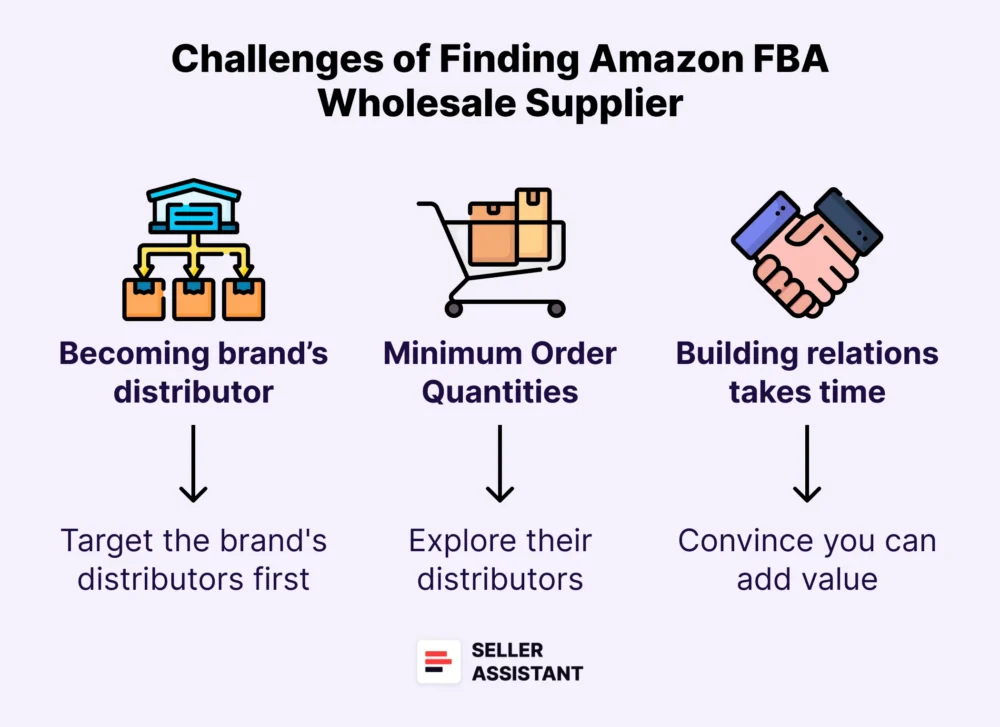
There are three main ways to source:
- Authorized wholesale distributors – best for brand-name products and ungating.
- Brand-direct / manufacturers – best for stable, long-term lines and higher margins.
- B2B marketplaces and platforms (DHgate, Alibaba, etc.) – best for testing products, private label, and price discovery, but not always suitable for branded wholesale.
Use wholesale distributors and brand-direct suppliers as your core, and treat marketplaces like DHgate as a supporting channel for certain product types and stages.
What the Platform Type Means
Before picking “top wholesale distributors,” it helps to clarify what people mean by:
What “Wholesale Distributors for Amazon FBA” Really Means
For Amazon FBA, a wholesale distributor is a business that:
- Buys products in bulk from brands or manufacturers.
- Resells them to retailers (including Amazon sellers) at wholesale prices.
- Issues commercial invoices with your business name and product details.
- Operates under legal business registration and tax rules.
Amazon often asks for invoices from manufacturers or distributors to:
- Verify authenticity.
- Ungate restricted categories or brands.
- Investigate IP complaints or customer issues.
So “good wholesale distributors for Amazon FBA” really means:
- Legit B2B suppliers whose paperwork and operations Amazon will recognize.
- Not just any cheap source or consumer marketplace.
What Is Not a Wholesale Distributor
These can still be useful, but they’re not “wholesale distributors” in the strict sense:
- Retail stores / outlets (e.g., buying from big-box stores).
- Consumer marketplaces (random sellers on general marketplaces).
- Liquidation / arbitrage sources (closeouts, returns, shelf pulls).
They may work for retail arbitrage or test buys, but they rarely provide the kind of invoices Amazon wants for long-term wholesale.
The Main Platform Types
Think in terms of platform type rather than just brand names. Each type has different strengths and risks for Amazon FBA.
1. Authorized Wholesale Distributors
These are distributors that:
- Have contracts with brands.
- Sell to retailers and e‑commerce sellers.
- Often appear on brand “where to buy wholesale” lists.
Examples of this type (US/EU-focused):
- Large general distributors (e.g., for consumer electronics, office supplies).
- Category-specific distributors (beauty, toys, automotive, etc.).
- Regional distributors that serve independent retailers.
Best for:
- Branded products.
- Ungating and Amazon compliance.
- Stable, repeatable inventory.
2. Brand-Direct / Manufacturer-Direct
Here you buy directly from:
- The brand owner (for branded goods).
- The factory (for unbranded or private label goods).
Best for:
- Building long-term relationships.
- Private label or custom products.
- Higher margins once you scale.
3. B2B Marketplaces (Cross-Border & Domestic)
These are platforms where many suppliers list products and you contact them:
- Cross-border B2B marketplaces – e.g., DHgate, Alibaba, Global Sources.
- Domestic B2B marketplaces – e.g., regional wholesale platforms, industry-specific portals.
They can include:
- Manufacturers.
- Trading companies.
- Small wholesalers.
Best for:
- Product research and price discovery.
- Testing new product ideas.
- Private label or generic products.
4. Cash-and-Carry / Local Wholesalers
Physical or hybrid wholesalers where you:
- Visit a warehouse or showroom.
- Buy in bulk on the spot.
- Sometimes order online for local delivery.
Best for:
- Fast restocking.
- Local/regional brands.
- Categories where shipping is tricky (e.g., heavy or fragile items).
5. Liquidators and Closeout Wholesalers
These handle:
- Overstock.
- Customer returns.
- Shelf pulls and discontinued items.
Best for:
- Opportunistic buys.
- Non-branded or low-risk categories.
Not ideal for:
- Long-term listings.
- Brands that are strict about authorized channels.
- Amazon ungating (invoices often not accepted).
Comparison Matrix
Use this matrix to see which platform type fits your Amazon FBA strategy.
Platform Comparison Matrix
| Platform Type | Who It Suits | Trust / Reviews Signal | Price / Budget Level | Shipping / Delivery | Quality / Features for FBA |
|---|---|---|---|---|---|
| Authorized Wholesale Distributors | Branded FBA sellers, ungating-focused | Trade references, brand listings | Medium – not cheapest, fair | Usually domestic, predictable | Strong for invoices, consistent SKUs, MAP policies, brand support |
| Brand-Direct / Manufacturer | Private label, long-term planners | Brand websites, factory audits | Medium–low per unit (MOQs) | Varies; often bulk freight | Customization, better margins, requires planning and QC |
| B2B Marketplaces (e.g., DHgate) | Testers, price-sensitive, explorers | Platform ratings, external checks | Wide range; often low | Cross-border; longer lead time | Great for variety and testing; invoices may or may not meet Amazon’s strict requirements |
| Local Cash-and-Carry Wholesalers | Local/regional sellers, fast movers | In-person visits, local reputation | Medium | Same-day / short distance | Quick restock, limited selection, paperwork quality varies |
| Liquidators / Closeout Wholesalers | Opportunistic, deal hunters | Auction history, lot manifests | Low per unit, high variance | Pallet/LTL shipments | Inconsistent condition, not ideal for brand compliance or long-term listings |
Decision Framework
Use this framework to decide which platform type (and specific distributors) to prioritize.
Step 1: Clarify Your Amazon Model
- Branded wholesale – selling existing brands, often in gated categories.
- Private label – your own brand on generic or custom products.
- Hybrid – some branded wholesale, some private label.
Step 2: Match Model to Platform Type
| Scenario / Goal | Best Primary Platform Type | Supporting Platform Type (Optional) |
|---|---|---|
| Ungate a brand/category and stay fully compliant | Authorized wholesale distributors, brand-direct | B2B marketplaces for price benchmarking |
| Build a private label line from scratch | Manufacturer-direct, B2B marketplaces | Local wholesalers for packaging/ancillary items |
| Test many product ideas with small budgets | B2B marketplaces (e.g., DHgate, others) | Later move to manufacturer-direct or distributors |
| Scale an existing retail store onto Amazon | Existing distributors, local wholesalers | B2B marketplaces for new category exploration |
| Opportunistic deals / seasonal closeouts | Liquidators, closeout wholesalers | B2B marketplaces for alternative SKUs |
Step 3: Filter by Amazon Requirements
Ask for:
- Invoices with:
- Your business name and address.
- Supplier’s full legal details.
- Product names, quantities, and dates.
- Proof of authorization if needed:
- Brand letter.
- Distributor authorization letter.
If a supplier cannot provide these, treat them as experimental or non-core for Amazon FBA.
Step 4: Evaluate Practical Factors
- MOQs and budget – can you afford the minimum order?
- Lead time – can you wait for production and shipping?
- Category risk – is the brand strict about authorized channels?
- Return and defect handling – how will you manage defective units?
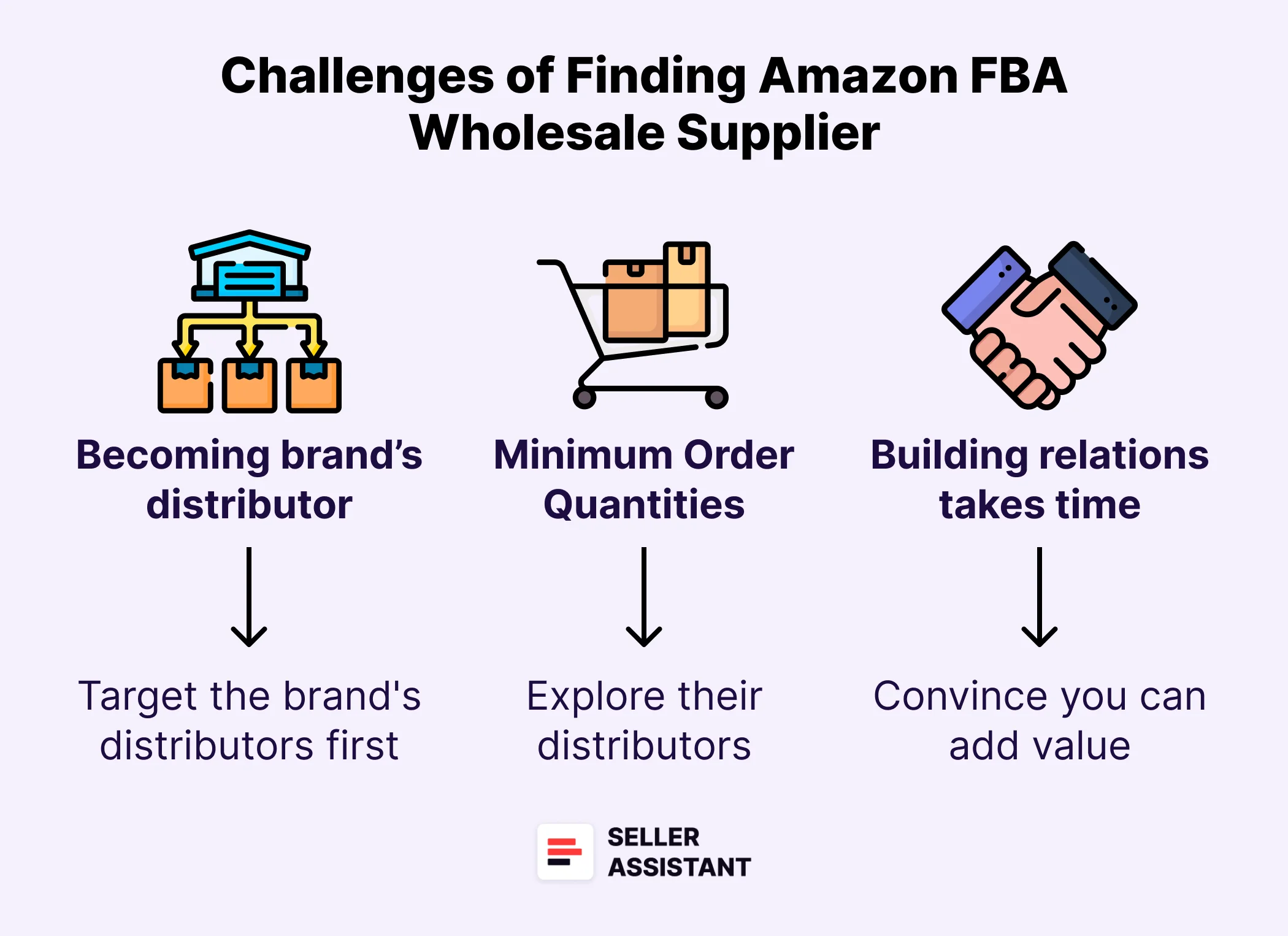
Where DHgate Fits Naturally
DHgate is a cross-border B2B marketplace that connects buyers with many suppliers, mainly for:
- Generic products.
- Private label opportunities.
- Price-sensitive sourcing.
It fits naturally in these roles:
1. Product Discovery and Price Benchmarking
Use DHgate to:
- Explore categories and see what’s being produced.
- Compare price ranges for generic items.
- Identify potential product ideas before committing to large MOQs elsewhere.
2. Testing Private Label or Generic Products
For private label or generic products:
- Order small batches to test demand on Amazon.
- Experiment with variations (colors, bundles, accessories).
- Use early sales data to decide whether to move to a more formal manufacturer-direct relationship later.
3. Supplementing, Not Replacing, Core Wholesale
For Amazon FBA:
- Use authorized distributors and brand-direct suppliers as your main source for branded products.
- Use DHgate and similar marketplaces for:
- Non-branded items.
- Accessories and add-ons.
- Early-stage product tests.
DHgate is not the natural fit when:
- You need official brand authorization.
- You’re dealing with heavily regulated categories.
- Amazon is likely to request invoices from recognized distributors.
What to Verify Before Using It
Whether you’re using an authorized distributor, a manufacturer, or a marketplace like DHgate, you need a consistent vetting process.
Vet Any Distributor or Supplier
-
Business Legitimacy
- Check business registration (where possible).
- Look for a real company name, address, and contact details.
- Search for reviews or complaints outside the platform.
-
Product Legitimacy
- For branded goods:
- Ask how they source the brand.
- Request proof of authorization if needed.
- For generic/private label:
- Confirm they own or control the molds/designs (if relevant).
- Check for any obvious IP conflicts.
- For branded goods:
-
Amazon-Ready Documentation
- Confirm they can issue:
- Commercial invoices with your business details.
- Clear product descriptions (matching what you’ll list on Amazon).
- Ask for a sample invoice (with sensitive info redacted) to see the format.
- Confirm they can issue:
-
Quality and Consistency
- Order samples before large orders.
- Check:
- Packaging.
- Labeling.
- Barcodes (if provided).
- Confirm they can maintain the same quality over repeated orders.
-
Logistics and FBA Compatibility
- Can they:
- Ship directly to Amazon FBA (with your labels)?
- Meet Amazon’s packaging and labeling requirements?
- Clarify:
- Lead times.
- Shipping methods.
- Incoterms (for cross-border).
- Can they:
-
Communication and Support
- Test response times.
- Ask detailed questions about:
- Defect handling.
- Reorders.
- Changes in product specs.
Extra Checks for B2B Marketplaces (Including DHgate)
When using DHgate or similar platforms:
-
Supplier Profile
- How long they’ve been active.
- Number of products and categories.
- Ratings and feedback patterns.
-
Consistency Across Listings
- Do product photos and descriptions look consistent?
- Are there obvious copy-paste or mismatched details?
-
Sample First
- Avoid large first orders.
- Use samples to validate:
- Actual product vs. listing.
- Packaging and labeling.
-
Invoice and Documentation
- Confirm in advance what kind of invoice they can provide.
- Understand that some marketplace suppliers may not issue invoices in a format Amazon accepts for branded ungating.
FAQ
What is a wholesaler in the context of Amazon FBA?
A wholesaler is a business that buys products in bulk from brands or manufacturers and resells them to retailers (including Amazon sellers) at discounted, bulk prices. For Amazon FBA, a good wholesaler also provides invoices and documentation that Amazon can use to verify authenticity and supply chain.
What are the different types of wholesalers?
Common types include:
- Authorized distributors – officially recognized by brands.
- General wholesalers – broad product ranges, often multi-brand.
- Category specialists – focused on one niche (e.g., beauty, toys).
- Cash-and-carry wholesalers – physical warehouses for local retailers.
- Liquidators – deal in overstock, returns, and closeouts.
Is wholesaling allowed in the Amazon store?
Yes. Amazon allows wholesale sourcing as long as:
- Products are genuine.
- You comply with brand and category policies.
- You can provide valid invoices if Amazon requests them.
Some brands restrict who can sell their products on Amazon, so you may need authorization.
What is an authorized distributor?
An authorized distributor is a wholesaler that has a formal agreement with a brand to distribute its products. Buying from authorized distributors:
- Reduces the risk of counterfeit or gray-market goods.
- Makes it easier to provide documentation Amazon accepts.
- Often aligns with brand policies for online sales.
Can I use B2B marketplaces like DHgate or Alibaba for Amazon FBA?
Yes, but with nuance:
- They’re often best for generic or private label products.
- For branded products, invoices from marketplace suppliers may not always satisfy Amazon’s requirements.
- Use them for product testing, price discovery, and early-stage private label, then consider moving to more formal manufacturer-direct or distributor relationships as you scale.
How do I know if a distributor is legit for Amazon?
Look for:
- Clear business identity and registration.
- Positive reputation and references.
- Ability to issue proper invoices.
- Transparent sourcing for branded goods.
- Willingness to answer detailed questions about products and logistics.
If they’re vague about sourcing or refuse to provide basic documentation, treat that as a red flag.
Ready to try wholesaling with Amazon – what’s the first practical step?
A simple starting path:
- Pick one category you understand.
- Identify 10–20 potential distributors or manufacturers.
- Shortlist 3–5 based on:
- Product fit.
- MOQs.
- Documentation.
- Order small test batches.
- Launch on Amazon, monitor performance, and refine your supplier list.
Evidence & Official References
Use these sources to cross-check policies and best practices:
| Topic | Reference Type | How It Helps |
|---|---|---|
| Amazon product authenticity & invoices | Amazon Seller Help / Policy pages | Clarifies what invoices Amazon accepts and when they’re needed |
| Brand and category restrictions | Amazon Seller Central guidelines | Shows which categories/brands require extra documentation |
| Wholesale and distribution basics | Trade associations, industry guides | Explains standard wholesale practices and terminology |
| Cross-border sourcing considerations | Government trade and customs sites | Highlights import, labeling, and compliance requirements |
Always check the latest Amazon Seller Central documentation, as policies and enforcement can change.
What to Do Next
- Define your model – branded wholesale, private label, or hybrid.
- Choose platform types:
- Branded: prioritize authorized distributors and brand-direct.
- Private label: prioritize manufacturer-direct and B2B marketplaces.
- Build a shortlist of specific distributors and suppliers.
- Vet them using the checks above (business, documentation, quality, logistics).
- Test small – start with limited orders and monitor Amazon performance.
- Scale what works – deepen relationships with reliable suppliers and phase out weak ones.
Use platforms like DHgate as a supporting tool for discovery and testing, while building your core Amazon FBA business on suppliers whose documentation and reliability align with Amazon’s requirements.