
DHgate can be a useful place to source DIY shoe materials like soles, leather, fabrics, and hardware, but it works as a marketplace of many independent sellers rather than one unified shop. To avoid disappointing materials, you need to focus less on finding a single “best” supplier and more on reading specs, judging seller history, and using DHgate’s search tools and protections to support your project.
Using DHgate as a source for DIY shoe materials
DHgate is a marketplace, not a single shoemaking shop. Independent sellers list their own DIY shoe materials, so quality, specifications, and reliability depend on each individual listing and seller rather than a central standard.
For DIY shoes, you’ll typically see components such as outsoles and soles, midsoles and cushioning foams, upper materials (natural and synthetic leather, mesh, canvas, knit fabrics), linings, insoles, and hardware like eyelets, buckles, zippers, snaps, laces, and decorative elements. Exact options change over time as sellers update their catalogs.
The real task is learning how to use DHgate’s search bar, categories, and filters, then reading listing photos and descriptions carefully to judge whether a material actually fits your project, instead of hunting for a single “best” supplier.
Personally, I’m much more comfortable ordering from listings that spell out material type, thickness, dimensions, and show a clear seller history, even if the price is a bit higher or the style range is smaller. I would only treat a vague listing as an experiment for a low-risk project, and only after checking the seller’s track record and any platform protections I still have.
Because DHgate is a variable marketplace, it helps to understand the main shoe material categories and the specifications that matter before interpreting listing details.
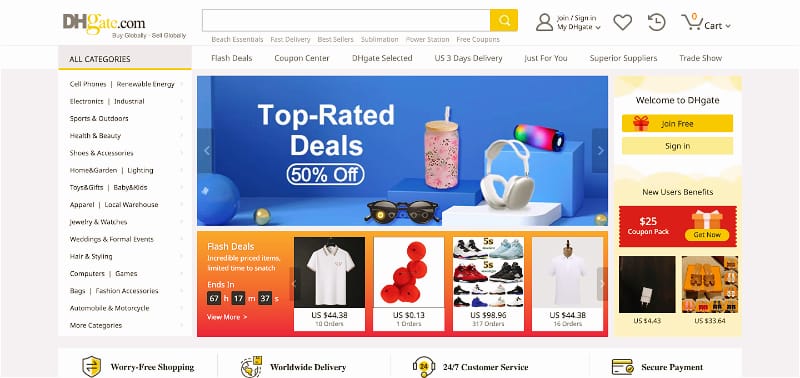
A DHgate search results page showing the search bar, category navigation, and product thumbnails, similar to what you’ll see when looking up DIY shoe materials.
Key DIY shoe material types and specs to understand
When you start browsing DHgate for DIY shoe supplies, it helps to picture how the main material groups fit into a shoe. Outsoles and soles provide grip and abrasion resistance; midsoles and cushioning foams add shock absorption; uppers made from natural or synthetic leather, mesh, canvas, or knit fabrics give the shoe its structure and look; linings sit against the foot for comfort and moisture management; insoles add support and fine-tune fit; and hardware such as eyelets, buckles, zippers, snaps, and laces controls how the shoe closes and adjusts.
Seeing a listing through this lens makes it easier to decide whether a material belongs on the ground-contact side of a daily-wear shoe, in a cushioning layer, or as part of the upper or closure system, and to spot when something is better suited to decorative or occasional use instead of heavy wear.
| Material category | Typical materials | Key specs to check | Practical consequences |
|---|---|---|---|
| Outsoles / soles | Rubber, TPU, EVA, mixed compounds | Material type, thickness, hardness/durometer, tread pattern, color | Determine grip, flexibility, and durability. Harder compounds and thicker soles usually last longer but can feel stiffer; softer compounds may grip better but wear faster. If hardness or thickness is unclear, treat the listing as a test order only. |
| Midsoles and cushioning foams | EVA foam, PU foam, latex foam, memory foam | Density or firmness, thickness, dimensions, compression or rebound notes | Affect cushioning level, support, and how quickly the foam packs out. Higher-density foams tend to be more supportive and durable; very soft foams feel plush but may lose shape quicker. Missing density or firmness details is a warning sign for daily-wear shoes. |
| Uppers | Full‑grain or split leather, synthetic leather (PU), mesh, canvas, knit fabrics | Material type, thickness or weight, finish/texture, color, any color‑fastness or water‑repellent notes, sheet or panel size | Control structure, breathability, and appearance, as well as glue and stitch compatibility. Thicker, firmer materials support the foot more; thinner or softer ones are better for lightweight or flexible designs. Vague material descriptions make it hard to predict creasing, stretching, and bonding. |
| Linings and insoles | Soft leather, fabric, microfiber, foam‑backed textiles | Material type, thickness, surface texture, color, moisture or odor control claims, dimensions | Influence comfort against the skin, moisture handling, and fit. Thickness and texture can change the internal volume of the shoe and how it feels over time. If size or thickness is not specified, you may need a small batch first to see how it affects fit. |
| Hardware and laces | Metal or plastic eyelets, buckles, zippers, snaps; cotton, polyester, or waxed laces | Size (diameter, length), material, finish/coating, strength or load hints, color | Ensure closures match your design and can handle expected stress. Size and material affect durability and how easily components install. When size or material isn’t clear, confirm measurements with the seller before ordering or keep the use to low‑stress, decorative projects. |
How to search and filter DIY shoe materials on DHgate
- Type a broad keyword for the shoe part you need into the DHgate search bar—for example “rubber shoe sole”, “leather upper material”, or “sneaker outsole”—then add a few precise descriptors like size range, color, or material type to narrow down obvious mismatches.
- Pick the category that best matches DIY shoe materials rather than finished shoes, and apply any useful filters you see, such as material type, price range, or shipping options, keeping in mind that the exact filter names and positions can change over time.
- Open several promising listings and study the photos closely: notice whether you’re seeing finished soles or flat sheets, whether there are side or cross‑section shots that hint at thickness, and whether close‑ups show texture, tread, and surface finish; then compare what you see to the key specs you learned to read in the previous section.
- Read the units and minimum order information line by line so you understand what each price actually buys—per pair, per set, per meter, or per sheet—and watch for MOQs that force you into bulk; this matters especially for hobby projects where a single sheet or a few pairs of soles may be enough.
- From your search results, save or bookmark only a small set of listings that combine reasonably clear photos, specific specs, and manageable MOQs, then reread their descriptions slowly before you contact any seller; I prefer to invest time upfront on this deeper screening instead of sending many quick, unfocused messages that I’ll have to track later.
- Once you have this short, carefully chosen list, you can shift your attention from the listings themselves to the people behind them and decide which sellers look reliable enough to trust with your order.
Checking seller reliability on DHgate
On DHgate, I start by looking at basic marketplace signals for each seller: their overall rating score, how many orders they’ve completed, and how long they’ve been active. A seller with a long history and a steady stream of orders gives me more confidence than a brand‑new account, even if both are offering similar DIY shoe materials.
I never rely on star ratings alone. I read review comments to see what buyers actually say about material quality, whether colors and thickness matched the description, how fast the order shipped, and—most importantly—how the seller handled problems like defects or wrong items. A mix of detailed, specific reviews across different shoe materials is more reassuring to me than a handful of short, generic compliments.
Listings with few or no reviews are not automatically off the table, but I treat them differently. For non‑critical experiments, I might order only a small test quantity and ask very specific pre‑sale questions about thickness, hardness, or finish before paying. For an important build where failure would be expensive, I usually skip low‑feedback listings entirely and choose a seller with clearer history, even if the price is higher or the style options are more limited.
I also check how consistent a seller looks across their catalog: similar photo quality, a recognizable description style, and comparable ratings on different products can signal a more established operation rather than a random mix of unrelated listings. In contrast, big gaps—some items with polished listings and others with vague or mismatched details—make me cautious.
None of these indicators are guarantees; ratings and reviews can be incomplete, outdated, or biased. Even with highly rated sellers, I keep basic precautions in place: I save copies of listings and messages, confirm key specs in writing, and avoid committing more money than I’m prepared to lose on an untested supplier. I’m willing to pay a bit more for a seller whose track record and communication reduce those uncertainties, especially when the materials are for shoes that need to hold up in regular use.
Common risks when buying DIY shoe materials online
- Color mismatch: Listing photos on DHgate can look different from real materials because of studio lighting, editing, or your screen settings. For visible uppers, linings, and trims, ask the seller for extra photos or short videos taken in neutral daylight and, where possible, compare a small test piece against your existing components before committing to a full build.
- Unclear thickness, hardness, or density: If a listing doesn’t state exact thickness or firmness, soles may arrive too stiff or too soft, foams may feel under- or over‑cushioned, and uppers might be unsuitable for the shoe type you have in mind. I treat vague specs as a warning sign: I ask for precise thickness measurements and hardness or density information, and I order the smallest practical quantity first to confirm fit and feel before scaling up.
- Adhesive compatibility issues: Some plastics, finishes, and coatings used in soles, uppers, or trims don’t bond well with common shoemaking adhesives, which can lead to delamination or weak joints. Before using a new material from DHgate in a critical pair of shoes, cross‑check general shoemaking guidance on which glues work with rubber, EVA, leather, and synthetics, and run a small bond test on offcuts or scrap rather than trusting the first full build.
- Unsuitable material combinations: Even when each component looks fine on its own, combining overly soft midsoles with rigid outsoles or stiff uppers with minimal lining can make the finished shoe uncomfortable or unstable. Use listing specs and any extra information from the seller to think through how the parts will work together, and reserve experimental mixes for low‑stakes projects until you’ve seen how they behave in wear.
- Costly shipping and returns: International shipping, customs, and return freight can make mistakes expensive, especially for heavy materials like soles or bulk leather. Before ordering, estimate how much you could lose if the materials aren’t usable, read DHgate’s current rules on returns and disputes, and only treat a poorly specified listing as an experimental purchase if you’re genuinely prepared to absorb that cost.
Using DHgate’s buyer protections for material orders
On large marketplaces like DHgate, buyer protections usually act as a safety net around each order. Payment is often held in an escrow‑style way until you confirm delivery or a set time window passes. You can also see basic tracking updates as the parcel moves, and formal dispute channels are available if items never arrive or differ significantly from what the listing promised.
The exact rules on DHgate—how long payments are held, which problems qualify for disputes or refunds, and what evidence you must provide—can change over time. Instead of assuming details from any guide, check DHgate’s official help and policy pages before you place an order, especially if the materials are expensive or mission‑critical for your shoe project.
To keep these protections effective, keep all communication with sellers inside DHgate’s messaging system, save copies of listings, order confirmations, and any spec details you agreed on, and take clear photos or videos of the materials as soon as they arrive. Don’t confirm receipt or close the order until you’ve inspected thickness, color, finish, and overall suitability against the listing description.
I treat DHgate’s buyer protections as a backstop, not a licence to take reckless risks: I still prioritise clear, detailed listings and sellers with solid history, and I reserve vague or experimental material orders for lower‑stakes projects where a problem wouldn’t be disastrous. Before making larger purchases, I would always review DHgate’s current buyer protection and dispute terms so I know what support is available if something goes wrong.
Pre‑order checklist for DIY shoe materials on DHgate
- Confirm key specs in the listing: material type (e.g., leather, rubber, EVA foam), thickness, dimensions, color, and hardness or density for soles and cushioning parts so they match your design and comfort needs.
- Check units, minimum order quantities, and lot descriptions carefully so you know whether you’re buying per pair, per set, per meter, or per sheet and avoid accidental bulk or mismatched orders.
- Message the seller to clarify any vague points and, if needed, request additional photos or short videos that show color, thickness, and texture more realistically before you commit.
- Review estimated shipping times, whether tracking is provided, and any likely customs or duties based on the shipment’s origin and your location, making sure the timeline fits your project.
- Revisit seller ratings and review content to confirm that past buyers mention material quality, accurate descriptions, and reasonable handling of issues such as delays or defects.
- Read DHgate’s current buyer protection and dispute policy so you understand time limits, what counts as a valid dispute, and what documentation (photos, messages, order details) you should keep before placing the order.
- Decide whether to start with a small test order when trying new materials or working with a seller for the first time, using larger orders only for projects where you’re confident about specs and the seller’s track record.
- Treat this checklist as a routine you can adapt: for important builds I would rarely skip any of these steps, while for low‑stakes experiments I might streamline a little but still confirm core specs, seller signals, and basic protections.
How DHgate compares to other DIY shoe material sources
| Source type | Typical price range | Variety and style options | Minimum order quantities | Spec detail and standardization | When it usually fits best |
|---|---|---|---|---|---|
| DHgate marketplace | Often on the lower side, especially for mass‑produced components; good for budget‑conscious projects. | Wide variety of styles, including unconventional or niche designs from many independent sellers. | Highly variable: some listings allow very small orders, others require multi‑pair or bulk quantities. | Specs can be patchy or inconsistent between sellers; details like thickness, hardness, and sizing may need extra confirmation. | Best when you prioritise price or style variety and are willing to apply careful listing checks, message sellers, and use buyer protections to manage variability. |
| Specialized shoemaking suppliers | Typically higher prices than broad marketplaces, reflecting more technical materials and consistent quality. | Focused but deep catalogues of soles, leathers, and components designed specifically for footwear. | Often higher minimums per size or material, especially for professional or production‑scale use. | Detailed, standardized specifications for thickness, hardness, last compatibility, and sizing, making repeat orders more predictable. | Best for everyday or critical‑wear shoes where durability, fit, and technical consistency matter more than price or sheer variety. |
| Craft and artisan marketplaces | Moderate to higher per‑unit prices, especially for handmade or small‑batch materials. | Good mix of mainstream and unique, artisan styles; often strong visual focus on design and finish. | Frequently flexible, with smaller quantities or custom sets available, though bulk options may be limited. | Specs are usually clearer than the vaguest marketplace listings but may still be less standardized than specialist suppliers. | Best for small runs, custom or decorative projects where distinctive looks and flexible quantities matter, and you’re comfortable balancing moderate spec detail with higher per‑unit cost. |
Practical FAQs about ordering DIY shoe materials on DHgate
Can hobbyists order DIY shoe materials in small quantities on DHgate?
Yes, but the minimum order quantity (MOQ) depends on each seller. Some listings are set up for single pairs of soles, a few meters of fabric, or small hardware sets, while others only sell bulk lots. When you search, look for wording that suggests smaller units such as “pair”, “set”, “pcs”, or “small batch”, and check whether the price is per pair, per meter, or per lot. Be prepared for slightly higher per‑unit prices when you choose flexible MOQs; that trade‑off is often worth it for hobby projects where you only need enough material for one or two builds rather than a full production run.
What should I do if the materials I receive from DHgate don’t match the listing description?
Start by keeping all packaging, labels, and order documentation, and take clear photos (or short videos) that show the difference between what was advertised and what arrived—for example, wrong color, thickness, or quantity. Contact the seller through DHgate’s internal messaging system with a calm, specific explanation and attach your evidence. If the seller’s response doesn’t resolve the issue, follow DHgate’s current dispute process and time limits to open a case, using your saved messages, photos, and order details as supporting documents. Because dispute steps and deadlines can change, always confirm the latest instructions on DHgate’s official help pages, and avoid off‑platform payments or side arrangements, especially once a problem has appeared; staying inside DHgate’s formal channels gives you the best chance of having buyer protections applied to your order.