
At a Glance
Finding reliable digital wholesale suppliers is less about chasing “secret lists” and more about choosing the right platform type and applying a consistent vetting process.
Quick answer:
- Know what you’re looking for: A digital wholesale supplier is any business that sells products in bulk (or at wholesale-like prices) through online channels to retailers, brands, or ecommerce operators.
- Choose the right platform type: Marketplaces (e.g., DHgate, Alibaba), curated B2B platforms, brand/authorized distributors, local wholesalers, and dropship directories each suit different needs.
- Use a comparison mindset: Evaluate platforms on trust signals, pricing, MOQs, shipping, returns, and how easy it is to vet individual suppliers.
- Decide when to use a marketplace: Use global marketplaces when you need cross‑border sourcing, broad assortment, and price comparison. Use local or brand-authorized channels when you need strict authenticity, warranties, or regulated after‑sales support.
- Always vet suppliers: Check business identity, product quality, communication, policies, and risk signals before committing.
This guide walks through platform types, a comparison matrix, a decision framework, and where a marketplace like DHgate naturally fits into your sourcing mix.
What the Platform Type Means
Before choosing suppliers, it helps to clarify what “digital wholesale” actually is and how platform types shape your experience.
Definition: Digital Wholesale Suppliers
A digital wholesale supplier is a company or individual that:
- Sells products in bulk or at wholesale-like prices
- Primarily through online channels (websites, marketplaces, B2B platforms)
- To other businesses (B2B) or ecommerce operators (including dropshippers)
- Often across borders, using digital tools for catalog, ordering, and communication
They can be:
- Manufacturers
- Trading companies
- Brand-authorized distributors
- Local wholesalers
- Dropship-focused suppliers
Why Platform Type Matters
The platform you use to find suppliers affects:
- Trust & transparency: How much information you get about the supplier and how easy it is to verify it.
- Pricing & negotiation: Whether prices are fixed, negotiable, or hidden until you contact the supplier.
- Risk & recourse: What happens if something goes wrong (quality issues, non-delivery, misrepresentation).
- Speed & convenience: How quickly you can search, compare, and place orders.
- Fit for your business model: Ecommerce store, marketplace seller, DTC brand, dropshipping, or offline retail.
Understanding platform types is the foundation for choosing where to look and how to vet.
The Main Platform Types
Here are the main digital routes people use to find wholesale suppliers today.
1. Global B2B Marketplaces
Examples: DHgate, Alibaba.com, Global Sources, Made‑in‑China.com
- Large, open marketplaces connecting buyers and suppliers worldwide.
- Wide product assortment, especially for consumer goods, electronics accessories, fashion, home & garden, and more.
- Often used for cross‑border sourcing and price comparison.
Best for:
- Price-sensitive sourcing
- Testing new product categories
- Comparing multiple suppliers quickly
- Cross‑border ecommerce and dropshipping
2. Curated B2B Wholesale Platforms
Examples: Faire, Tundra, Handshake (Shopify), Ankorstore
- Focus on curated brands and wholesalers, often with stricter onboarding.
- Stronger emphasis on design, brand story, and retailer experience.
- More common for boutique retail, lifestyle products, and branded goods.
Best for:
- Independent retailers and boutiques
- Higher-margin, branded or artisanal products
- More predictable quality and branding
3. Brand-Authorized Distributors & Official Channels
Examples: Official brand distributor lists, regional master distributors, brand B2B portals
- Suppliers directly authorized by brands to sell wholesale.
- Often listed on brand websites or via official sales reps.
- Stronger alignment with warranties, authenticity, and after‑sales support.
Best for:
- Regulated categories (medical devices, safety equipment)
- Products where warranty and brand support are critical
- Retailers needing official invoices and documentation
4. Local Wholesalers & Cash-and-Carry
Examples: Regional wholesale centers, local importers, cash-and-carry warehouses
- Physical or hybrid (online + offline) wholesalers in your country or region.
- Often discovered via trade directories, local business networks, or trade shows.
- Shorter shipping times and easier returns.
Best for:
- Fast replenishment and shorter lead times
- Heavy or bulky products
- Businesses that prefer in-person inspection and relationships
5. Dropship Marketplaces & Supplier Directories
Examples: Spocket, Syncee, Modalyst, SaleHoo, niche dropship directories
- Platforms that connect ecommerce stores to dropship suppliers.
- Focus on integration with ecommerce platforms (Shopify, WooCommerce, etc.).
- Often include product sync, inventory feeds, and automated ordering.
Best for:
- Dropshipping business models
- Testing products without holding inventory
- Early-stage ecommerce operators validating demand
6. Direct Manufacturer Websites & Sourcing via Search
Examples: Manufacturer websites, LinkedIn, Google search, industry forums
- Going directly to manufacturers or factories via their own sites or contact channels.
- Requires more legwork to verify and negotiate.
- Potentially better pricing and customization.
Best for:
- Larger or growing brands needing custom products
- Long-term strategic supplier relationships
- Higher order volumes and private label projects
Comparison Matrix
Use this matrix to compare platform types against common decision factors.
| Platform Type | Who It Suits | Typical Budget Level | Returns / Policies | Reviews / Trust Signals | Shipping / Delivery | Quality / Features |
|---|---|---|---|---|---|---|
| Global B2B Marketplaces (e.g., DHgate, Alibaba) | Ecommerce, marketplace sellers, dropshippers | Low to medium (price-sensitive) | Varies by supplier; must check each listing | Platform ratings, buyer reviews, transaction history | Cross‑border; longer lead times; varied options | Wide range; quality varies; requires vetting |
| Curated B2B Wholesale Platforms | Boutiques, specialty retailers | Medium to higher | Platform-standardized or curated policies | Platform-level vetting, brand profiles, retailer reviews | Regional or international; often clearer ETAs | Generally more consistent; branded products |
| Brand-Authorized Distributors | Retailers needing official stock | Medium to higher | Formal, documented; aligned with brand rules | Brand authorization lists, trade references | Regional; more predictable logistics | High authenticity; aligned with brand specs |
| Local Wholesalers & Cash-and-Carry | Local retailers, small chains | Medium | In-person or local policies; easier negotiation | Local reputation, business registry, word-of-mouth | Fast, local delivery or pickup | Can inspect in person; quality varies by source |
| Dropship Marketplaces & Directories | Dropship stores, lean ecommerce | Low to medium (per unit) | Platform or supplier-specific; often more restrictive | Platform reviews, app ratings, store case studies | Direct-to-consumer shipping; variable speed | Mixed; often consumer-grade; vet via samples |
| Direct Manufacturer Websites | Brands, larger ecommerce operations | Medium to high (but lower per unit at scale) | Negotiated contracts; more formal terms | Business registration, trade references, industry reputation | Bulk freight; longer lead times; more planning | Customizable; can align closely with specs |
Use this table as a quick filter: identify your business type, budget, and risk tolerance, then narrow down platform types that fit.
Decision Framework
To choose where and how to find reliable digital wholesale suppliers, walk through these steps.
Step 1: Clarify Your Business Model
Ask:
- Are you holding inventory or dropshipping?
- Are you selling on your own site, marketplaces, or offline retail?
- Are you focused on branded products or generic/private label?
Typical fits:
- Dropshipping: Dropship marketplaces, global B2B marketplaces, some DHgate suppliers that support small MOQs.
- Inventory-based ecommerce: Global B2B marketplaces, local wholesalers, curated B2B platforms, direct manufacturers.
- Brand-focused retail: Brand-authorized distributors, curated platforms, local wholesalers with official lines.
Step 2: Define Your Risk and Compliance Needs
Consider:
- Do you need official warranties and brand authorization?
- Are you in a regulated category (health, safety, food, children’s products)?
- How critical is after‑sales support and returns?
If these are high priorities:
- Favor brand-authorized distributors, local wholesalers, or curated platforms.
- Use global marketplaces mainly for accessories or non-critical items where risk is lower.
Step 3: Set Budget and Volume Expectations
- Low budget / testing phase: Global B2B marketplaces, dropship platforms, some local wholesalers.
- Medium budget / growing store: Mix of marketplaces, curated platforms, and local wholesalers.
- Higher budget / scaling brand: Direct manufacturers, brand-authorized distributors, curated platforms.
Step 4: Match Platform Type to Scenario
Here’s a scenario-based decision table:
| Scenario | Recommended Primary Route | Secondary / Mix Options |
|---|---|---|
| Testing a new product niche for an online store | Global B2B marketplace (e.g., DHgate, Alibaba) | Dropship marketplace; local wholesalers |
| Building a boutique store with branded lifestyle goods | Curated B2B wholesale platform | Brand-authorized distributors; trade shows |
| Selling regulated or safety-critical products | Brand-authorized distributors; official channels | Local wholesalers with documented sourcing |
| Running a local convenience or discount store | Local wholesalers & cash-and-carry | Brand distributors; regional B2B platforms |
| Scaling a private label brand | Direct manufacturers via search & B2B platforms | Global marketplaces for component sourcing |
| Starting a low-capital dropshipping business | Dropship marketplaces & directories | Global B2B marketplaces for future bulk buying |
Step 5: Apply a Supplier Vetting Framework
Regardless of platform, vet individual suppliers using a consistent checklist:
-
Business identity
- Company name, registration details, address
- Years in business, main markets served
-
Product quality
- Samples or small test orders
- Certifications where relevant (e.g., safety, compliance)
- Clear product specs and photos
-
Communication
- Response speed and clarity
- Willingness to answer detailed questions
- Language and professionalism
-
Policies
- Minimum order quantities (MOQs)
- Payment terms
- Return, replacement, and defect handling policies
-
Reputation
- Reviews and ratings on the platform
- Repeat buyers or long-term relationships
- Any negative patterns in feedback
-
Risk signals
- Prices far below market norms without explanation
- Vague company information
- Pressure to move off-platform or use risky payment methods
This framework is your main defense against unreliable suppliers, regardless of where you find them.
Where DHgate Fits Naturally
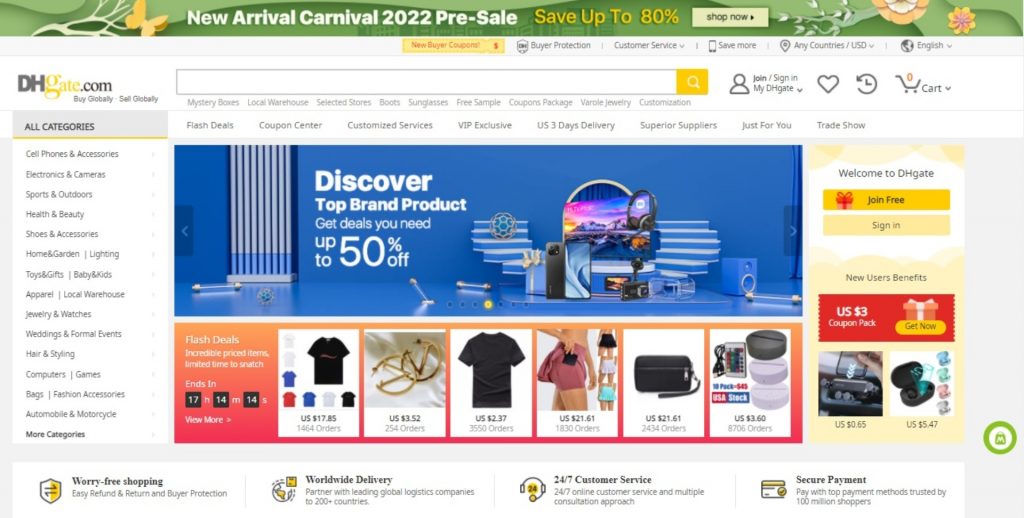
DHgate is one of several global B2B marketplaces that can play a useful role in a modern sourcing strategy, especially for cross‑border ecommerce.
Natural Fit Scenarios for DHgate
DHgate tends to fit well when:
- You need broad assortment of consumer goods, accessories, or general merchandise.
- You’re price-sensitive and want to compare multiple suppliers for similar products.
- You’re testing new product ideas and want to start with smaller quantities.
- You’re operating cross‑border, selling into markets different from where products are sourced.
Typical use cases:
- An online store owner comparing different suppliers for phone accessories or home decor items.
- A marketplace seller sourcing generic products to test demand before committing to large orders.
- A dropshipper exploring suppliers that offer relatively low MOQs and can ship directly to customers or to a fulfillment center.
How to Use DHgate in a Platform Mix
You don’t need to rely on a single platform. DHgate can be part of a broader mix:
- Discovery & comparison: Use DHgate to explore product categories, price ranges, and supplier options, then cross-check with other marketplaces or local wholesalers.
- Pilot sourcing: Place small test orders from a few DHgate suppliers to evaluate quality and reliability before scaling.
- Complementary sourcing: Use DHgate for accessories or lower-risk items while using brand-authorized or local channels for core, regulated, or warranty-critical products.
DHgate is not always the best route when:
- You require strict brand authorization, official warranties, or regulated after‑sales support.
- You’re sourcing highly regulated products where local compliance and documentation are essential.
- You need local, same-week replenishment and in-person inspection.
In those cases, prioritize local wholesalers, brand distributors, or curated platforms, and use DHgate mainly for supplementary or non-critical items.
What to Verify Before Using It
Whether you’re using DHgate or any other digital wholesale platform, verification is crucial. Focus on two layers: platform-level understanding and supplier-level vetting.
Platform-Level Understanding
Before relying on any marketplace:
-
Read platform terms and policies
- Understand how orders, cancellations, and disputes are handled.
- Check what information is available about suppliers and transactions.
-
Know what the platform does and doesn’t do
- Some marketplaces primarily provide a venue for buyers and sellers to connect.
- Protection mechanisms, if any, vary and may have conditions or limits.
-
Check platform reputation
- Look at independent reviews, forums, and case studies.
- Pay attention to patterns: shipping times, quality consistency, communication.
Apply this mindset to DHgate and other marketplaces alike: treat platform policies as part of your risk assessment, not as a guarantee that replaces vetting.
Supplier-Level Verification on Marketplaces
When evaluating a supplier on DHgate or similar platforms:
-
Profile completeness
- Company description, years active on the platform
- Product range and specialization (general trader vs focused niche)
-
Ratings and reviews
- Overall rating and number of transactions
- Detailed buyer feedback, especially on quality and delivery times
- Look for consistent patterns rather than single reviews
-
Product listing details
- Clear specifications, sizes, materials, and variants
- Realistic photos (avoid listings that look copied or generic without detail)
- Transparent pricing and MOQs
-
Communication test
- Send a message with specific questions (packaging, lead time, customization).
- Evaluate response speed and clarity.
- Check if they can provide additional photos or documentation when asked.
-
Sample or small test order
- Start with the minimum viable quantity to test:
- Product quality
- Packaging
- Actual delivery time vs stated time
- Use this as a practical reliability check before larger orders.
- Start with the minimum viable quantity to test:
-
Payment and logistics clarity
- Confirm shipping methods, estimated delivery times, and cost breakdown.
- Clarify who is responsible for customs, duties, and any local fees.
- Avoid arrangements that push you into opaque or high-risk payment channels.
Red Flags and Risk Reduction
Watch for:
- Unrealistic pricing far below other suppliers for the same product without explanation.
- Incomplete or inconsistent information in the supplier profile or product listings.
- Pressure to transact off-platform or use payment methods that reduce traceability.
- Poor communication or reluctance to provide samples or documentation.
Reduce risk by:
FAQ
How do I quickly screen digital wholesale platforms before signing up?
Check three things: platform reputation (independent reviews), buyer protection policies (disputes, refunds, escrow), and supplier transparency (ratings, verification badges, transaction history). If any of these are weak or unclear, treat the platform as higher risk.
What’s the safest way to place my first order with a new supplier?
Use platform-protected payment (escrow or trade assurance), start with a small test order, and choose trackable shipping. On DHgate or similar marketplaces, avoid moving to off-platform payments until the supplier has proven reliable over multiple transactions.
How can I tell if a supplier’s reviews are trustworthy?
Look for a high number of reviews over time, detailed comments about quality and delivery, and consistent ratings across different products. Be cautious if reviews are all short, generic, or clustered in a very short time frame.
Should I work with multiple suppliers for the same product?
Yes, when possible. Having at least two vetted suppliers per key product reduces stock-out risk, gives you leverage on pricing, and protects you if one supplier changes terms or quality. Use platforms to discover options, then narrow down via samples and performance.
When is DHgate a good fit versus local wholesalers?
DHgate is useful for variety, competitive pricing, and testing new product lines or accessories with lower risk. Local wholesalers or brand-authorized distributors are better for regulated items, strict warranty needs, or urgent replenishment where speed and compliance matter.
How often should I re-evaluate my digital suppliers?
At least every 6–12 months, or sooner if you notice changes in quality, communication, or delivery times. Review recent feedback on the platform, compare current pricing and terms, and re-check compliance for any regulated categories.
What to Do Next
- List your product categories and mark which are high-risk (regulated, warranty-critical) vs low-risk.
- Shortlist platforms (e.g., DHgate plus 2–3 others) that fit each category’s needs.
- Create a vetting checklist for suppliers: profile, reviews, samples, communication, and logistics clarity.
- Run small test orders with 2–3 suppliers per key product and track performance in a simple table.
- Standardize your sourcing process based on what works: preferred platforms, supplier criteria, and reorder rules.
By treating platforms as tools and suppliers as partners you systematically vet, you’ll build a more resilient, reliable digital wholesale pipeline over time.