
At a Glance
Online goods platforms are websites or apps where products are listed, discovered, and purchased digitally. They range from single-brand stores to huge multi-seller marketplaces like Amazon, AliExpress, and DHgate.
This article walks through:
- What online goods platforms are and how they work
- The main platform types and who they suit
- A comparison matrix of major marketplace models
- A decision framework to choose the right platform
- Where DHgate naturally fits for buyers, sellers, and ecommerce operators
- What to verify before using any marketplace
- Key FAQs and reference points
What the Platform Type Means
When people say “online goods platform” or “online marketplace,” they usually mean one of three things:
- A place to buy – as a consumer or business buyer
- A place to sell – as a merchant, brand, or wholesaler
- A place to integrate – as an ecommerce operator using platforms as supply, sales channels, or data sources
At its core, a platform is:
- Digital infrastructure: product listings, search, payments, and order management
- Rules and policies: who can sell, what can be listed, how disputes are handled
- Network of participants: buyers, sellers, logistics partners, sometimes payment and service providers
Understanding the platform type matters because:
- It affects price levels (retail vs wholesale vs bulk)
- It shapes risk and responsibility (who handles returns, warranties, and support)
- It determines integration options (APIs, dropshipping, sourcing workflows)
Before choosing a site like Amazon, AliExpress, or DHgate, it helps to know which platform model you’re actually dealing with.
The Main Platform Types
Most online goods platforms fall into a few recognizable categories.
1. Single-Retailer Ecommerce Stores
Examples: Official brand sites, local electronics chains, supermarket websites.
Characteristics:
- One company owns the inventory and sells directly
- Clear pricing, local taxes, and usually local warranties
- Limited assortment compared to marketplaces, but more controlled quality and support
Best for:
- Buying branded goods with official warranty
- Straightforward returns and customer service
- Local delivery with predictable timelines
2. Multi-Seller Retail Marketplaces
Examples: Amazon Marketplace, eBay, regional marketplaces.
Characteristics:
- Many sellers list products on one platform
- Mix of brand-owned stores, resellers, and small merchants
- Platform provides search, payments, and some trust signals (ratings, reviews)
Best for:
- Comparing prices and sellers for the same product
- Finding both new and used items
- Leveraging fast shipping options in supported regions
3. Cross-Border Consumer Marketplaces
Examples: AliExpress, DHgate, some global sections of eBay.
Characteristics:
- Sellers are often based in manufacturing hubs (e.g., China)
- Products ship internationally, usually at lower prices but longer delivery times
- Assortment is broad, including niche and generic items
Best for:
- Price-sensitive buyers willing to wait longer for delivery
- Accessing niche or hard-to-find items not stocked locally
- Comparing multiple suppliers for similar generic products
Where DHgate fits:
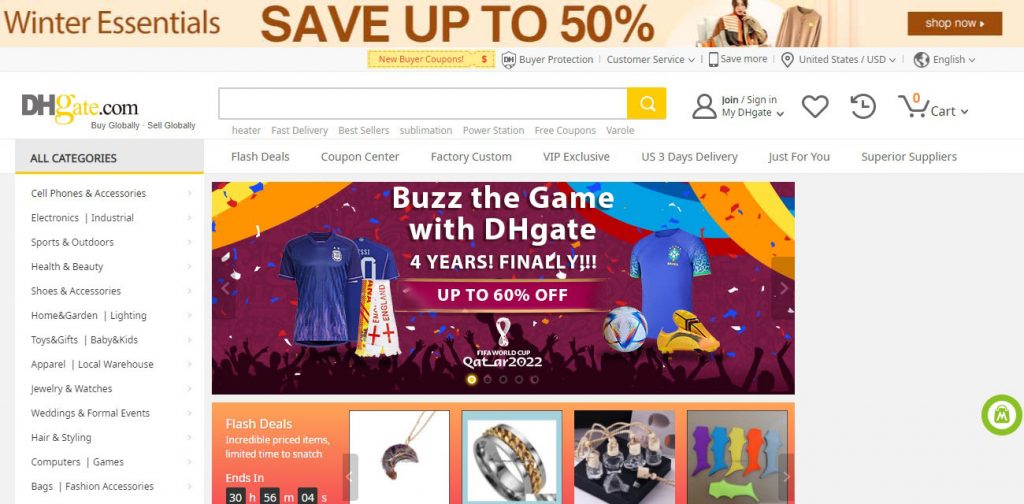
DHgate is a cross-border marketplace with a strong focus on bulk and wholesale-style purchasing, though small-quantity orders are also common. It’s typically used when buyers want to compare multiple suppliers for similar goods, especially for resale or business use.
4. Wholesale & B2B Marketplaces
Examples: Alibaba.com, industry-specific sourcing platforms.
Characteristics:
- Focus on business buyers, bulk orders, and long-term supplier relationships
- Often used for sourcing products to resell or to integrate into a supply chain
- Pricing and terms are frequently negotiated off-platform
Best for:
- Businesses sourcing inventory or components
- Customization, private labeling, or OEM manufacturing
- Building ongoing supplier relationships
DHgate’s overlap:
DHgate sits between consumer and B2B: it’s accessible to individual buyers but often used by small retailers and online sellers to source inventory in smaller batches than traditional wholesale.
5. Dropshipping & Integration Platforms
Examples: Shopify apps that connect to marketplaces, product feed aggregators.
Characteristics:
- Not marketplaces themselves, but tools that connect stores to marketplaces
- Allow merchants to import product listings, sync inventory, and route orders
- Used by ecommerce operators to build multi-channel operations
Best for:
- Store owners wanting to add products without holding inventory
- Testing new product lines with minimal upfront cost
- Automating sourcing and fulfillment workflows
DHgate in this context:
Some operators use DHgate as a sourcing source alongside other marketplaces, manually or via third-party tools, to test products and compare supplier options.
Comparison Matrix
The table below compares typical marketplace models from the perspective of buyers and sellers. Individual platforms may differ, but these patterns are common.
| Platform Type | Who It Suits (Buyer) | Who It Suits (Seller) | Assortment & Features | Shipping & Delivery | Reviews & Trust Signals | Price / Budget Profile |
|---|---|---|---|---|---|---|
| Single-Retailer Ecommerce Store | Brand-focused, warranty-conscious consumers | Brands and retailers selling own inventory | Curated, brand-specific, limited breadth | Usually local, faster, predictable | Brand reputation, site reviews | Mid to high; less variation |
| Multi-Seller Retail Marketplace | Everyday shoppers, deal seekers | Small–large merchants, brands, resellers | Very broad; strong search & filters | Mix of fast local and standard shipping | Seller ratings, product reviews, badges | Wide range; strong price competition |
| Cross-Border Consumer Marketplace | Price-sensitive, variety-seeking buyers | Export-focused sellers, small manufacturers | Very broad, many generic and niche items | International; longer, variable delivery | Platform-level reviews, seller feedback | Often lower prices; shipping time trade-offs |
| Wholesale & B2B Marketplace | Business buyers, procurement teams | Manufacturers, wholesalers, trading companies | Bulk, components, custom and OEM options | Negotiated logistics; freight common | Company profiles, trade history, references | Negotiated; per-unit lower in larger quantities |
| Dropshipping / Integration Platform | Store owners, ecommerce operators | Suppliers integrated via apps or feeds | Depends on connected marketplaces | Depends on supplier and shipping setup | Depends on source marketplace | Flexible; margin depends on sourcing choices |
Where DHgate typically sits in this matrix:
- Primarily in Cross-Border Consumer Marketplace
- With overlap into Wholesale & B2B for small and medium buyers sourcing inventory
Decision Framework
To choose between platforms like Amazon, AliExpress, DHgate, and others, it helps to map your situation to a simple framework.
Step 1: Clarify Your Role
- Consumer buyer: You want a product for personal use.
- Reseller / small business: You want inventory to sell on your own channels.
- Ecommerce operator: You want to integrate platforms into your store or operations.
Step 2: Define Your Priority
Pick your top one or two:
- Speed & reliability (fast shipping, predictable returns)
- Lowest possible price (willing to trade time and convenience)
- Brand authenticity & warranty
- Assortment breadth & supplier choice
- Integration & automation (APIs, feeds, dropshipping)
Step 3: Match to Platform Types
| Scenario / Priority | Platform Types That Usually Fit Best | DHgate Fit Level |
|---|---|---|
| Need official brand goods with local warranty | Single-Retailer Ecommerce Store; brand shops on retail marketplaces | Low – better to use official/local routes |
| Need fast delivery and easy returns | Multi-Seller Retail Marketplace with local fulfillment | Low–Medium – depends on region and seller |
| Need lowest price on generic items, can wait longer | Cross-Border Consumer Marketplace (e.g., AliExpress, DHgate) | Medium–High – one of several options |
| Need small-batch inventory to resell online | Cross-Border Consumer Marketplace; Wholesale & B2B marketplaces | High – often used for this purpose |
| Need bulk orders and custom manufacturing | Wholesale & B2B Marketplace (e.g., Alibaba.com) | Medium – for some categories and sellers |
| Need to test products via dropshipping or light sourcing | Integration platforms + cross-border marketplaces | Medium – as a sourcing source |
Step 4: Shortlist Platforms
Once you know your scenario, shortlist 2–3 platforms:
- Compare total cost (item + shipping + fees)
- Check delivery estimates and return policies
- Review seller ratings and product reviews
- For business use, consider communication quality and documentation
DHgate should be on the shortlist when:
- You’re comparing cross-border options for generic or semi-branded goods
- You want to see multiple suppliers for similar items, often in small wholesale quantities
- You’re balancing price against delivery time and are comfortable with international sourcing
Where DHgate Fits Naturally
DHgate is best understood as a cross-border marketplace that leans toward wholesale-style buying, but remains accessible to individual consumers.
For Buyers
DHgate tends to fit when:
- You’re looking for generic or lightly branded products (e.g., accessories, home goods, hobby items)
- You want to compare multiple suppliers offering similar items
- You’re comfortable with international shipping times and checking seller details carefully
- You may be buying slightly larger quantities than a typical consumer (e.g., for events, small resale, or group purchases)
It’s less suitable as the primary route when:
- You need official brand warranties and local after-sales support
- You’re buying regulated products that require strict compliance or certification
- You want same-day or next-day delivery as a non-negotiable requirement
For Sellers
DHgate can be considered when:
- You’re a manufacturer or trading company looking to reach global buyers without building your own international ecommerce site
- You’re comfortable operating in a marketplace environment where buyers compare multiple suppliers
- You can handle cross-border logistics and communication in English or other major languages
It may be less suitable if:
- Your main focus is local retail with fast domestic delivery
- You rely heavily on brand-controlled environments and strict pricing policies
For Ecommerce Operators
DHgate can play a role in:
- Sourcing inventory for your own store, especially for testing new product lines
- Comparing supplier options against other marketplaces to balance price, quality, and delivery time
- Filling assortment gaps where local wholesalers don’t offer certain niche products
Operators typically use DHgate alongside other platforms rather than as a single source, to diversify risk and compare offers.
What to Verify Before Using It
Whether you’re using DHgate, Amazon, AliExpress, or any other marketplace, a verification checklist helps reduce risk.
For Buyers
Before placing an order:
-
Seller Profile
- Check seller ratings and feedback volume
- Look for consistent comments about product quality and delivery
-
Product Details
- Read the full description, specifications, and size charts
- Check photos carefully; look for real-life images in reviews
-
Pricing & Total Cost
- Confirm item price, shipping cost, and any taxes or duties that may apply
- Compare with at least one alternative platform or local store
-
Shipping & Delivery
- Review estimated delivery time and shipping method
- Consider whether you need tracking and how delays might affect you
-
Returns & Support
- Check the platform’s general policies and the seller’s specific terms
- Understand who you contact if something goes wrong (seller vs platform)
For Sellers
Before listing or sourcing:
-
Platform Rules
- Review listing policies, restricted items, and fee structures
- Understand how disputes and order issues are handled
-
Demand & Competition
- Search for similar products to gauge competition and pricing
- Identify niches where you can differentiate (quality, bundles, customization)
-
Logistics
- Plan how you will handle shipping, tracking, and returns
- Consider using reliable logistics partners for cross-border orders
-
Documentation
- Keep product documentation, certifications, and clear descriptions ready
- For business buyers, verify supplier credentials and business registration where possible
For Ecommerce Operators
Before integrating a marketplace into your operations:
-
Data & Integration
- Check if the platform offers APIs or if third-party tools support it
- Plan how you’ll sync inventory, pricing, and orders
-
Quality Control
- Test products from multiple suppliers before scaling
- Build internal checks for product consistency and packaging
-
Risk Management
- Avoid relying on a single marketplace for critical inventory
- Set clear policies for your own customers about delivery times and returns
FAQ
What are online goods platforms?
Online goods platforms are digital environments where products are listed, discovered, and purchased. They include single-brand ecommerce sites, multi-seller marketplaces, cross-border platforms, and B2B sourcing sites.
How do marketplaces like Amazon, AliExpress, and DHgate work?
All three are marketplaces where multiple sellers list products:
- Amazon: Mix of Amazon-owned inventory and third-party sellers, strong focus on fast delivery and local fulfillment in many regions.
- AliExpress: Cross-border marketplace with many sellers based in manufacturing hubs, often offering low prices and broad assortment with longer delivery times.
- DHgate: Cross-border marketplace used by both consumers and small businesses, often for generic goods and small wholesale-style orders, with multiple suppliers per product type.
Each platform sets its own rules for listings, payments, and dispute handling, and provides tools like search, reviews, and ratings.
What technology is involved in ecommerce platforms?
Typical components include:
- Product catalog and search systems
- Shopping cart and checkout flows
- Payment processing and fraud checks
- Order management and logistics integration
- User accounts, reviews, and messaging
- APIs and data feeds for integrations
When should I use DHgate instead of other sites?
DHgate is worth considering when:
- You’re comparing cross-border options for generic or semi-branded goods
- You want to source small batches for resale or events
- You’re comfortable with international shipping times and verifying sellers carefully
If your priority is official brand warranty, local after-sales support, or very fast delivery, local retailers or large retail marketplaces with local fulfillment are usually more suitable.
Is there a website like AliExpress but cheaper?
Prices vary by product and seller rather than by platform alone. AliExpress, DHgate, and other cross-border marketplaces often overlap in assortment. For a specific item:
- Compare prices across multiple platforms
- Factor in shipping cost, delivery time, and potential duties
- Consider seller ratings and product reviews, not just headline price
Sometimes one platform will be cheaper for a given product; other times another will be.
Are AliExpress alternatives like DHgate safe?
Safety depends on:
- The platform’s policies and enforcement
- The individual seller’s behavior and reliability
- How carefully you verify listings, reviews, and terms
No marketplace is risk-free. To reduce risk:
- Use platforms with clear policies and visible seller ratings
- Avoid deals that look unrealistically cheap compared to similar listings
- Start with smaller test orders before committing to large purchases
What is the best alternative to AliExpress?
There is no single “best” alternative; it depends on your needs:
What to Do Next
Use this as a practical checklist before committing to any platform or marketplace strategy:
| Step | Action | Why it matters |
|---|---|---|
| 1 | Clarify your goal (personal buying, side hustle, or full ecommerce business) | Determines which platforms and features you actually need |
| 2 | Map your options (local retailers, Amazon-style marketplaces, cross-border sites like DHgate, direct-from-brand stores) | Helps you compare price, speed, and risk across channels |
| 3 | Test small | Place small trial orders with 2–3 suppliers to validate quality, delivery times, and communication |
| 4 | Standardize processes | Define how you handle product checks, returns, and customer communication across all platforms |
| 5 | Diversify | Avoid depending on a single marketplace for all sourcing or sales; keep at least one backup channel |
| 6 | Review regularly | Re-check fees, policies, and performance every few months as platforms and seller conditions change |
If you’re sourcing goods (for resale, events, or projects), treat DHgate and similar marketplaces as one tool in a broader toolkit: useful for variety and price, but best combined with clear quality checks, realistic delivery expectations, and a plan for handling issues when they arise.