

At a Glance
If you’re looking for wholesale apparel online, you’re really choosing between platform types, not just brand names:
- Wholesale marketplaces (global or regional) – huge assortments, many suppliers, variable quality.
- Curated B2B platforms – vetted brands, higher prices, more predictable quality.
- Brand-direct and manufacturer-direct – best for consistency, control, and long-term relationships.
- Blank apparel & print-on-demand platforms – ideal for merch, uniforms, and custom designs.
- Closeout / liquidators – opportunistic deals, but limited repeatability.
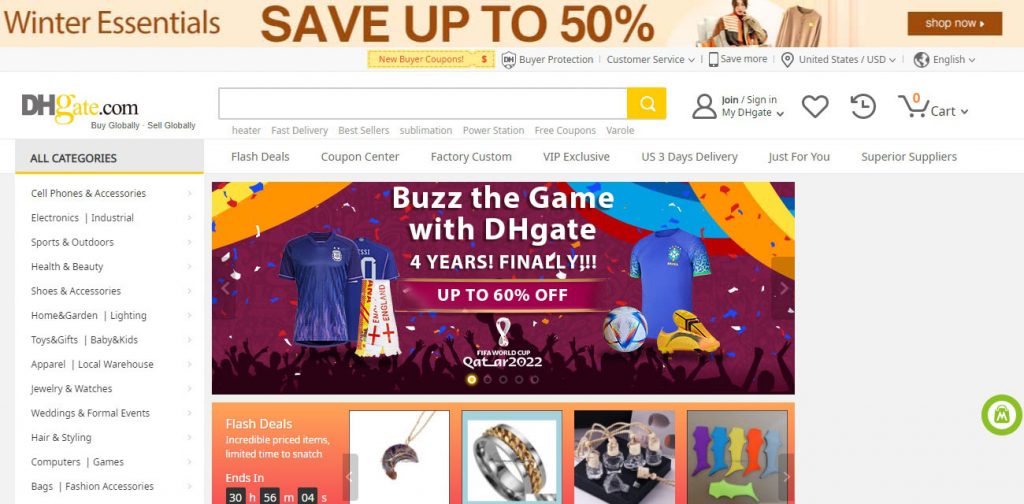
DHgate sits in the global marketplace category: useful for cross-border price comparison, broad assortment, and testing new product ideas, but not always the right choice when you need brand-authorized stock or strict domestic compliance.
This guide walks through what each platform type means, compares major options, and gives you a decision framework to choose the right mix for your apparel business.
What the Platform Type Means
When someone asks, “Can you recommend wholesale apparel sources online?” they’re usually mixing together several different needs:
- Inventory needs – boutique fashion vs. blank tees vs. private label.
- Risk tolerance – how much variability in quality, shipping, and communication you can accept.
- Control level – whether you need brand-authorized stock, custom labels, or just low-cost inventory.
- Speed vs. price – how quickly you need goods vs. how low you want your unit cost.
A platform type is simply the way a site organizes and mediates wholesale buying:
- Some platforms act like open marketplaces where many sellers list products.
- Others are curated catalogs where the platform pre-vets brands and sets standards.
- Some are direct channels where you buy straight from a brand or manufacturer.
Understanding the type first helps you:
- Predict the tradeoffs (price vs. reliability vs. control).
- Ask the right questions before placing an order.
- Decide where a global marketplace like DHgate belongs in your sourcing mix.

The Main Platform Types
1. Global Wholesale Marketplaces
Examples: DHgate, Alibaba.com, Made-in-China, other cross-border B2B marketplaces.
What they are:
Large platforms where international suppliers list products and buyers worldwide place orders.
Strengths
- Very broad assortment (fashion, basics, niche categories).
- Competitive pricing, especially for bulk and private label.
- Useful for testing new product ideas or comparing factory-level pricing.
Tradeoffs
- Quality and reliability vary by supplier.
- Longer shipping times and customs considerations for U.S. buyers.
- Communication and after-sales processes can be more complex.
Best for
- Price-sensitive buyers.
- Private label or custom designs (e.g., custom tags, prints).
- Experimenting with new categories before committing to a long-term supplier.
DHgate fits here as one of several global marketplaces you can browse when you want cross-border options and wide assortment.
2. Regional / Domestic Wholesale Marketplaces
Examples: FashionGo, LA Showroom, Tundra, Faire (for some apparel), regional B2B fashion platforms.
What they are:
Marketplaces focused on specific regions (often U.S.-based) with apparel brands, importers, and distributors.
Strengths
- More familiar sizing and style for U.S. consumers.
- Often faster shipping and easier returns.
- Better alignment with local regulations and labeling requirements.
Tradeoffs
- Prices can be higher than direct-from-factory options.
- Assortment is broad but not as deep as global platforms.
- Some platforms focus heavily on boutique fashion, less on blanks or private label.
Best for
- Boutiques and small retailers needing trend-right fashion.
- Buyers who want domestic shipping and easier communication.
- Those who value platform-level curation and reviews.
3. Curated B2B Brand Platforms
Examples: NuOrder, Joor, brand showrooms, invite-only B2B portals.
What they are:
Platforms that connect retailers with established brands, often with pre-vetted partners and structured ordering.
Strengths
- Higher trust and consistency in quality.
- Clear brand policies, MAP (minimum advertised price), and authorized distribution.
- Better for long-term brand-building and multi-season planning.
Tradeoffs
- Higher minimums and price points.
- Less flexibility for private label or heavy customization.
- Access may require approval or existing retail presence.
Best for
- Retailers building a brand portfolio (e.g., carrying known labels).
- Stores that need reliable seasonal collections and marketing support.
- Buyers who prioritize brand reputation over lowest cost.
4. Brand-Direct and Manufacturer-Direct Channels
Examples: Brand-owned wholesale portals, factory websites, direct sales reps.
What they are:
You buy directly from the brand or manufacturer, often via their own site or sales team.
Strengths
- Strong control over authenticity and quality.
- Clear communication and stable product lines.
- Potential for custom programs, exclusives, or co-branded collections.
Tradeoffs
- May require higher minimum order quantities (MOQs).
- Less variety than marketplaces (you’re limited to that brand or factory).
- Onboarding can be slower (credit checks, account setup).
Best for
- Retailers who want deep relationships with a few key suppliers.
- Private label brands working closely with a manufacturer.
- Buyers who need consistent replenishment and predictable sizing.
5. Blank Apparel & Print-on-Demand Platforms
Examples: S&S Activewear, SanMar, AlphaBroder, Printful, Printify, other POD/blank suppliers.
What they are:
Platforms specializing in blank garments (tees, hoodies, polos) and/or on-demand printing and embroidery.
Strengths
- Reliable basics with consistent sizing and fabric.
- Ideal for merch, uniforms, and branded apparel.
- POD options reduce inventory risk (you print as you sell).
Tradeoffs
- Less fashion-forward variety; more basics.
- Unit costs can be higher for POD vs. bulk blanks.
- Limited to the brands and cuts they carry.
Best for
- Screen printers, promotional product companies, and merch brands.
- Businesses needing logo apparel or uniforms.
- Creators testing designs without holding inventory.
6. Closeout, Liquidation & Off-Price Platforms
Examples: B-Stock, Via Trading, off-price wholesalers, closeout marketplaces.
What they are:
Platforms selling overstock, returns, and end-of-season goods at discounted prices.
Strengths
- Very low prices relative to original retail.
- Good for opportunistic buys and margin-heavy deals.
- Useful for outlet-style or discount-focused stores.
Tradeoffs
- Inconsistent availability; hard to repeat winning styles.
- Mixed conditions (new, shelf-worn, returns).
- Limited size runs and broken assortments.
Best for
- Off-price retailers and discount stores.
- Buyers comfortable with opportunistic, non-repeatable inventory.
- Clearance events or short-term promotions.
Comparison Matrix
Use this matrix to quickly see how the main platform types stack up for apparel sourcing.
| Platform Type | Who It Suits Best | Reviews / Trust Level | Quality / Features | Returns / Policies | Price / Budget Fit | Shipping / Delivery |
|---|---|---|---|---|---|---|
| Global Wholesale Marketplaces (e.g., DHgate, Alibaba.com) | Price-sensitive buyers, private label, experimenters | Highly variable by supplier; rely on ratings and history | Wide range from basic to premium; customization often available | Depends on each seller; cross-border returns can be complex | Generally lowest unit costs; good for bulk | Longer lead times; international shipping and customs |
| Regional/Domestic Marketplaces (e.g., FashionGo, Faire) | Boutiques, U.S. retailers, trend-focused stores | Moderate to high; platform curation plus seller reviews | Fashion-forward assortments; U.S.-friendly sizing | Typically clearer and easier than cross-border | Mid-range pricing; mix of value and premium | Faster domestic shipping; simpler logistics |
| Curated B2B Brand Platforms | Established retailers, multi-brand stores | High; brands are vetted and known | Branded collections, consistent quality | Brand-standard policies; more structured | Mid to high; reflects brand positioning | Standard wholesale shipping; predictable timelines |
| Brand-Direct / Manufacturer-Direct | Private label, long-term partners | High once relationship is built | Consistent lines; potential for custom work | Negotiated case by case; often stable | Can be very competitive at scale | Depends on location; often planned and scheduled |
| Blank Apparel & POD Platforms | Merch sellers, uniform buyers, creators | Generally high; industry staples | Reliable basics; print/embroidery options | Clear policies; POD often handles reprints | Blanks: low to mid; POD: higher per unit | Blanks: standard wholesale; POD: on-demand fulfillment |
| Closeout / Liquidation Platforms | Off-price and discount retailers | Variable; depends on source | Mixed; overstock and returns | Often limited; “as-is” common | Very low; deep discounts | Varies; may be slower or bulk freight |
Decision Framework
Instead of chasing a long list of “best wholesale clothing vendors,” start with a simple decision framework.
Step 1: Clarify Your Primary Use Case
Ask yourself:
- Are you a boutique needing trend-right fashion?
- A merch brand needing blanks or POD?
- A private label building your own line?
- An off-price retailer focused on deals?
Step 2: Match Use Case to Platform Type
Use this quick mapping:
| Scenario / Goal | Best-Fit Platform Types | Secondary Options to Explore |
|---|---|---|
| Launching or growing a boutique in the U.S. | Regional/domestic marketplaces; curated B2B brand platforms | Select global marketplaces for unique items and price checks |
| Building a private label apparel brand | Brand-direct/manufacturer-direct; global marketplaces | Blank apparel suppliers for base garments |
| Selling branded merch or uniforms | Blank apparel wholesalers; POD platforms | Regional marketplaces for complementary fashion items |
| Running an off-price or discount store | Closeout/liquidation platforms | Regional marketplaces for sale and clearance lines |
| Testing new categories with limited budget | Global marketplaces (including DHgate) | Closeout platforms for small trial buys |
| Scaling a multi-brand retail concept | Curated B2B brand platforms; brand-direct portals | Regional marketplaces for trend fill-in |
Step 3: Decide Your Risk Tolerance
- Low risk tolerance → favor curated platforms, brand-direct, domestic marketplaces.
- Moderate risk tolerance → mix domestic platforms with selected global marketplace suppliers.
- High risk tolerance / very price-sensitive → explore global marketplaces and closeout platforms more heavily, but vet suppliers carefully.
Step 4: Build a Mixed Sourcing Strategy
Most successful apparel businesses use more than one platform type:
-
A boutique might use:
- FashionGo for core assortment,
- A curated brand platform for key labels,
- DHgate or similar for occasional private label experiments.
-
A merch brand might use:
- SanMar or S&S for blanks,
- POD for small runs,
- A global marketplace to test custom cuts or fabrics.
Where DHgate Fits Naturally
DHgate is a global wholesale marketplace that can fit into your sourcing mix in specific, practical ways:
-
Cross-border price comparison
When you want to understand factory-level pricing for a category (e.g., hoodies, leggings, sports bras), browsing DHgate alongside other global marketplaces can give you a sense of typical unit costs and MOQs. -
Assortment exploration
If you’re looking for niche items, custom trims, or variations not easily found on domestic platforms, DHgate’s broad assortment can help you discover options and suppliers you might not see elsewhere. -
Private label and customization
Many suppliers on global marketplaces offer customization (e.g., labels, packaging, color runs). DHgate can be one of the places you explore when you’re testing a private label concept and comparing offers. -
Budget-sensitive trials
For small test orders where you’re exploring a new category and are willing to accept some variability, DHgate can be part of your trial sourcing strategy, alongside other marketplaces and local options.
Where DHgate is less natural:
- When you need brand-authorized stock from major labels.
- When your priority is local warranty, regulated after-sales support, or strict compliance with domestic retail standards.
- When you want fast, predictable domestic shipping for frequent replenishment.
In those cases, domestic marketplaces, brand-direct portals, and curated B2B platforms usually fit better.
What to Verify Before Using It (or Any Marketplace)
Regardless of platform, the same verification steps apply. Before placing an order with any wholesale apparel supplier:
1. Supplier Identity and Track Record
- Check ratings, reviews, and transaction history on the platform.
- Look for repeat buyers and detailed feedback, not just star scores.
- Search the supplier name online to see if they have a site or other presence.
2. Product Quality and Specifications
- Request detailed specs: fabric composition, GSM (weight), sizing charts, care instructions.
- Ask for real photos (not just polished catalog images).
- Order samples before committing to a large run, especially for private label.
3. Minimums, Pricing, and Hidden Costs
- Confirm MOQ (minimum order quantity) and price breaks at higher volumes.
- Ask about additional charges: customization fees, packaging, labeling.
- Factor in shipping, duties, and taxes for cross-border orders.
4. Returns, Replacements, and Defect Handling
- Clarify the supplier’s return or replacement policy:
- What counts as a defect?
- How quickly must you report issues?
- Who pays for return shipping, if applicable?
- For cross-border orders, understand whether returns are practical or if you’ll handle defects locally.
5. Communication and Lead Times
- Confirm production time (for made-to-order) and handling time (for ready stock).
- Ask for estimated delivery windows and shipping methods.
- Evaluate how quickly and clearly the supplier responds to questions.
6. Compliance and Labeling
For U.S. apparel buyers:
- Check that garments can meet basic labeling requirements (fiber content, country of origin, care instructions).
- If you sell children’s apparel or specialized categories, ensure the supplier understands relevant safety standards and can provide documentation if needed.
FAQ
What is a wholesale clothing vendor?
A wholesale clothing vendor is a business that sells apparel in bulk to other businesses (retailers, brands, merch companies) at wholesale prices. Vendors can be:
- Manufacturers (factories producing garments).
- Brand owners (selling their own label).
- Distributors or importers (reselling goods from multiple sources).
- Marketplace sellers (operating through platforms like DHgate, FashionGo, or others).
Is reselling wholesale clothing profitable?
It can be, but profitability depends on:
- Margin – the difference between your landed cost (including shipping and duties) and your selling price.
- Sell-through – how quickly and consistently items sell.
- Returns and defects – how much you lose to quality issues or customer returns.
- Operating costs – marketing, rent, staff, and platform fees.
Choosing the right platform type helps you balance margin against risk and operational complexity.
What should you consider when evaluating wholesale clothing suppliers?
Key factors:
What to Do Next
Use this checklist to move from research to action:
| Step | What to Do | Why It Matters |
|---|---|---|
| 1 | Define your target customer and product mix (categories, price range, quality level). | Clarifies which platforms and suppliers are a realistic fit. |
| 2 | Shortlist 2–3 platform types (e.g., DHgate for variety and price, a domestic B2B marketplace for branded stock, local wholesalers for fast replenishment). | Diversifies risk and sourcing options. |
| 3 | Pick 5–10 candidate suppliers per platform and run through the verification steps above. | Filters out weak or risky vendors before you spend money. |
| 4 | Order small test batches or samples from your top 3–5 suppliers. | Lets you compare quality, sizing, and reliability side by side. |
| 5 | Track landed cost, delivery times, and defect rates for each supplier. | Builds real data to guide long-term partnerships. |
| 6 | Commit to 1–2 core suppliers and keep 1–2 “backup” options on other platforms. | Gives you stability plus flexibility when demand or supply shifts. |
Start with one platform and a narrow product focus, refine your supplier list using the verification framework, then gradually expand to additional marketplaces and local sources as your apparel business grows.