
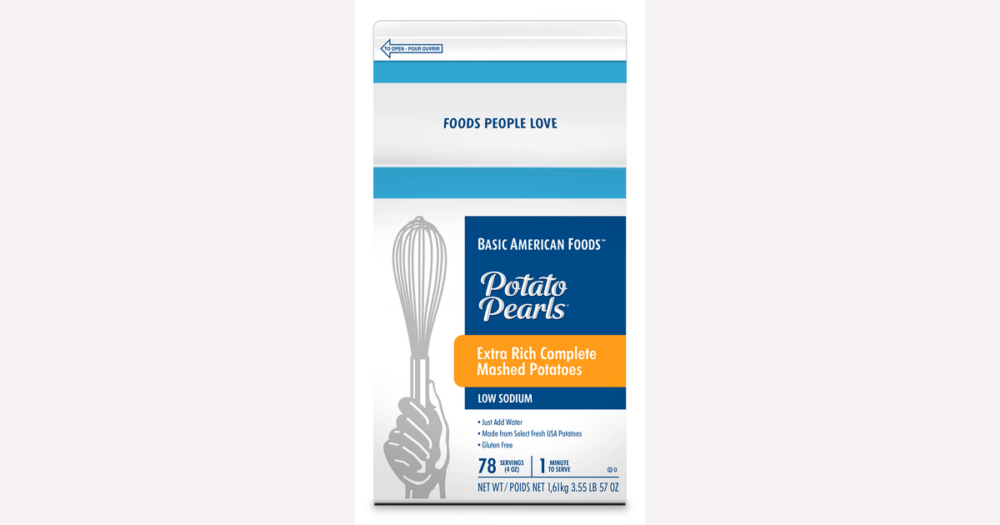
Potato pearls are usually sold as bulk, food-service style cases that turn a few bags of dry mix into hundreds of servings, and those case prices translate into a rough per-pound or per-serving range. Using these illustrative benchmarks gives a DHgate buyer in Canada a grounded way to judge whether any imported potato product really beats familiar domestic or distributor pricing once shipping, duties, and platform-related costs are added.
How are potato pearls typically packaged and priced at non-DHgate retailers?
| Retailer | Case contents (bags and weight per bag) | Total net dry weight | Stated prepared yield (lbs or servings) | Headline case or bag price | Notable variant or format | Illustrative cost metric (per prepared lb or per serving) |
|---|---|---|---|---|---|---|
| WebFoodStore | 6 bags × 3.5 lb each | 21 lb dry mix | Around 118 lb prepared potatoes | About US$90 per case | Standard food-service potato pearls | Roughly US$0.75 per prepared lb (about US$0.12 per 4-oz serving) |
| Grocery.com | 12 bags × 3 lb each | 36 lb dry mix | Approx. 468–504 4-oz servings | Around US$100 per case | Butter-flavor potato pearls | Around US$0.20–0.22 per 4-oz serving (about US$0.80–0.90 per prepared lb) |
| Restaurant and More | 8 bags × 3.75 lb each | 30 lb dry mix | Roughly 150–170 lb prepared potatoes | About US$110 per case | Extra rich formulation | Approximately US$0.65–0.75 per prepared lb (around US$0.10–0.12 per 4-oz serving) |
| ChickenPieces.com | 4 bags × 5 lb each | 20 lb dry mix | Around 100 lb prepared potatoes | Roughly US$120 per case | Low-sodium variant | Close to US$1.20 per prepared lb (about US$0.19 per 4-oz serving) |
| Penny Pinchers (discount grocer) | Single 28-oz bag | 1.75 lb dry mix | Around 8–10 lb prepared potatoes | About US$5 per bag | Retail-size instant mashed potatoes | Roughly US$0.50–0.60 per prepared lb (about US$0.08–0.10 per 4-oz serving) |
Taken together, these examples show potato pearls priced mainly as bulk food-service cases that turn relatively small bags of dry mix into well over 100 lb of prepared potatoes or hundreds of 4-oz servings. The derived per-pound and per-serving figures are simple illustrations based on the listed case sizes and prices, not precise market statistics; yields and formulations vary by brand, so the real cost for any specific product will sit somewhere within, or just outside, these ranges.
For a DHgate-focused buyer, the key takeaway is the scale and purpose of these offers: they are back-of-house, high-yield formats designed to feed many people from a single case. That food-service mental model—cases, multi-bag packs, and large prepared yields—is the right reference point when you later compare any DHgate potato product against domestic options on a landed-cost basis, even if the exact case size or flavor profile differs.
How should a DHgate buyer turn those benchmarks into landed-cost math?
Once you have a sense of what domestic potato pearl cases cost per prepared pound or per serving, any DHgate offer becomes a landed-cost problem. For food products, landed cost is the total you actually pay to get goods into your hands in Canada: DHgate product price + international shipping and handling + import duties and taxes (including GST/HST) + any brokerage or clearance fees + any platform- or payment-related charges.
To see whether a DHgate offer really improves on those domestic benchmarks, total that figure and divide it by a consistent unit such as net dry weight or expected prepared yield. That gives you an effective cost per lb or per 4-oz serving that can be compared directly to the ranges you saw from non-DHgate retailers.
For example, imagine a clearly hypothetical case where a DHgate seller quotes US$80 for a case of instant potatoes, international shipping is US$40, and you expect duties, GST/HST and fees to add another US$20. The landed cost is US$140. If the case is expected to yield about 140 lb of prepared potatoes, your effective cost is US$1.00 per prepared lb. If your domestic benchmarks cluster between roughly US$0.70 and US$0.90 per prepared lb for similar yields, that imported case is less attractive once everything is included; if your own real numbers push the landed cost below that band, DHgate starts to look better on pure price.
For a Canada-based buyer, the shipping and import line items are often where headline savings vanish, especially on small or mixed orders where per-case freight and customs charges stay high. The structure above is designed so you can plug in your own DHgate quote, shipping method, and local duty and tax rules; the decision turns on how those added costs scale with volume and whether the final per-unit figure genuinely undercuts what you already know domestic cases cost.
How do yield, preparation time, and format affect the real value you’re getting?
Two potato pearl offers with the same sticker price can deliver very different value once you look at how much prepared product they actually yield and how quickly they’re ready to serve. In the examples from non-DHgate retailers, one case might be described as yielding around 100–118 lb of prepared potatoes or roughly 468–504 4‑oz servings, while another case with similar pricing prepares a different total weight or serving count. Those numbers are specific to those brands, but they show how wide yield differences can be even within the same general product type.
When you divide case price by prepared pounds or servings, a higher-yield case drives your cost per serving down, even if the upfront price is slightly higher. If one bulk case at a given price yields 118 lb prepared and another only 100 lb, the first effectively gives you more portions to sell or serve from every dollar spent. That benchmark logic carries over to DHgate: you need enough detail about weight and expected yield to calculate cost per prepared lb or cost per serving before deciding whether an imported offer is really cheaper than the domestic cases you already know.
Preparation time and technique also change the value equation. Some examples emphasize very fast prep, such as claiming the product can be served after about a minute of hand mixing, while others suggest a few minutes from mixing to the table. Those claims aren’t performance guarantees for DHgate items, but they illustrate why busy kitchens and catering operations care about prep speed and predictability. In a home setting, shaving a few minutes off mash prep might be convenient but not critical; in a restaurant, a product that consistently goes from dry pearls to ready-to-serve mash in a short, known window can reduce labor pressure and help portion control.
Format and case size are the final part of the picture. Food‑service cases are often built around multiple bags inside one outer carton, with each bag holding a set dry weight; a domestic discount grocer, by contrast, might sell single 28‑oz bags instead of multi‑bag cases. For home users, a huge food‑service case can be overkill unless they have freezer or pantry space and confidence in the product’s shelf life. For food‑service or resale buyers, large, predictable cases are often ideal, because they support menu planning, batch prep, and standardized portion costs.
For DHgate buyers, the takeaway is that headline case price alone is never enough. To know whether a potato product is genuinely competitive with the domestic benchmarks you’ve already calculated, you need to see net dry weight, expected prepared yield or servings, prep instructions and time, and how the product is packaged. Without those details, you can’t translate an attractive overseas unit price into a realistic cost per serving or into a clear sense of how difficult the product will be to store and prepare in your own kitchen or operation.
- Confirm stated net dry weight and, where available, prepared yield in pounds or servings so you can compute a meaningful cost per prepared lb or per portion and compare it to your domestic benchmarks.
- Review prep instructions and estimated prep time to understand the effort involved and whether the process fits your kitchen workflow; treat very fast prep claims as illustrative rather than assuming identical performance from every potato product on DHgate.
- Check packaging format, including the number of bags per case and weight per bag, to judge how easy the product will be to handle, store, and portion for your specific use case.
- Look for shelf‑life or best‑before information and storage conditions, especially if you plan to hold inventory for extended periods or rely on the product for recurring events or menu items.
- Treat listings without clear yield, weight, or prep details cautiously. Missing information makes it much harder to compare the offer fairly to the non‑DHgate benchmarks and increases the risk that an apparently cheap case will turn into poor value once you see how little it yields or how demanding it is to prepare.
How does buying potato products on DHgate differ from using conventional food-service retailers?
Buying potato products on DHgate means dealing with a marketplace rather than a single standardized food‑service distributor. DHgate hosts many independent sellers, and each seller controls their own product descriptions, minimum order quantities, case formats, shipping methods, and after‑sales practices. There isn’t one central catalog for potato pearls; you’re evaluating individual offers, each with its own terms and level of detail.
Domestic food‑service distributors or grocers, by contrast, usually operate with more consistent product specs, established shipping channels, and familiar return processes. You may pay higher headline prices, but you are used to how claims about yield, shelf life, and preparation translate into real‑world performance, and you can typically resolve problems through local customer service or standard return policies.
On DHgate, the protections are more procedural. The platform generally sits between you and the seller in payment processing, holding funds until an order is marked delivered and offering a window in which you can raise a dispute if goods arrive late, damaged, or not as described. Those mechanisms only help if you are willing to document issues clearly, communicate through the platform, and act within the stated timelines; letting a problem sit until after the dispute window closes can leave you with little recourse even if the product is unusable.
Because of that structure, I would treat DHgate as the better option only when the landed cost—including product price, international shipping, duties, taxes, any platform fees, and realistic risk—clearly beats what you pay domestically, and the seller plus policy checks look solid. If ratings are thin, shipping terms are vague, or refund language feels ambiguous, I’d default to domestic suppliers for clarity and predictability, even if a DHgate sticker price looks slightly lower at first glance.
- Review seller ratings and feedback volume, focusing on whether buyers mention food products, packaging quality, or delivery reliability. A long track record with consistent positive comments is more reassuring than a handful of recent reviews.
- Confirm that product descriptions match the yield, format, and prep details you need—net weight, expected prepared output, servings, and preparation steps. Avoid listings with vague, contradictory, or obviously copied information, because those are harder to compare to your established benchmarks.
- Check minimum order quantities and case sizes against your use case and storage capacity. Large MOQs might make sense for a busy kitchen or resale operation but can be impractical for home buyers or small caterers.
- Verify stated shipping methods, estimated delivery windows, and tracking options. Consider how longer lead times and cross‑border logistics will affect your menu planning or resale schedule, especially for time‑sensitive events.
- Understand, at a general level, how the listing’s refund, return, and dispute terms work alongside DHgate’s buyer‑protection and payment processes, and be prepared to document any mismatch or quality problem promptly and raise it within the platform’s timelines so those protections can actually apply.
When does DHgate sourcing tend to beat domestic retailers on profit—and when doesn’t it?
Imagine a small home-use buyer who needs roughly the equivalent of one domestic case of potato pearls. If a local food-service distributor sells a case for an illustrative CAD $130 delivered and that case yields about 100 lb prepared, the effective domestic cost is around CAD $1.30 per prepared pound. Suppose a DHgate offer looks cheaper at CAD $90 for a similar-looking case but adds CAD $70 in international shipping and CAD $30 in duties and fees. The landed cost rises to CAD $190, or about CAD $1.90 per prepared pound. At this low volume, the shipping and import charges outweigh the lower unit price, so I would stick with the domestic option.
For a medium food-service buyer ordering several cases—say five at a time—the picture changes slightly. Using the same illustrative domestic price, five local cases at CAD $130 each cost CAD $650 and yield about 500 lb prepared, or CAD $1.30 per pound. If a DHgate seller offers a similar case at CAD $90 and will ship five cases together for CAD $150, with CAD $80 in combined duties and fees, the DHgate landed cost becomes CAD $680 (5 × $90 + $150 + $80). That works out to roughly CAD $1.36 per pound. Here, consolidating volume dilutes per-case shipping and brokerage costs, but DHgate still does not clearly beat domestic pricing once all components are included, so I’d treat domestic supply as the more straightforward choice unless other DHgate advantages are compelling.
A large reseller or pallet-level buyer might see a more meaningful shift. Assume a reseller wants 40 cases. Domestically, 40 cases at CAD $130 each cost CAD $5,200 for about 4,000 lb prepared, or CAD $1.30 per pound. Hypothetically, a DHgate supplier could quote CAD $80 per case at that volume, with CAD $400 for palletized ocean freight and CAD $400 in duties and fees. The DHgate landed total would be CAD $3,600 (40 × $80 + $400 + $400), or about CAD $0.90 per pound. In this kind of high-volume, well-planned scenario—with slower but cheaper shipping, stable demand, and acceptable customs handling—DHgate sourcing could deliver a noticeably lower effective cost per serving and leave more room for margin.
Across these examples, the decision rule is simple: DHgate tends to be more attractive when you can bundle enough volume to spread fixed shipping and import costs, accept longer lead times, and are comfortable managing cross-border procedures. Domestic options usually remain preferable for small, urgent, or storage-constrained needs, where international logistics and fees eat into any headline unit savings.
Because of that, I would only choose DHgate for potato products when the total landed cost per pound or per serving, plus realistic risk, clearly beats domestic alternatives. If the numbers are close or the DHgate terms feel uncertain, domestic food-service or retail suppliers are the safer default, even if DHgate prices look lower at first glance.
What risks can wipe out DHgate’s apparent savings on potato products?
- Missing or vague information on ingredients, allergens, shelf life, labeling language, or regulatory compliance can turn into unusable stock. If a DHgate listing does not clearly state what is in the product, how long it keeps, or whether labeling meets your market’s rules, you risk receiving goods that you cannot legally sell or confidently serve.
- Ambiguous or slow shipping methods create timing and quality risks. Long, poorly defined transit times can lead to missed menu windows or resale opportunities, and rough handling over long distances may affect packaging or perceived quality, even for shelf-stable items.
- Customs and food-import restrictions can add paperwork, inspections, and unexpected fees. Mis-declared goods or incomplete documentation may lead to extra duties, storage charges, or, in the worst case, seizure or destruction of the shipment, wiping out any apparent savings from a low unit price.
- Dispute and refund processes on a cross-border marketplace can be slower or more complex than local returns. If an order arrives late, damaged, or not as described, you may spend substantial time documenting issues, communicating with the seller, and working through platform procedures, and an unsatisfactory outcome can turn into both financial loss and lost time.
Practical DHgate questions about potato pearls, customs, and mismatched orders
Are potato products on DHgate usually in food-service style case sizes?
Formats on DHgate can vary from single retail-style bags to multi-bag food-service cases. Treat the domestic benchmarks you’ve already seen—multi-bag cartons with high prepared yields—as your reference, then read each DHgate listing carefully for bag count, weight per bag, and total case weight so you can see whether it truly matches a food-service scale or is closer to home-use packaging.
What should I do if a DHgate listing only shows net dry weight and not prepared yield?
Use the net dry weight as a starting point and be conservative. You can estimate a rough yield by comparing to similar domestic potato pearl products, but before committing significant money you should message the seller through DHgate to ask for prepared yield or servings per case. If the seller cannot or will not provide clear yield information, treat the offer as higher risk and avoid using optimistic assumptions in your cost-per-serving math.
How should I think about customs duties and taxes on potato products when using the landed-cost formula?
Treat customs and taxes as variable inputs that you must look up rather than guess. In your landed-cost calculation, include a line for import duties, GST/HST, and any brokerage or clearance fees, then use official tools—such as your national customs authority’s tariff calculator and DHgate’s own guidance on tax handling—to estimate those amounts. If the numbers are uncertain, err on the high side so your comparison with domestic prices does not depend on unrealistically low duty or tax assumptions.
What steps should I take if the potato products delivered from DHgate don’t match the described yield, packaging, or labeling?
Document the mismatch immediately: keep packaging, take clear photos of labels, case contents, and any obvious differences from the listing description. Contact the seller through DHgate with a concise explanation and your evidence, and, if you cannot resolve it directly, open a dispute within DHgate’s stated timelines. Platform guidance explains which proofs are accepted and how the process works; acting quickly and keeping all communication on-platform makes it more likely that buyer protection will apply.
How can I reuse the benchmarks and frameworks from this page when evaluating future DHgate potato-product listings?
Start by comparing any listing’s case size, net dry weight, and stated yield to the domestic benchmark ranges you’ve already calculated. Run a landed-cost calculation that includes product price, international shipping, duties, taxes, and fees, then divide by prepared pounds or servings. Check spec details—yield, prep steps, packaging, shelf life—and apply the risk lens from the earlier section: be cautious when information is missing or vague, assume higher costs where customs or logistics are unclear, and favour offers where the numbers and terms still look good after you do conservative, well-documented math.