
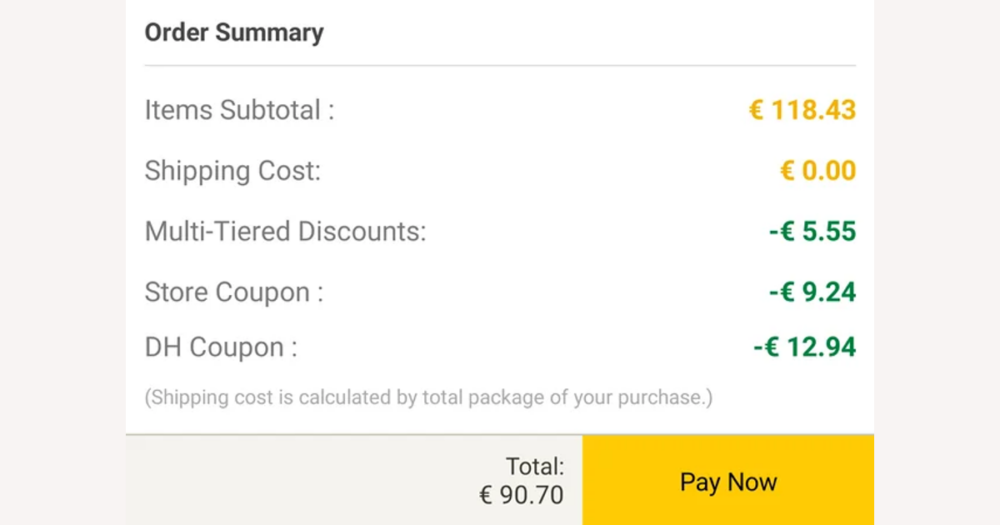
On DHgate, unlimited coupon codes do not simply stack. The platform determines which combinations of seller discounts, DHgate coupons, and shipping offers can apply together, then enforces those rules in your cart and at checkout. For entertainment and retail items alike, a clear, predictable final price and order record matter more than squeezing in one extra code at the cost of confusing terms or unstable totals.
Can you stack multiple coupons and promotions on one DHgate order?
You usually cannot stack unlimited coupon codes on a single DHgate order. DHgate’s system determines which promotion combinations are allowed and applies only those that fit each offer’s written terms.
In practice, seller‑set discounts such as a temporary sale price or store promotion can often coexist with one DHgate or platform coupon, but trying to add more platform coupons or conflicting promo types is likely to fail. At checkout, incompatible codes are either rejected outright or cause another discount to drop off, and the final payable total shown there is what counts.
For example, you might see a game accessory already on a seller sale price and successfully apply one DHgate coupon on top, but when you enter a second platform coupon, the system may refuse it or remove the first coupon so only one applies. The same pattern generally applies across entertainment and retail categories on DHgate: what matters is the promotion type and DHgate’s stacking rules, not the specific product you’re buying.
How DHgate coupons, seller discounts, and shipping offers typically interact
Most DHgate discounts for entertainment and retail goods fall into a few categories. Seller-level promotions change the item price itself, whether through a temporary sale, a percentage discount for buying more units, or a store-wide offer that automatically reduces the listed price in your cart.
Platform or DHgate‑issued coupons usually apply at the order or category level. They might require a minimum spend, be limited to certain product types, and either apply automatically when conditions are met or require you to select or enter a code at checkout.
Shipping offers sit on top of this, such as free or reduced shipping on specific items, or free shipping when your order reaches a threshold amount. These perks can disappear if the discounted order no longer meets the threshold.
Imagine a console accessory that’s already on a seller sale and you apply a single DHgate coupon at checkout: both discounts may show in the cart, giving you a lower item price plus an extra order‑level reduction. By contrast, consider a toy order that qualifies for free shipping only above a certain spend; if you then apply a strong coupon that drops the order value below that threshold, the system may remove the free‑shipping perk so your shipping cost goes back up.
As a rough rule, discounts are more likely to stack when they affect different parts of the price—item price, order total, or shipping—and the terms do not prohibit combining them. Overlapping platform coupons or multiple order-level offers for the same spend often do not stack. The only reliable way to know what will apply to a given DHgate order is to read each promotion’s terms and check the breakdown in your cart and at checkout before paying.
A simple check sequence for trying and verifying stacked discounts
- Before using a DHgate coupon or promotion, check which items or categories it covers, the minimum spend, expiry date, and any note saying it cannot be combined with other offers.
- Add your entertainment or retail items to the cart and make sure the cart value and product mix meet the minimum spend and scope requirements for the promotions you plan to use.
- Apply one coupon or promotion at a time at checkout, watching how the item subtotal, seller discounts, and order-level reductions change. If a new code makes a previous discount disappear, those offers are not stackable.
- After each change, recheck shipping charges and any fees. Threshold-based perks like free shipping or reduced shipping can vanish if a discount drops your order value below the required level.
- Before clicking pay, read the order summary carefully: item subtotal, each listed discount, shipping, tax and other fees, and the final amount to be charged. That final amount is what matters for your landed cost and any later dispute or refund.
- Save or screenshot the final checkout summary so you have a record of the price breakdown and discounts DHgate showed at the moment of payment if the order, pricing, or perks are later questioned.
- Stop once you have a clear, system-approved combination with a predictable landed cost and documented terms. Endless code experiments may produce only small, uncertain extra savings.
Why chasing unsupported coupon stacks can backfire
How stacked discounts change your landed cost and profit
Imagine a DHgate entertainment device listed at $80. The seller runs a 20% sale, so the item price drops to $64. You apply a single DHgate coupon worth $6 off orders over $50, bringing the subtotal to $58. If shipping on that item is $12, your landed cost is $70. Without the coupon, the same sale item plus shipping would cost $76, so the coupon gives you a real $6 saving, even though the headline discount percentages (20% sale + coupon) sound larger.
Now take a case where shipping and fees eat into the benefit. Suppose a collectible toy has a sale price of $40 and you use a 10% platform coupon that should knock $4 off, taking the subtotal to $36. If the cheapest available shipping is $14 and there is a $2 service fee, your landed cost is $52, compared with $56 without the coupon. You still save $4 overall, but the effective discount on the landed cost is smaller than 10% because of the fixed charges that don’t change when you apply the code.
For resellers, even a small change in landed cost can shift profit margin. If you plan to resell an item for $100 and your all‑in landed cost from DHgate is $70, your gross margin is $30. If stacked, legitimate discounts bring that landed cost down to $63, the margin rises to $37. That extra $7 can matter, but only if similar promotions and shipping rates are reliably available when you restock; margin planning that assumes you will always get the best combination of sale price, coupon, and cheap shipping is risky.
Because DHgate promotions, shipping rates, and fees change over time, it is safer to treat stacked discounts as a bonus rather than the baseline for your pricing model. I would rather accept a slightly smaller, repeatable discount with clear terms and a predictable landed cost than chase an extra few percent through complex stacks that are hard to track and may disappear by the time I place the next order. Use the simple math above to judge whether experimenting with additional combinations is worth the effort for your situation.
How discounts relate to DHgate buyer protection, disputes, and refunds
On DHgate‑like marketplaces, buyer protection, disputes, and refunds are tied to the transaction as recorded: the items purchased, the final price after any accepted discounts, the shipping charges, and the timing and conditions shown at checkout. When you use legitimate DHgate coupons and promotions that the system accepts, those simply become part of that transaction; they do not usually remove standard protections for the order.
Consider a hypothetical dispute: you buy an entertainment item with a seller discount and a DHgate coupon, and later open a case because the product is not as described. Support staff will look at the order summary in your account and the payment record to see exactly what you were charged, which promotions were applied, and what shipping and delivery terms were shown. Their decision is based on those records and DHgate’s policies, not on how many codes you tried or the headline percentage you had in mind.
Problems tend to arise when expectations diverge from that record—for example, if a buyer assumes two coupons applied when only one did, or relies on vague promo wording and overlooks exclusions or minimum‑spend rules. In those situations, refunds or adjustments may not match what the buyer hoped for, because support will point back to the actual charged amount and written terms.
To keep disputes straightforward, treat the checkout page as your reference point. Read promo terms carefully, make sure the discounted total, shipping, and any perks like free gifts or insurance look correct, and keep a copy of that summary (such as a screenshot or saved invoice). If something goes wrong, that clear, documented transaction is far more useful than memories of which coupons you tried, and it helps ensure that using discounts on DHgate works with buyer protection rather than against it.
Which stacking attempts are realistic versus likely to be blocked
| Stacking scenario | Typical outcome on DHgate-like platforms | What to watch for |
|---|---|---|
| Seller sale price plus one DHgate coupon | Commonly allowed when the coupon terms don’t forbid combining with seller promotions. | Check the coupon text for “cannot be combined” language and make sure the discounted item still meets any minimum spend or category limits after the sale price is applied. |
| Seller/store discount plus automatic platform promotion | Sometimes allowed, but often limited by promo rules that give priority to one offer. | Read both offers carefully; if one says it overrides other discounts or applies to “original price only,” expect the second promo to be reduced or blocked at checkout. |
| Multiple platform coupon codes on one order | Often blocked; most systems accept only a single coupon code per order. | Assume that only one DHgate code will stick. If the total doesn’t change when you add a second code or one code disappears, the system is enforcing a one-code rule. |
| Free‑shipping threshold promo plus a spend‑based coupon | Sometimes allowed, but can conflict if the coupon lowers your order below the free‑shipping threshold or if terms exclude other offers. | Watch how the cart recalculates after the coupon: confirm that your order value still meets the free‑shipping minimum and check for fine print that says free shipping “cannot be combined with other promotions.” |
FAQ: Do coupons affect free shipping and other DHgate perks?
If I use a DHgate coupon on entertainment or retail items, will that affect free shipping or other promotional perks on my order?
It can, but there’s no single rule that applies to every DHgate promotion. Some perks—like free shipping over a certain amount or a bonus gift—depend on your order meeting a minimum spend or specific item conditions. If a coupon lowers your order total below that threshold, or the terms say the perk “cannot be combined with other discounts,” the free shipping or gift may disappear when the coupon is applied.
For example, if free shipping applies only to orders of $50 or more and your cart is exactly $50, a $10 coupon that brings the subtotal down to $40 could remove the free‑shipping benefit so you end up paying for shipping again.
Other DHgate campaigns are designed to stack, such as a sale price plus a coupon plus free shipping that’s advertised together in a banner or event page. In those cases, the system is set up so all the listed perks can apply at once, as long as you meet the conditions.
Because the rules vary by promotion, the safest approach is to read the fine print on both the coupon and the perk offer, then apply the coupon and check your cart and checkout carefully. Make sure lines like “Free shipping applied” or the bonus item still show after the coupon is used. The final checkout summary—item prices, discounts, perks, shipping, and the amount you will pay—is the authoritative record of which perks and discounts actually apply to that DHgate order.