
Affordable wholesale children’s board books are bulk-packed, durable books for babies and toddlers sold at a discounted per-unit price. For US buyers, the real decision is not just “where’s the cheapest box?” but which mix of supplier type, themes, print quality, safety, and logistics fits your use case—whether that’s a small bookstore, a preschool classroom set, or a nonprofit book drive.
This guide walks through how the board-book supply chain works, how to vet suppliers, what to expect on pricing and minimum order quantities (MOQs), and how different channels—from domestic wholesalers to cross-border marketplaces—line up for different orders.
How the Wholesale Children’s Board Book Market Works
Children’s board books are printed on thick, usually laminated boards rather than paper pages. They’re built to survive chewing, bending, and rough handling, so they’re the staple format for ages 0-3. In wholesale, you’ll typically see:
- Themes: ABCs, numbers, animals, vehicles, farm life, faith-based stories, and simple social-emotional topics.
- Formats: single titles, matched pairs, or multi-book series with consistent art and messaging.
- Destinations: indie bookstores, discount retailers, preschools, daycare chains, religious organizations, and literacy nonprofits.
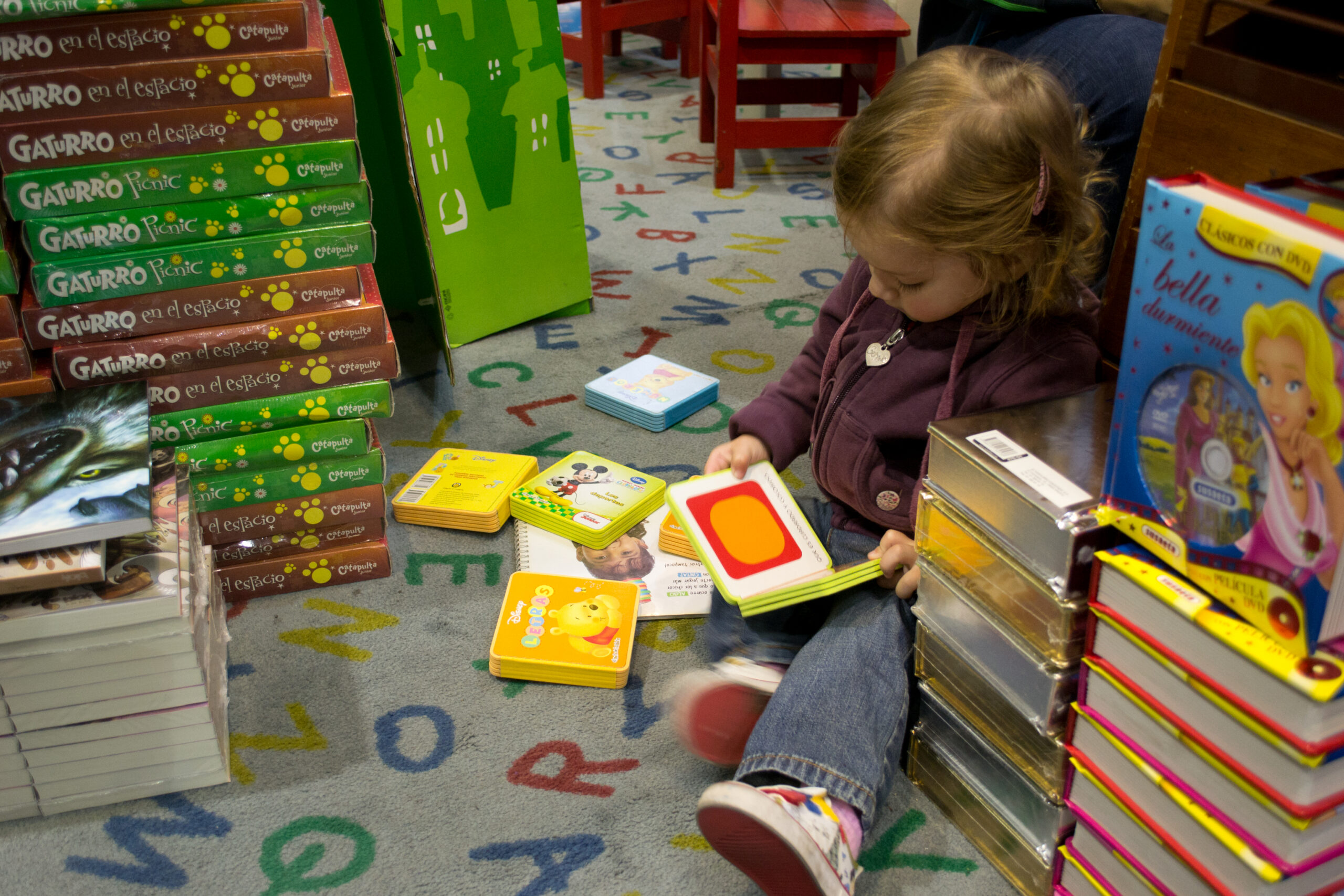
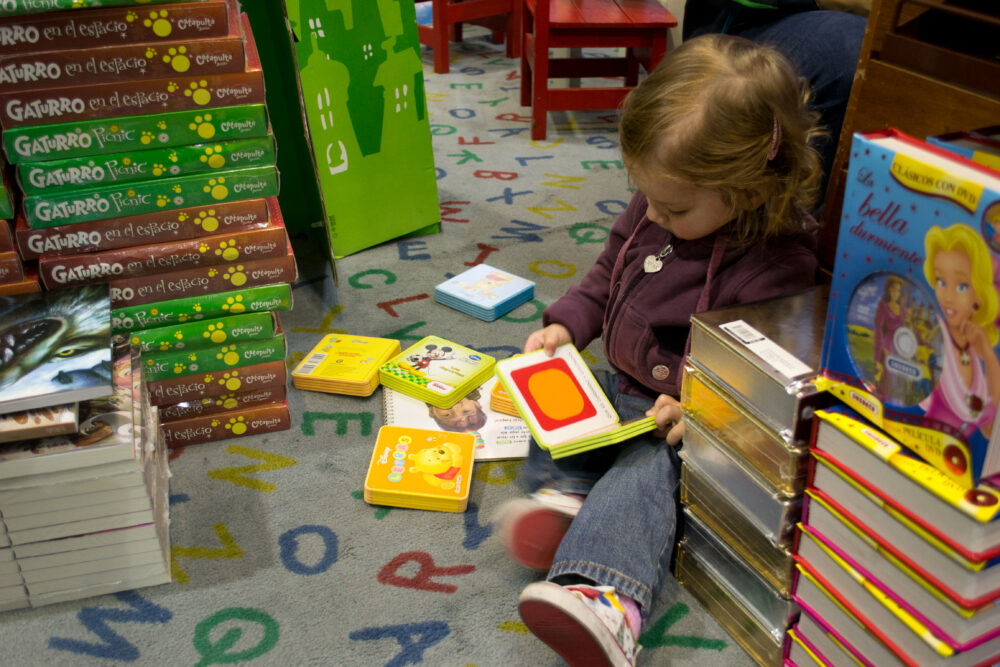
A child reads board books in a bookstore; photo by Gustavo Devito, CC BY 2.0 via Wikimedia Commons.
Domestic wholesalers often focus on specific niches. For example, Dot Gibson Distributors lists children’s board books under categories like farm books and general kids’ titles, illustrating how a US-based wholesaler might bundle themed board books for retailers and farm stores.
Affordable bulk supply for schools and nonprofits is often served by discount-focused wholesalers. DollarDays positions its children’s books in bulk as budget-friendly, aiming at classrooms, camps, and charity drives where price per book and simple themes matter more than brand recognition.
You’ll also see institutional distributors and series specialists. BulkBookStore markets bulk children’s books to institutions and groups, while JA Riollano offers series-based board books (like the “Friends” series), showing how some suppliers package board books as cohesive sets useful for lesson planning or themed displays.
Production is split between domestic printing and overseas (often Asia-based) factories. For pre-made titles, your main choice is which wholesaler’s catalog to tap. For custom titles—your own story, branding, or curriculum—you’re choosing a printer or marketplace listing rather than a pre-existing book.
Choosing and Vetting Board Book Suppliers
Board books involve more safety and durability concerns than ordinary paperbacks. When you’re buying in bulk, a bad batch doesn’t just mean returns—it can mean choking hazards or books that fall apart in a week.
Supplier types you’ll encounter
- General book wholesalers (Dot Gibson, DollarDays-style sites): wide range of titles, often remaindered or closeout blends plus new stock.
- Institutional distributors (BulkBookStore-style): geared toward schools, libraries, and nonprofits, sometimes with better support for POs and tax-exempt orders.
- Series and niche suppliers (JA Riollano’s board-book series model): tighter curation around a specific age range or educational theme.
- Custom printers and cross-border marketplaces: you provide the files; they provide printing and finishing.
Each type has different strengths: general wholesalers for low prices and variety, institutional distributors for paperwork and reliability, series suppliers for curriculum-like bundles, and custom printers for branded content.
Board-book-specific quality and safety checks
When you’re evaluating a supplier, focus on details that matter for babies and toddlers:
1. Board thickness and binding Ask about board thickness (often measured in pt or gsm) and binding method. You want boards that don’t flex too easily and bindings that don’t separate when tugged.
2. Coatings and finishes Confirm whether the books are laminated or coated and whether finishes are described as child-safe. For very young children, glossy lamination is common because it resists drool and surface stains.
3. Corners and cut quality Check that corners are rounded and edges are smooth. Poor cutting can leave sharp or flaky edges. For a first order, insist on physical samples and run fingers along every edge.
4. Color accuracy and registration Misaligned print (color registration off) or muddy colors can make books look low-rent fast. When you receive samples, flip through quickly: are lines crisp, are faces and letters clear, or do you see doubles and blurs?
5. Odor and glue Strong chemical smells from ink or glue are a red flag, especially for baby products. If a sample smells aggressively “industrial” after airing, consider a different supplier.
Micro-checklist: Questions to ask before ordering
Keep these questions handy for any new board-book supplier:
- Can you send physical samples of the exact titles or a close match?
- What age range are these titles intended for (baby, toddler, preschool)?
- Are corners rounded and surfaces coated for durability?
- How are the books packed (e.g., 12 per case, mixed titles vs. single-title cases)?
- What is your return or replacement process for misprints or damaged cartons? (Ask, but don’t assume any particular guarantee without seeing written terms.)
Scenario examples:
- Small bookstore: might test a new wholesaler with one themed case—say farm animal board books from a Dot Gibson-style catalog—then expand if sell-through and quality meet expectations.
- Preschool: could buy a series set—using a JA Riollano-style bundle—for each classroom to create consistent storytime themes.
- Nonprofit book drive: may prioritize lowest per-unit costs via a DollarDays-type bulk channel, with fewer concerns about having multiple copies of the same title.
Pricing, MOQs, Custom Printing, and Channel Trade-offs
Affordable wholesale children’s board books are all about how price, quantity, and customization intersect. You’ll see different structures depending on the channel.
What to expect on pricing and MOQs
Most suppliers quote prices per book but ship in cases or packs. Discount-focused wholesalers like DollarDays often position themselves as budget options, which can be appealing for high-volume donations or classroom sets where branded authorship is secondary.
Institutional distributors such as BulkBookStore focus on bulk orders for schools and groups, and will typically steer you toward higher quantities that unlock lower per-unit pricing. Series suppliers like JA Riollano bundle sets, which can simplify ordering but reduce your ability to mix individual titles.
MOQs vary widely. As a rule of thumb (not a guarantee), expect:
- Lower MOQs or mixed-title cartons at discount and general wholesalers.
- Higher MOQs or strict case quantities at institutional distributors.
- Custom printers to set MOQs based on page count, color coverage, and finishing.
Custom board books vs. pre-made titles
Custom printing is a different decision than buying pre-made titles. You’re not picking from a catalog—you’re commissioning printed books based on your own files.
Domestic custom printers exist, but some buyers look at cross-border marketplaces to reduce unit costs. A DHgate listing snapshot from 2026-10-08 illustrates this:
- High Quality Custom Book Printing Color Children Learning Books – a listing in DHgate’s Packaging & Printing Service category, showing a price range around $0.41–$0.44 per unit at research time, with customization for children’s learning books (DHgate listing).
This kind of listing signals how cross-border printers can offer low unit prices for custom children’s books. Prices and availability can change quickly, and the listing itself does not guarantee safety, quality, or minimum quantity. If you consider a route like this, treat it as one option among many and apply strict vetting: request printed samples of your design, clarify coatings and inks, and confirm production timelines.
Comparing sourcing channels
Here’s a compact view of how common channels line up for affordable board books:
| Channel type | Typical buyers / fit | Main strengths (from article) | Key trade-offs (from article) |
|---|---|---|---|
| Discount/bulk wholesalers | Nonprofits, camps, book drives | Low per-unit prices; simple bulk packs | Limited curation; mixed quality across titles |
| Institutional distributors | Schools, libraries, preschools | Support for bulk POs; curated children’s catalogs | Higher MOQs; may favor mainstream titles |
| Series/niche suppliers | Themed classrooms, specialty retail | Cohesive series; age-targeted or themed content | Less flexibility in title mix; potentially higher cost |
| Cross-border custom printers | Branded programs, proprietary stories | Access to custom layouts and designs at low unit prices | Longer shipping; buyer must handle quality and safety vetting |
| Wholesale marketplaces (e.g., Faire) | Indie bookstores, gift shops | Access to indie brands and small publishers | Each brand sets its own terms; curation varies |
Platform-style wholesale marketplaces like Faire connect brands and retailers, including children’s products. For board books, this route can be useful if you want indie or boutique titles that aren’t in the big-box wholesale catalogs. You’ll evaluate each brand’s line rather than one centralized wholesaler.
If you’re specifically weighing DHgate sellers, the way you validate them—samples, print specs, and clear written terms—is similar to how you’d vet any overseas printer. Internal guides on this site like finding DHgate suppliers and choosing a DHgate wholesale supplier can help you structure that evaluation process.
For most US buyers starting out, the practical sequence is: test a small case from a domestic wholesaler to understand demand and quality, then consider expanding to institutional distributors or series suppliers. Only once you have clear volume needs and content requirements does it usually make sense to explore custom printing and cross-border options like DHgate.